You know the routine. The van gets loaded in low light, yesterday's kit is still mixed in with today's, and you're already thinking about whether the combi drill, SDS, laser, fixings, and test gear are all in there before you hit the first job. If you're covering Molesey, Hampton Court, and the wider patch in one day, tool management stops being a side issue. It becomes part of whether the day runs properly or turns into dead time and excuses.
A lot of subcontractors treat storage as something to sort out later. They start with the van, then the garage, then a corner of a workshop, and only look for outside space after something goes missing or access becomes a problem. That usually costs more than getting organised early.
That's why tool storage for contractors in Molesey matters. Not as a convenience. As a working system for security, access, loading, insurance, and daily job flow.
The Daily Grind Of Tool Management For Molesey Contractors
A typical day for a contractor around Molesey doesn't happen in a straight line. You might start in West Molesey, swing through East Molesey, pick up materials on the way to another job, then finish with an urgent call-out before heading home. The work changes. The kit changes. What doesn't change is the pressure to have the right tools with you, in working order, and easy to get at.
That's where a lot of setups start falling apart. The van becomes a rolling storeroom. Cases get stacked by habit rather than logic. Consumables end up under heavier gear. Expensive kit stays in the vehicle longer than it should because unloading every night is a chore. Then the garage fills up, family space disappears, and finding one missing charger takes longer than the job itself.
Why the old setup stops working
For a sole trader, the first warning sign is usually wasted time. For a growing subcontractor, it's usually inconsistency. One day the setup works. The next day a labourer can't find the core bits, the tile cutter is under waste bags, or the wrong fittings have gone out because everything was packed in a rush.
Professional storage fixes that when it's used properly. It gives you one stable base for tools, equipment, and spare materials that don't need to live in the van. That matters because business use of self-storage isn't a niche anymore. In the UK, the self-storage sector generated £1.2 billion in annual turnover in 2024 and covers around 64 million square feet across more than 2,900 sites, according to the SSA UK figures cited by Cleveland Containers.
That scale tells you something practical. Tradespeople are already using storage because the alternatives are messy, risky, and inefficient.
What storage changes on a working week
A proper storage unit won't do the job for you, but it does remove friction from the day. Instead of carrying your full trade setup everywhere, you keep only what the current job needs in the van and hold the rest off-site in a secure, organised base.
That usually means:
- Less clutter in the van so daily-use items are easier to access
- Cleaner separation of kits for first fix, second fix, decorating, maintenance, and snagging
- Quicker morning starts because tools are staged, not hunted for
- Less reliance on home space for bulky or dirty equipment
Use storage to support the van, not replace it. The van carries the day's work. The unit carries the business.
If you're still treating off-site storage like an emergency backup, you're making the week harder than it needs to be.
Beyond The Van The Real Risks Of Onsite Tool Storage
Leaving tools in a van feels convenient right up until it isn't. The problem isn't just theft. It's the chain reaction after theft. One break-in can knock out your ability to finish work, invoice on time, or even start the next day properly.

In the UK, contractors face more than 40,000 tool theft incidents every year, and YESSS Electrical notes that pressure-treated steel storage units with anti-theft hinges and central key-locking systems reduce unauthorised access by 92% compared with standard plastic alternatives. That's the useful comparison. Not all “secure storage” is equal, and not all lockable boxes deserve the name.
The three risks that hit hardest
The first hit is obvious. You lose tools. That might be your SDS drill, breaker, mitre saw, test kit, lasers, extractor, or hand tools. Replacing them costs money, but the bigger problem is timing. Most trades don't have spare full kits sitting around ready to roll.
The second hit is downtime. A missing impact driver is annoying. A missing trade-specific setup can stop a job. Electricians, plumbers, fitters, decorators, carpenters, and flooring teams all rely on having the right combination of gear, not just one tool.
The third hit is reputation. Clients don't always care why you've had to delay. They care that the work hasn't been done.
Why vans and site corners aren't enough
A van is transport first. Storage second. It's exposed, visible, and often loaded with gear far beyond what's needed for one day. Site compounds and client garages can help in some jobs, but they bring their own issues. Access depends on someone else. Security standards vary. Responsibility becomes fuzzy the moment several people are coming and going.
A simple comparison makes the trade-off clearer:
| Storage method | Main strength | Main weakness |
|---|---|---|
| Van | Immediate mobility | High exposure, poor long-term storage choice |
| Client property | Close to the job | Access and liability are often unclear |
| Site corner or shed | Quick drop-off | Security depends on the site, not you |
| Dedicated off-site unit | Consistent control and separation | Requires planning and routine |
If every valuable tool you own is sleeping in the van, you haven't built a storage system. You've built a single point of failure.
What actually works better
The safer approach is layered. Use the van for the day's active kit. Use internal lockable boxes or steel storage for immediate control. Keep reserve tools, specialist gear, seasonal equipment, and surplus materials in a dedicated off-site unit where they're not travelling around unnecessarily.
That setup also changes behaviour. You stop carrying tools just because they might come in handy. You start loading with intent.
For tool storage for contractors in Molesey, that's a significant shift. It's not only about preventing theft. It's about reducing how much of your business is exposed at one time.
Choosing The Right Molesey Storage Facility For Your Trade
The wrong unit creates new problems. You save a few pounds, then lose time every week because access is awkward, loading is slow, or the site doesn't suit trade use. Contractors need a storage facility that works with the job, not one that assumes you're storing spare furniture.
West Molesey already has established self-storage options. Kiwi Storage's West Molesey information notes local facilities including Big Yellow, which has operated since 2001, and unit sizes ranging from 10 to 220 sq ft, alongside features such as 24/7 CCTV, controlled access, and onsite parking. That tells you the local market is set up for regular access and practical loading, but the details still matter.

Access hours matter more than most people realise
A lot of contractors make the same mistake. They ask whether a site is secure, then forget to ask when they can get to their tools. Those aren't the same question.
A significant issue in Molesey is that many providers talk about security but don't solve the access problem for multi-site work. LS Engineers' discussion of tool storage points out that local content often misses the need for 24/7 on-demand access, while competitors such as Big Yellow in West Molesey list extended hours of 5am to 11pm rather than true round-the-clock access.
If your day starts early, overruns late, or includes emergency visits, that difference matters. Extended hours sound generous until you need the unit outside that window.
Ask these questions before you book
- Can I access the unit when jobs require it? Don't accept vague wording. Ask whether access is round-the-clock or longer than office hours.
- Can I get the van close to the unit? If you're carrying breakers, towers, extractors, tile cutters, or boxed stock, distance becomes wasted effort.
- Is the route in and out simple for trade vehicles? Tight turns, awkward gates, or long internal corridors get old fast.
- What security is active on site? Controlled entry, perimeter protection, CCTV, and site layout all matter more than a sales phrase.
Judge the facility by workflow, not brochure language
Good contractor storage should make loading and retrieval feel routine. You should be able to reverse up, open the van, move gear safely, and leave without dragging half your day through a maze of doors and lifts.
A few practical signs usually separate a useful site from a frustrating one:
| What to look for | Why it matters on real jobs |
|---|---|
| Drive-up practicality | Faster loading of heavy, awkward equipment |
| Parking near units | Less carrying, fewer knocks, less wasted time |
| Clear access control | Better accountability for who entered and when |
| Range of unit sizes | Lets you scale up or down as jobs change |
One option contractors often look at locally is business storage in Molesey, especially when they need drive-up access and a setup that suits regular business use rather than occasional domestic storage.
Pick the site that saves time every week, not the one that only looks tidy on viewing day.
Match the unit to the trade
A decorator doesn't need the same layout as an outdoor tradesperson. An electrician with test gear, trunking, boards, and fixings has different access needs from a bathroom fitter carrying cutters, adhesive systems, and plumbing tools.
Choose a unit based on how you load and unload. If bulky gear moves in and out often, prioritise access and turning space. If your main headache is keeping expensive power tools secure and separated by job, prioritise layout and internal organisation. The right answer depends on the work pattern, not the marketing label.
Organise Your Unit For Maximum Job Site Efficiency
Once you've got the unit, don't treat it like a dumping ground. That's the fastest way to recreate the same chaos you were trying to escape from in the van or garage. A good storage unit should work like a small logistics base. You walk in, grab the right kit, load in order, and leave.

Build zones that match the way you work
Most contractors organise by item type first. That's useful, but it isn't enough. What works better is a mix of tool category and job function.
For example:
- Daily-use zone for drills, drivers, batteries, chargers, hand tools, and testing gear
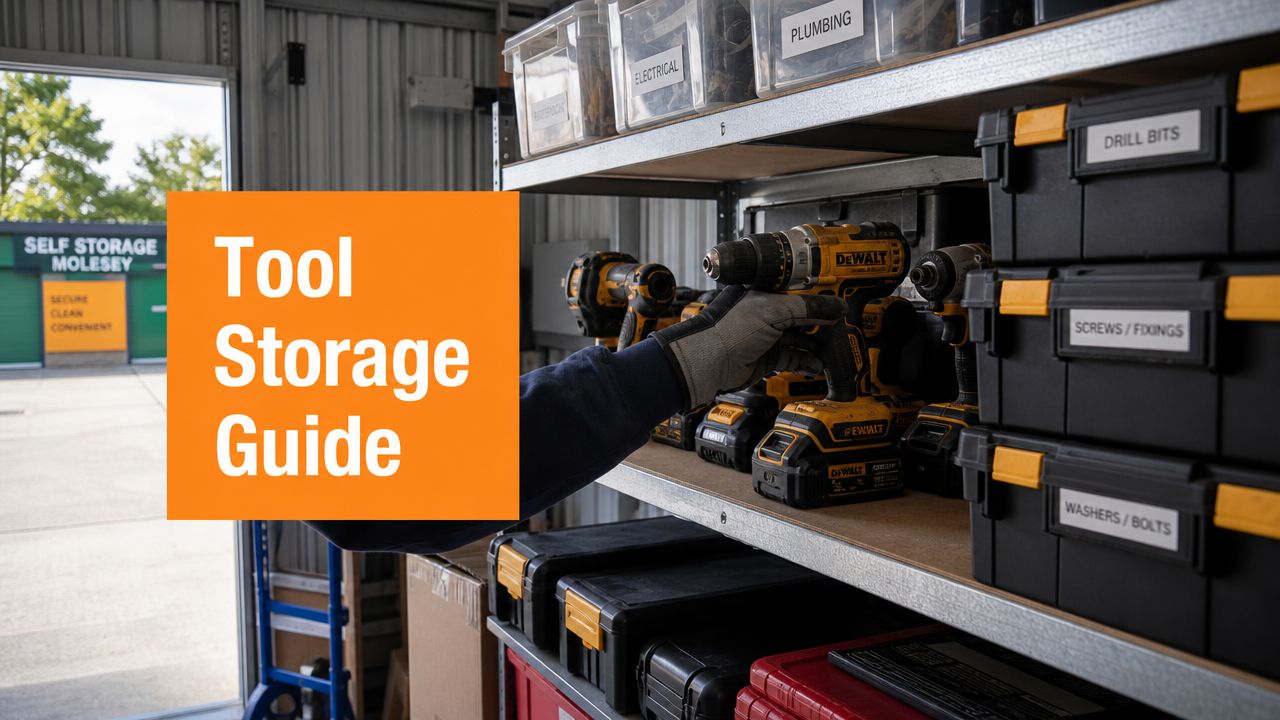
- Consumables zone for screws, fixings, tapes, blades, sealants, connectors, and PPE
- Project kit zone for trade-specific setups such as first-fix, decorating, flooring, or bathroom install
- Bulk and reserve zone for spare tools, seasonal equipment, and larger material packs
The daily-use zone should sit nearest the door. Reserve stock should go further back. Heavy items belong low down. Fragile gear needs a dedicated shelf or lidded crate so it doesn't get crushed under everything else.
Label what matters, not everything
Over-labelling wastes time. Under-labelling causes mistakes. The fix is simple. Label shelves, stackable crates, and project kits in plain language that someone else can understand without asking.
Good labels look like this:
| Better label | Poor label |
|---|---|
| 1st Fix Electrical | Misc |
| Decorating Prep | Tools |
| SDS Bits and Core Drills | Drill Stuff |
| Plumbing Consumables | Box 4 |
Use clear bins where you can. If you use solid boxes, keep a list on the outside. The point isn't neatness for its own sake. The point is fast retrieval.
A unit is organised when someone can find the right kit without ringing you.
Create grab-and-go kits
This is where efficiency really improves. Instead of pulling individual items for every new job, build complete kits around repeat work.
A few common examples:
First-fix kit
Cable tools, drill bits, fixings, clips, tapes, detector, charger, and spare batteries.Decorating kit
Sanders, abrasives, masking, dust sheets, fillers, scrapers, brushes, and touch-up gear.Plumbing repair kit
Jointing gear, isolation tools, cutters, seals, common fittings, and test essentials.Snagging kit
Small hand tools, sealant gun, blades, filler, spare fixings, wipes, and protection materials.
Pack each kit so it can be moved in one go. That might mean a lidded tote, stackable crate, or dedicated toolbox depending on weight and how often it's used.
Track what leaves and what returns
You don't need a fancy system. A shared phone note, spreadsheet, or simple inventory app is usually enough. What matters is consistency.
Record:
- Tool or kit name
- Who has it
- Which job it's out on
- Whether it's due back
- Any damage or missing parts
If you're tightening up the physical layout, it's worth reviewing practical methods for organising your self-storage container so shelving, pathways, and access points support the way your team loads gear.
A clean system saves more than time. It cuts duplicate buying, stops tools disappearing into the wrong van, and makes week-to-week planning easier.
Navigating Insurance And Security Compliance
A lot of contractors only think about insurance after a theft. By then, the important part isn't what cover you thought you had. It's whether you can show where the tools were, when they were moved, and how they were secured.
That's where most generic advice falls short. It talks about locks, alarms, and prices, but not the paperwork trail behind a claim. For tool storage for contractors in Molesey, that trail matters just as much as the physical unit.
Transit is where many claims get messy
One of the more overlooked issues is movement between places. Hold Self Storage's discussion of tool storage notes that 42% of UK tool thefts occur during transit between sites, and it highlights the need for insurance-compliant transit-to-storage hygiene with a documented chain of custody.
That tells you two things. First, theft doesn't only happen from a fixed location. Second, insurers may want more than proof that you owned the tools.
What a contractor should be able to show
If tools go missing, your records need to be credible and easy to follow. In practical terms, that usually means being able to show:
- Where the tools were last stored
- When they were removed
- Who had access
- How they were transported
- What security measures were in place
That's why access logs, CCTV coverage, and controlled site entry aren't just nice features. They help support the timeline behind a claim. If your only answer is “they were in the van at some point,” you've left too much open to argument.
Insurance works best when your storage routine creates evidence without extra effort.
Separate the three cover situations in your head
Contractors often blur these together, but they aren't the same.
| Situation | What matters most |
|---|---|
| In transit | Vehicle security, timing, route, handover, proof of movement |
| On site | Who had access, where tools were left, whether the area was secured |
| In storage | Facility controls, entry records, unit security, item records |
That distinction changes behaviour. If you know transit is a weak point, you stop making unnecessary stops with a fully loaded van. If you know storage claims depend on traceable access, you become stricter about who gets keys, codes, and collection responsibility.
Build a chain-of-custody routine that holds up
A workable routine doesn't need to be complicated. It just needs discipline.
Try this:
- Photograph high-value kits and keep serial numbers in one place.
- Log movement in and out of storage at the end and start of each working day.
- Assign responsibility when one person takes a kit to site.
- Store reserve tools off the van so a transit theft doesn't wipe out the whole business.
- Check your policy wording for how tools are covered in storage, in transit, and overnight.
If you're reviewing policy language, a plain-English guide to protecting business tools and equipment is useful for understanding how insurers think about movable business property, even if your final cover details come from your own provider.
For the physical side, contractors should favour facilities with documented controls. When you're weighing options, it helps to understand whether self-storage units are safe and what site-level protections support a claim rather than just sounding reassuring in a brochure.
The key point is simple. Storage isn't only about preventing loss. It's about proving what happened if loss occurs.
Smart Booking And Cost Saving Strategies
Plenty of contractors delay getting a unit because they assume the process will be clunky. Phone calls, office visits, paperwork, keys, deposits, and slow move-in dates. That used to be common. It doesn't need to be now.
The smarter approach is to treat storage like any other operational purchase. Check availability, compare the right size, book only what you need, and keep the commitment flexible so the unit supports current work instead of locking you into wasted overhead.

Don't over-rent space
The most common mistake is paying for a bigger unit than the workflow needs. Contractors often picture everything spread out like a workshop, then end up storing mostly boxed tools, a few larger items, and some reserve materials.
Start by listing what needs to live in storage:
- High-value tools not needed on every job
- Duplicate or reserve kit
- Trade-specific equipment used on certain contracts
- Consumables bought in sensible quantity
- Bulky items that clutter the van or home garage
Then think in terms of layout, not just floor area. Shelving, vertical stacking, and grab-and-go kits usually reduce the footprint required. A smaller unit with a disciplined setup often works better than a larger one filled loosely.
Use flexibility to your advantage
Storage needs change with workload. A subcontractor on steady domestic jobs won't need the same setup as a team running several sites at once. That's why flexible terms matter. If your workload expands, you need room to adjust. If a contract ends, you shouldn't be stuck paying for space you no longer need.
A good booking process should let you do four things quickly:
| Booking priority | Why it saves money or hassle |
|---|---|
| Check pricing clearly | Helps you compare real costs before committing |
| Choose the right unit size | Prevents paying for empty space |
| Move in without delay | Cuts the gap between decision and use |
| Avoid long lock-ins | Keeps storage aligned with live work |
Keep the unit working hard
A unit saves money when it reduces hidden costs. That means fewer lost tools, fewer duplicate purchases, less van clutter, and less wasted time hunting for gear. It starts costing you money when it becomes a remote junk pile.
A few habits keep it efficient:
- Review the contents regularly and remove dead stock
- Group by active jobs so current work is easiest to reach
- Return unused gear promptly instead of letting it sit in the van
- Resize when your workload changes rather than carrying spare space month after month
If you're booking locally, one practical route is to use a provider with an online portal that lets you check pricing, secure a unit, and move in without waiting for an office-based process. That kind of setup suits contractors because the admin doesn't get in the way of the work.
If you need a straightforward base for tools, equipment, and day-to-day trade storage, Standby Self Storage offers Molesey contractors a practical option with online booking, flexible terms, controlled access, and drive-up units that fit real working routines.