
If you're running a small business in Crawley, stock creep usually starts innocently. A few extra cartons in the spare room. Tool cases left in the van overnight because the garage is already full. Seasonal lines stacked in the office where staff should be packing orders.
Then it starts costing you time.
You lose ten minutes finding one product variant. You over-order because the old stock is buried. You avoid taking on more work because you don't have anywhere sensible to put the goods. That's usually the point where business stock storage in Crawley stops being a convenience and starts becoming an operational decision.
Why Smart Crawley Businesses Are Turning to Self Storage
A common Crawley pattern looks like this. Stock starts in the office, spills into the van, then takes over the spare corner of the workshop. Before long, staff are picking around cartons, drivers are unloading in the rain because there is nowhere clear to put deliveries, and nobody is fully sure what is saleable, returned, or dead stock. Self storage fixes that operational mess by giving stock a proper home with clearer access, better security, and fewer interruptions to the working day.
For a lot of local firms, the gain is simple. Better use of expensive space.
Office and retail square footage costs more per month than many owners realise because it carries hidden labour costs as well. If staff spend time shifting boxes to reach desks, packing benches, or product lines, you are paying wages for avoidable handling. If stock is stored in a van overnight, the risk cost rises too. Theft, damage, moisture exposure, and missed jobs all get more likely.
What changes when stock leaves your workspace
A dedicated unit creates separation that small businesses often need sooner than they expect.
Sales space stays focused on customers. Admin space stays usable. Vehicles go back to doing transport work instead of acting as insecure stock rooms. For e-commerce sellers, that usually means quicker picks and fewer dispatch errors. For trades, it often means fewer damaged materials and less money tied up in carrying duplicate items "just in case".
Practical rule: If staff are moving the same stock more than once before it is sold, fitted, or dispatched, storage is already costing you money.
There is another point that gets missed in generic advice. Access terms matter just as much as floor area. A unit with 24 hour entry can look attractive, but some operators charge a premium for it, restrict how that access works, or tie it to higher-tier units. Climate control needs the same scrutiny. If you are storing packaging, adhesives, paper records, electrical stock, cosmetics, or anything temperature-sensitive, ask for actual conditions and monitoring details, not vague wording about being "suitable" or "protected". Lack of clear data is where budgets and stock quality both get hit.
Businesses reviewing access control and monitoring also benefit from understanding how unmanned building IT infrastructure is set up, especially if alarms, remote entry, and camera coverage affect how you manage stock off-site.
Why flexibility suits growing businesses
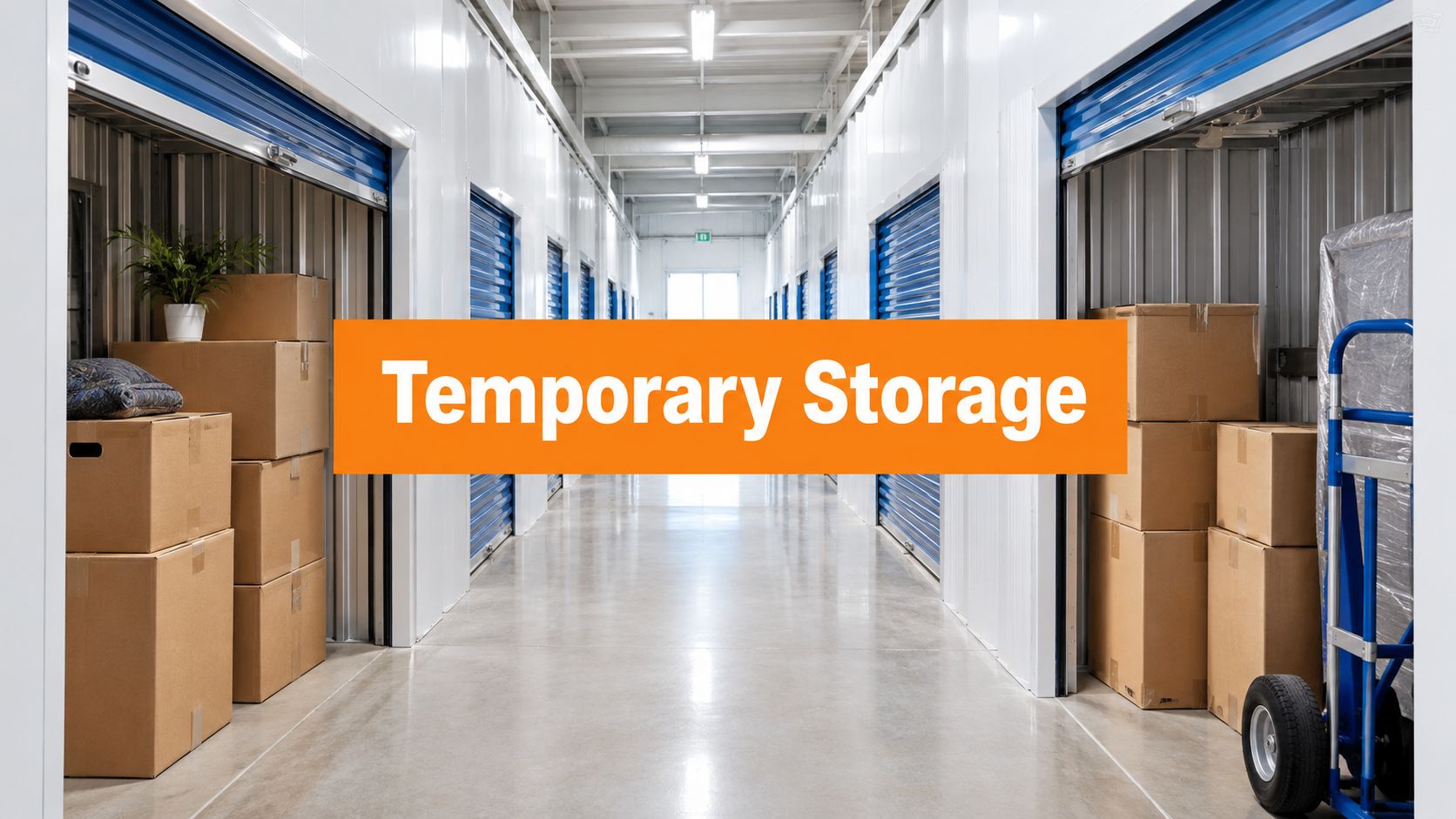
Many Crawley firms are not ready for a warehouse lease, business rates, and a long commitment. They need extra room they can increase or reduce without taking on property overhead they may regret six months later.
Self storage often fits well for:
- e-commerce overflow during promotions and peak season
- trade materials and tools that should not stay in a vehicle overnight
- archived paperwork and boxed records that do not need daily access
- seasonal ranges, exhibition kit, and campaign materials
If you want a realistic view of what different unit types can support, this guide to self storage for businesses is a useful starting point before you request quotes.
The smart decision is not just getting stock out of the way. It is choosing a setup that lowers handling time, avoids paying premium access fees you do not need, and protects stock that can be damaged by poor storage conditions. That is where self storage starts saving money rather than just storing boxes.
First Step Assessing Your Real Stock and Space Needs
Most businesses choose the wrong unit for one simple reason. They estimate by eye.
That usually leads to one of two bad outcomes. You rent too small and spend months stacking awkwardly, or you rent too large and pay for unused air. The fix is an audit that looks at movement, not just volume.
Sort stock by how often you touch it
Start with three working categories:
Fast-moving stock
These are your repeat sellers, daily consumables or job-critical materials. Keep them nearest the door and only store them off-site if access is straightforward.Seasonal or campaign stock
Packaging, event materials, Christmas lines, summer ranges, exhibition kit. These often suit storage very well because they matter a lot for short periods and very little outside them.Slow-moving or archive items
Backstock, records, spare fixtures, older product lines and long-retention documents. These can usually go furthest back.
With workflow-oriented thinking, layout decisions become easier. A unit isn't just a box. It's a workflow. If you want ideas on warehouse-style thinking for smaller spaces, Material Handling USA's guide to Tackle your space constraints offers a practical way to think about height, access lanes and picking points.
Measure in a way that helps you book properly
Don't count “about 40 boxes”. Measure what you're storing.
Use a simple sheet with:
- Item type
- Quantity
- Packed dimensions
- Weight or handling notes
- How often it needs to be accessed
- Whether it can be stacked
Then check what needs shelving, what can be palletised, and what must stay upright. Document boxes, for example, can be stacked densely. Printed packaging often can't if you need to preserve shape. Cosmetics, electronics and labelled retail units need cleaner handling.
A good stock audit doesn't ask, “How much do we have?” It asks, “What needs to be reached quickly, stored safely, and expanded later?”
Leave room for growth, not guesswork
Many Crawley businesses book storage after a crunch point. That's understandable, but it creates short-term decisions. Better practice is to allow room for your next purchase order, not just the current one.
A sensible check is to ask:
- Are you carrying incoming stock for a promotion or launch?
- Do you have annual peaks that need extra holding space?
- Will you need a packing bench, shelving, or a clear aisle?
- Do you expect your range depth to increase soon?
If you're still unsure, a practical sizing calculator like how much storage space do I need can help turn your stock list into a more realistic unit shortlist.
Choosing the Right Storage Unit Near Crawley
A Crawley retailer takes a cheap unit because the monthly rate looks fine. Two weeks later, staff are queueing for the lift, outer cartons are soft from damp air, and every stock check takes twice as long. That is usually how the wrong unit shows itself. Not on day one, but in lost time, damaged packaging, and workarounds your team repeats every week.

Internal units versus external units
Start with how your stock moves.
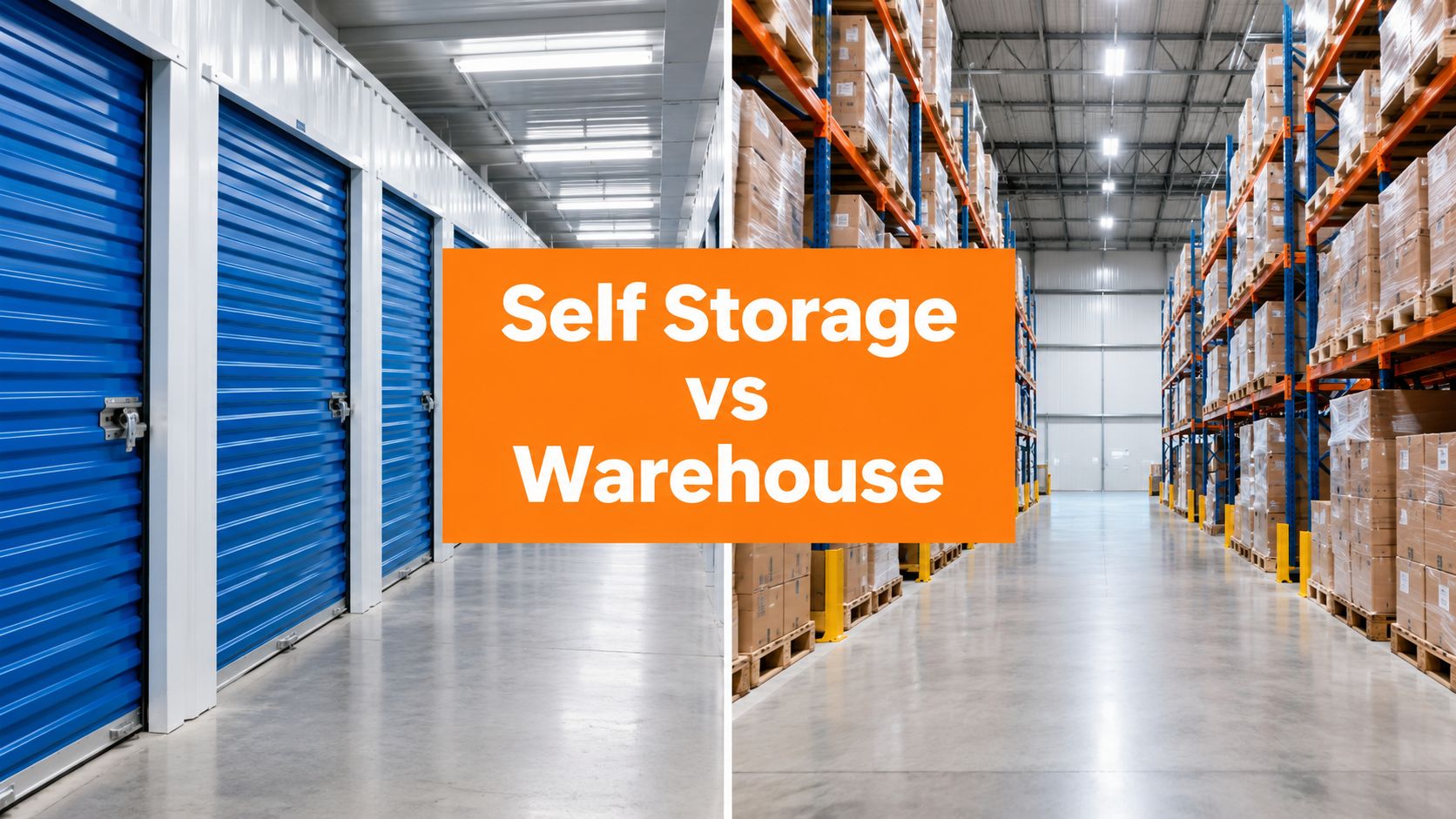
Internal units usually suit boxed retail stock, documents, electronics, printed materials, and anything that benefits from a cleaner, more stable environment. External units suit heavier goods, trade materials, event kit, and stock that needs frequent vehicle loading with minimal walking distance.
Here is the practical comparison:
| Storage type | Best fit | Main advantage | Main caution |
|---|---|---|---|
| Internal unit | Documents, retail stock, boxed inventory, electronics, packaged goods | Cleaner conditions and a steadier internal environment | Loading can be slower if staff rely on corridors, lifts, or shared loading bays |
| External unit | Bulkier goods, tools, trade materials, event kit, heavier stock movement | Faster drive-up loading and easier handling for weightier items | More exposure to temperature changes and condensation risk |
Price often pushes businesses toward the first available space. Daily use matters more. If your team picks orders every day, an awkward internal route can cost more in labour than the unit saves in rent. If you store printed packaging, cosmetics, or electronics in a basic external unit, the saving can disappear the first time stock arrives at a customer marked, warped, or damp.
Ask harder questions about climate control
Many quotes become unclear at this stage.
Plenty of facilities describe units as indoor, secure, or suitable for business use, but give almost no usable detail on temperature range, humidity, or condensation control. For sensitive stock, that missing information matters more than another line about CCTV.
Ask direct questions and wait for direct answers:
- What temperature range is typical through summer and winter?
- Is humidity actively managed or just passively monitored?
- Are dehumidifiers or ventilation systems installed in the area my unit is in?
- Do you have units that are better suited to paper records, cosmetics, electronics, or printed packaging?
- Can you confirm any environmental conditions in writing?
If the answer stays vague, assume the conditions are vague too.
I tell business customers to judge this the same way they judge supplier terms. If a facility cannot explain the conditions clearly, do not store stock that is expensive to replace or easy to spoil. That applies to labels, cartons, fabrics, adhesives, supplements, beauty products, and archived paperwork. Insurance helps with some losses, but it does not protect your margin from slow deterioration, rejected stock, or customer complaints. It is worth checking the provider's rules alongside your own storage contents insurance requirements for business stock.
If a provider talks in detail about alarms and access control but avoids specifics on moisture, ventilation, or temperature, treat that as a warning sign.
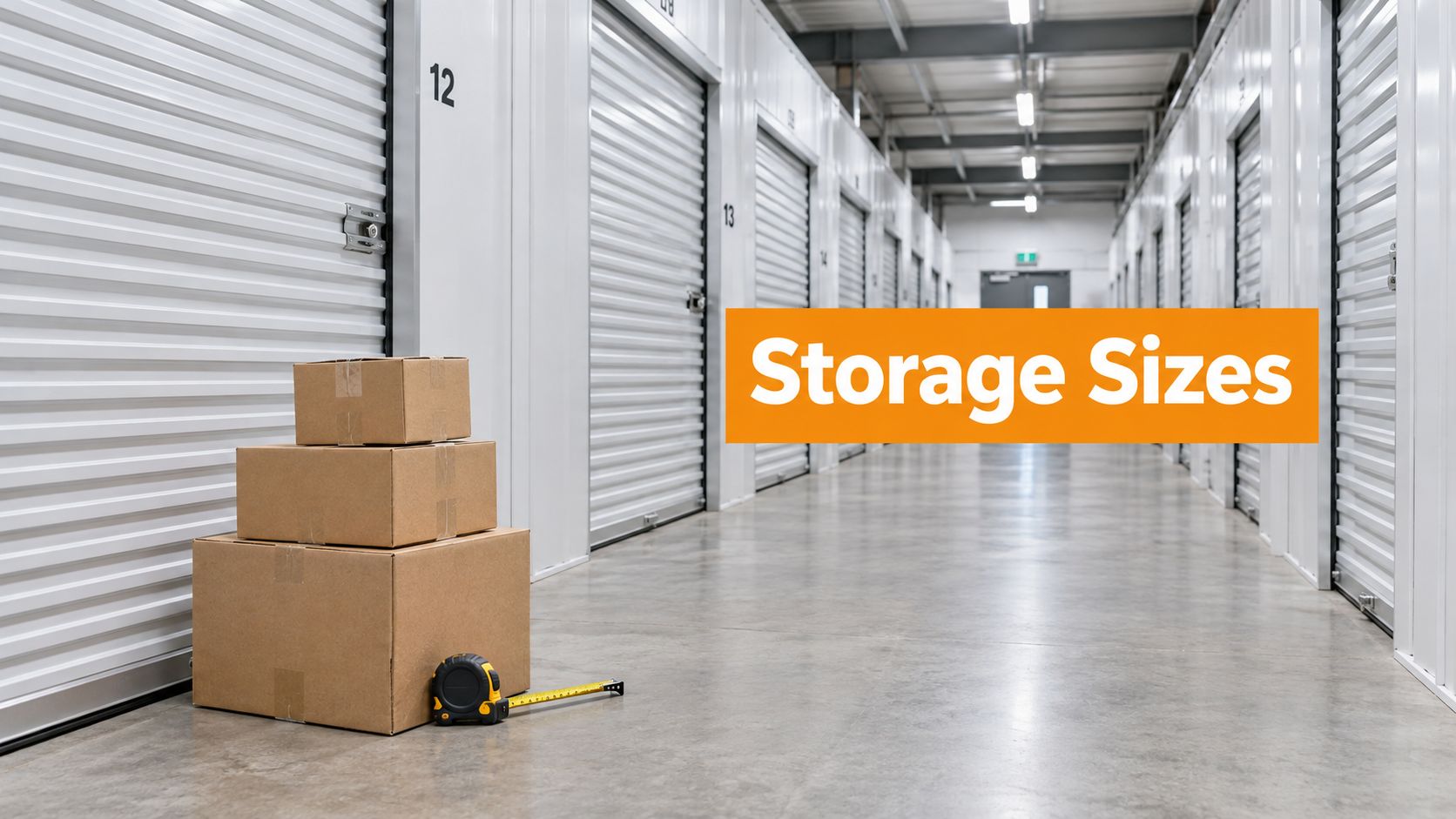
Business storage unit size guide
Use size guides as a starting point, not a booking decision.
A 50 sq ft unit can hold plenty on paper. In practice, it may be too small once you add shelving, leave a picking aisle, and keep your fastest-moving lines near the front. Businesses usually underbook when they measure by box count rather than by working layout.
| Unit Size (sq ft) | Equivalent To | Ideal For |
|---|---|---|
| 25 sq ft | Small cupboard | Archive boxes, documents, small parcels, spare samples |
| 50 sq ft | Large walk-in cupboard | E-commerce cartons, marketing material, light equipment |
| 75 sq ft | Half garage | Mixed boxed stock, shelving runs, trade consumables |
| 100 sq ft | Single garage | Growing online retail stock, bulk packaging, regular picking |
| 150+ sq ft | Large garage or mini-warehouse | Palletised goods, larger product ranges, trade stockholding |
The best unit is the one that lets staff unload quickly, find stock without reshuffling half the room, and leave enough space for the next delivery. That usually means choosing for workflow, not just cubic capacity.
Understanding Costs Insurance and Legal Obligations
A Crawley business can book a unit on a low monthly rate, move stock in, then find the actual cost looks very different by the second invoice. Extra charges for extended access, mandatory locks, insurance minimums, and admin changes are where budgets usually drift. That is why the licence agreement matters as much as the price list.

The hidden cost of 24 7 access
Late access sounds useful until you price it properly. Some providers include broad access hours in the base rent. Others treat evenings, weekends, extra users, or gate credentials as chargeable add-ons. For a business that needs staff to collect stock after a courier delay or before an early site visit, those extras can turn a cheap unit into an expensive one.
Ask for the full charging structure in writing before you commit.
Check these points:
- Whether off-hours access is included in the quoted rent
- Whether weekend access is priced differently from weekday access
- Whether each staff member needs their own fob, app setup, or approval
- Whether there is an admin fee for changing authorised users
- Whether locks, deposits, or minimum notice periods add to month one cost
This part catches owners out because the headline rate is easy to compare. The operating cost is what affects margin.
Insurance needs to match stock value and stock movement
Insurance is not a box-ticking exercise. If the declared value is wrong, or the policy excludes the goods you hold, the cover may not help much when you need it. Fast-moving stock creates another problem. The insured amount can fall behind replacement value within weeks.
Review the policy against the stock profile, not just the rent. A plain-English guide to storage contents insurance for business stock helps clarify what is usually covered, what is often excluded, and what evidence insurers expect.
Pay close attention to:
- Declared value, based on realistic replacement cost
- Excluded items, especially high-value goods, perishables, batteries, chemicals, or cash-like items
- Proof of ownership and value, including invoices, SKU lists, and dated photos
- Transit cover, because damage in the van or during loading may sit outside storage cover
One more point gets missed. Climate conditions and moisture risk can affect stock quality long before a clear insurance claim arises. If you are storing packaging, paper goods, fabrics, electronics, or labelled products, ask the operator what they can tell you about ventilation, humidity control, and temperature consistency. If they cannot give a clear answer, build that risk into your decision and your insurance review.
Legal terms and stock restrictions
The legal side is usually straightforward, but small clauses cause expensive problems. Businesses get caught by access rules, overdue payment terms, and restrictions on what can be stored. Read the licence as an operating document, not just a form to sign.
Look for clauses on:
- Notice periods and renewal terms
- Late payment charges and lockout rights
- Access hours and exceptions
- Who can enter on behalf of the business
- Restricted or prohibited goods
- The provider's right to move, inspect, or refuse items
Do not assume trade stock is automatically acceptable. Flammable liquids, aerosols in quantity, gas canisters, leaking goods, food items, live materials, and anything illegal are commonly barred. If a stock line sits in a grey area, get written approval before move-in.
If your business handles controlled goods, customer-owned items, or products with traceability requirements, keep a clear handover record from vehicle to unit. You can explore chain of custody with Packaging Panda if that process matters to your stock control or compliance work.
A storage contract should protect both sides. The right one is clear about cost, access, liability, and what happens if something goes wrong.
Mastering Your Stock Management and Logistics
A week into using off-site storage, the same problem usually shows up. Someone needs three cartons for a customer order, the wrong person has the key code, half the boxes are stacked in front of the fast-moving line, and a ten-minute collection turns into a wasted hour. That is how storage starts costing money instead of saving it.

Build the unit around movement
Set the layout before move-in day, not after the first van is unloaded. Businesses that treat the unit like overflow space usually pay for it in repeat handling, picking errors, and staff time. Businesses that treat it like a working stockroom tend to keep collections quick and stock counts cleaner.
Leave a clear central path. Keep your fastest-selling items close to the door. Put heavy cartons low and stable. If the stock will be picked more than once a week, shelving usually pays for itself in saved time.
A simple layout is enough for many Crawley firms:
- Front section for daily or weekly pick items
- Rear section for reserve stock
- One side for seasonal, promotional, or slow-moving lines
- A separate marked area for returns, damaged goods, or quarantine stock
Keep those zones fixed. Constantly changing locations creates errors, especially when more than one staff member uses the unit.
Use FIFO and ABC analysis properly
Two methods are particularly effective for small business stock storage.
FIFO, or first-in first-out, keeps older stock moving before newer deliveries. That matters for dated goods, packaging materials that degrade in poor conditions, and product lines that change regularly. If a site cannot give you clear information on temperature stability or humidity control, FIFO becomes even more important because older stock is at greater risk of sitting too long in unknown conditions.
ABC analysis is simpler than it sounds. Split stock by commercial importance. A items are your quickest-moving or highest-margin lines. B items move steadily but less often. C items can sit deeper in the unit because they are slower and less urgent to access.
In practice, that means:
- A stock at eye level and near the entrance
- B stock in secondary picking space
- C stock higher, lower, or further back
This does not require warehouse software. It requires clear labels, fixed locations, and staff following the same rules every time.
Protect retrieval accuracy and chain of custody
The biggest stock-control failures in self storage are usually ordinary ones. Opened cartons with no quantity update. A driver collecting goods without recording it. Returned stock going straight back onto saleable shelving. Those mistakes are small on the day and expensive at month-end.
Use a sign-out process whenever stock leaves the unit. Record the item, quantity, date, and name of the person taking it. If you handle customer-owned goods, regulated products, or branded stock that could trigger disputes, keep a handover record from vehicle to unit and back again. You can explore chain of custody with Packaging Panda if you need a clearer framework for traceability.
For day-to-day control, keep it practical:
- Label every carton on two sides
- Record part-box quantities as soon as they are opened
- Run routine spot checks on A stock
- Batch collections by route or job, not by habit
- Keep a basic unit map near your stock sheet
One more point gets missed regularly. Access convenience can distort the whole system. If a facility charges extra for extended or 24/7 access, businesses sometimes send staff less often and start overloading each trip. That usually leads to rushed picking, poor stock rotation, and boxes being put wherever space appears. A cheaper base rent can end up costing more in labour and stock errors if the access model does not match how your business operates.
A well-run storage unit should reduce friction in your fulfilment process. If collections are slow, counts drift, or staff rely on memory, the setup needs fixing before the stock volume grows.
Your Crawley Move-In Checklist and Booking Your Unit
Move-in day goes smoothly when the decisions have already been made. The last thing you want is a van full of stock and unresolved questions about access, insurance, prohibited goods or how the unit will be laid out.
This is the checklist I'd work through before any business move-in.

Pre move checks
- Finish the stock list and separate saleable goods from returns, damaged items and archive material.
- Confirm access hours in writing, especially if your team needs early, late or weekend entry.
- Check your packing method so boxes are stackable, labelled and suitable for the conditions you've booked.
- Bring the right kit such as pallet wrap, marker pens, tape, gloves, trolley and shelving plan.
- Assign one person to direct the layout so the unit isn't loaded randomly under time pressure.
Security features worth insisting on
For business stock, basic locking isn't enough. Stronger facilities typically combine monitored access, perimeter security and clear surveillance coverage.
Class A storage facilities in the UK that use 24/7 CCTV and perimeter-fencing security protocols reduce theft claims by an average of 95%, which is exactly why security shouldn't be treated as a nice extra when storing business goods.
That matters even more if you're holding tools, electronics, packaged retail inventory or customer-owned items. The replacement cost is one problem. Operational disruption is the other.
Choose the facility you can trust on a wet Tuesday evening when a staff member needs one urgent carton, not just the one that looked cheapest during a quick online search.
A simple move-in sequence
Keep the first load organised:
- Put shelving or heavy support items in place first.
- Load slow-moving stock to the rear.
- Keep your pick face near the front.
- Photograph the finished layout.
- Save a location map where your team can access it.
Good storage should reduce friction from the first week. If the unit is hard to use, staff will work around it, and that usually means old bad habits returning.
If you're ready to move stock out of the office, van or spare room, Standby Self Storage offers flexible, secure business storage with online booking, live pricing, controlled access, perimeter fencing and 24/7 CCTV across convenient South East locations for Crawley businesses.