You can tell an office has outgrown its paperwork before anyone says it out loud. Meeting rooms turn into box rooms, the spare desk disappears under lever-arch files, and someone eventually asks where the contract from 2017 went, usually on the same day an HMRC query lands or a renovation starts. In Reading, that's when archive storage stops being a nice-to-have and becomes a decision about compliance, retrieval speed, and whether your team can work.
When the Office Is Buried in Boxes
A lot of local owners wait until the mess becomes embarrassing. By then, the boxes have spread into corridors, the client meeting space has shrunk, and staff are wasting time searching for records that should have been indexed months ago. That's not a storage problem, it's an operations problem.
A Reading business with old contracts, payroll files, tax papers, and IP records needs a system that keeps those documents available without keeping them underfoot. The right archive setup gives you room back, but it also protects you from the bigger issue, which is not knowing what you've got or where it is.
Practical rule: if a file matters enough that you'd panic if it vanished, it shouldn't be sitting in a random office cupboard.
The same is true if you're mid-refit, moving premises, or trying to keep a small team productive while paperwork piles up. A proper archive arrangement gives you a controlled place for low-use records, so the office can stay an office. If you're looking at office overflow already, start with the business-storage option on Standby Self Storage's office storage page, then decide what belongs in long-term archive space.
What Archive Storage Means for a Reading SME
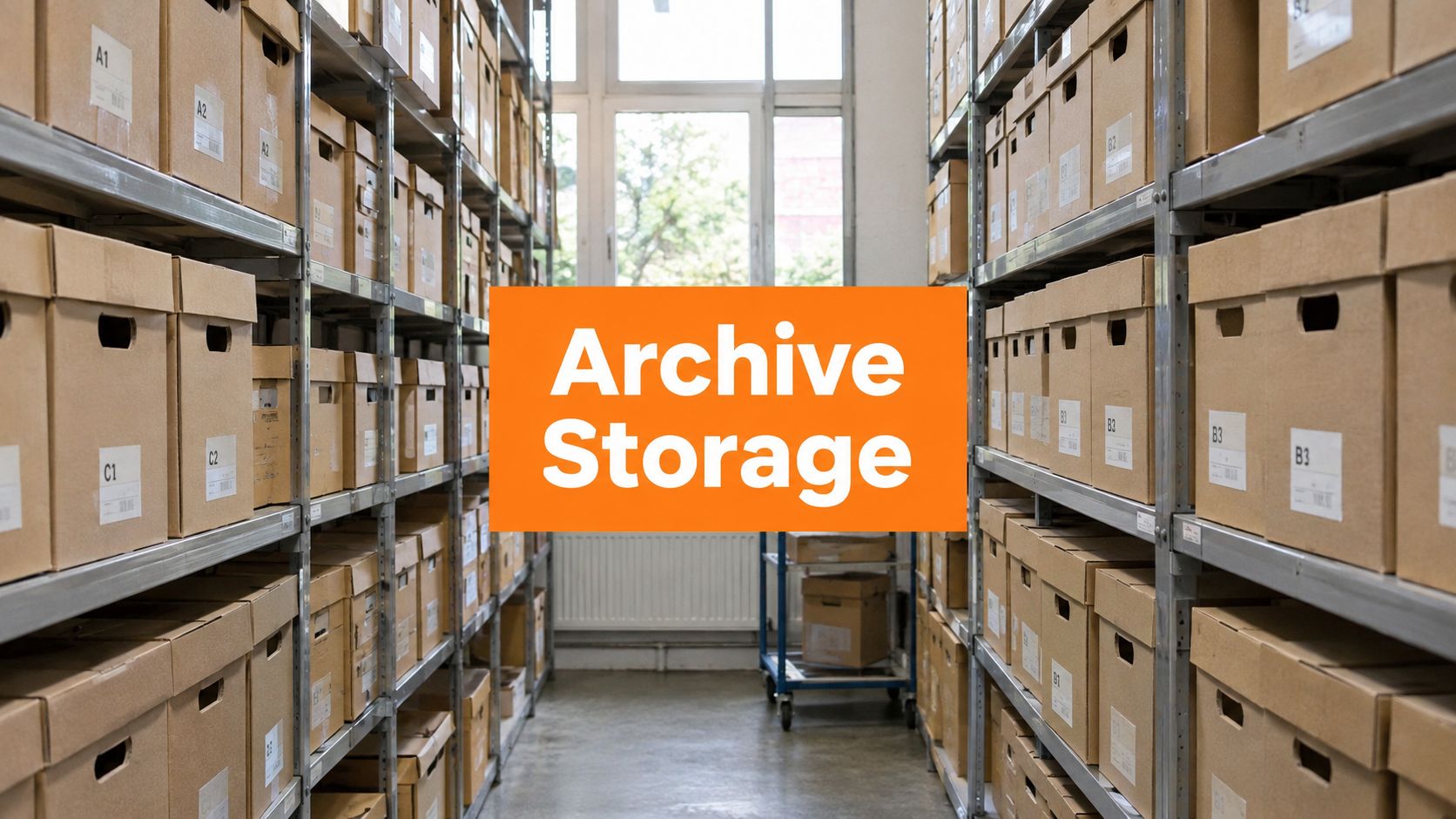
Archive storage goes beyond extra space, it is a managed system for records you must keep, rarely need, but still need to pull out quickly when a client, auditor, or colleague asks for them. That is a different job from stacking boxes in general storage and hoping the right file turns up later.
A chartered accountancy firm needs clean indexing and controlled access. A recruitment agency needs candidate files separated by retention date and sensitivity. An independent school has pupil records and staff paperwork. A small manufacturer may hold old accounts, supplier contracts, warranty files, and technical documents. They all need archive storage, but each business needs a different structure, because retrieval habits and compliance pressures are not the same.

Reading SMEs usually run into the same problem. Paperwork gets kept for years, then finding one file turns into a slow search through cupboards, underused shelves, and half-labelled boxes. Small Business reported that businesses kept paperwork for just over 10 years on average, smaller firms held records for 12.25 years on average, and retrieval commonly took 5 to 6 days, with over a week for 44% of firms. That is exactly why archive storage exists, it keeps long-retained records organised and available instead of lost in the office clutter.
If you run a Reading SME, stop asking where to dump boxes. Ask which records must be kept, how often they are needed, and how fast someone may need them back. That is the standard that should shape your archive setup, whether you are storing accounts, staff files, or old contracts. For a practical baseline on company document storage, use the document archiving best practices guide as a working reference alongside your retention policy and filing process.
Compliance, GDPR and Security Triggers You Cannot Ignore
Office space alone does not drive the decision to use archive storage, compliance requirements do. HMRC expectations, GDPR obligations, insurance evidence, and contract retention clauses all push a Reading SME towards a controlled archive process, not a stack of folders in a back room.
Owners get this wrong when they treat security as a nice extra. It is part of the compliance setup. If records hold employee data, customer details, or sensitive contracts, then storage, access, and disposal all need to be controlled together. That means looking for layered protection, not a reassuring line on a sales page.
A good Reading provider should be able to show perimeter fencing, 24/7 CCTV, controlled access, and individually alarmed units, because those controls reduce the risk of loss or unauthorised access. Some local operators also provide 24/7/365 access via a phone app, which helps when an auditor, solicitor, or client asks for a file outside normal hours. Rapid access and physical security need to work together for regulated SMEs.
Off-site archive storage does not remove risk. It reduces the blast radius when something goes wrong at your own premises.
Disposal matters just as much. If files have reached the end of their retention period, do not leave them sitting in a corner waiting to become a problem. Use a documented destruction process, and review compliant data destruction methods before anything leaves your control. For a practical baseline on the process itself, document archiving best practices is the right reference point alongside your retention policy and filing routine.

One more point. Off-site storage should sit inside your records system, not outside it. In England, the National Archives' 2025 sector survey found that 49% of archive services used off-site storage in some form, with the average share of collections stored off-site at 39% and the median at 35%. Among services using off-site storage, 65% kept 25% or less of collections off-site, and only 3% stored more than 75% off-site, according to the National Archives report. That is the model to copy, use archive storage selectively, and keep control of what stays on site and what moves out.
How to Size an Archive Unit Without Overpaying
Start with the boxes, not the rent. Count the archive boxes you have, estimate the cubic volume they'll occupy, and separate the files by access frequency. If you skip that step, you'll either pay for space you don't use or cram records into a unit that's awkward to work in.
Square footage alone is the wrong lens for archive storage. Boxes stack by volume, and the key question is how many rows you can build safely, how much aisle space you need, and whether anyone has to walk in and pull files regularly. A small Reading unit of around 10 square feet can still be useful when retrieval is rare, because dense stacking matters more than walking room.
Size by box count and access pattern
If a file category is almost never touched, it can go high and tight. If staff need to pull records during client calls or audits, you need more breathing space and easier reach. That is why a finance archive and a sales archive should not be sized the same way.
A useful way to think about it is this:
- Rare access files can live in compact, densely stacked storage.
- Occasional access files need clear labelling and a few minutes' retrieval time.
- Frequent access files probably don't belong in archive storage at all.
| Typical Reading Archive Unit Sizes and Use Cases | |||
|---|---|---|---|
| Unit Size (sq ft) | Approx Box Capacity | Best For | Access Pattern |
| 10 | Small box run | Low-use records, closed years, long-retention files | Rare |
| 25 | Medium archive set | SMEs with several departments or recurring compliance checks | Occasional |
| 50 | Larger archive load | Businesses with steady paper inflow and structured retrieval | Regular but controlled |
| 160 | High-volume storage | Multi-department archives and long-retention stockpiles | Mixed |
A Reading facility also reports units up to 160 square feet, or 1,280 cubic feet, which shows how much archive capacity a local business can access when the record load is serious, according to Reading Storage Solutions. That doesn't mean bigger is better. It means the right size is the one that matches your box count and retrieval rhythm.
If you're paying for future growth that never arrives, you're subsidising empty air.
For a realistic working rule, a 50-box archive should be judged against access needs first and price second. If you're visiting the unit all the time, the cost isn't just the rent, it's the staff time. If you want a wider business-storage option for mixed-use records, company document storage is the kind of service that can fit a structured archive plan without turning into overflow chaos.
Physical, Digital or Hybrid How to Choose
Many Reading businesses waste money by assuming the choice is either boxes or scanning, when the smarter answer is usually both. The decision is which records deserve physical originals, which ones should be digitised, and which ones should be backed up in more than one place.
The DPC digital-preservation guide makes the right point, define why you're storing records before you pick the method. That means deciding whether the need is compliance, retrieval, confidentiality, or continuity. If the file has a legal or evidential role, keep the original where required. If it's high-access and low-risk, digitise it and make it searchable.
Use the right mix for the right records
A recruitment agency with seven years of candidate files should usually prioritise a hybrid model, digital for daily access, physical for originals that must be retained. A dental practice has a stronger confidentiality burden, so access control and a careful disposal trail matter more than casual convenience. A family manufacturer with 30 years of accounts might keep historical paper off-site while pushing current operations into shared digital workflows.
That approach mirrors the National Archives off-site storage guidance, which says organisations should estimate demand for access by record category and set retrieval times accordingly. In plain English, don't choose a unit before you know how often you'll need the box back.
Here's the clean rule:
- Physical archive suits originals, signed contracts, legacy files, and records with a low access rate.
- Digital storage suits high-use documents that staff need immediately.
- Hybrid suits almost everyone else, especially SMEs balancing compliance and convenience.

If you're thinking about centralising records across paper and digital systems, unified data storage strategies are a useful way to frame the problem. Don't let a vendor sell you only one format if your workflow clearly needs two.
A Reading Checklist for Choosing the Right Provider
Choose the provider that answers your questions plainly. If they dodge around access hours, retrieval fees, insurance cover, or exit terms, walk away. Reading businesses get burned when they buy storage on convenience alone and discover the contract is tighter than the box space.
Ask about security and access first
You want perimeter security, 24/7 CCTV, alarmed units, and controlled entry as standard. If a provider offers app-based access, ask exactly how it works and who can use it. If they can't explain how a box is logged in and out, they're not ready for business records.
Then check the contract
The traps are familiar. Automatic renewals catch owners who meant to stay for three months and are still paying nine months later. Unclear retrieval fees turn “secure archive storage” into an extra cost every time someone needs a file. Sub-let clauses are a red flag if your records will be handled by anyone outside the actual facility.
Finish with local reality
Ask where the site sits in Reading, how easy the loading area is, and whether you can collect during the time of day your office needs access. If your team will be coming from town, route planning matters. A good provider should fit your working day, not force you to build your day around their lock-up habits.
Standby Self Storage is one local option that offers secure units, flexible terms, and an online booking flow, so it can sit in the same shortlist as other Reading providers. Use that as a benchmark, not an excuse to stop comparing.
From Decision to Move-In Your Next Steps in Reading
Do a one-hour records audit. List the box count, label the file types, and mark each group by access frequency. Then ask at least two Reading providers for quotes using the same box count and the same retrieval pattern, so you're comparing like with like.
Visit the shortlist in person at the time of day you'll need access. Check loading, ask about app setup, and bring ID plus proof of business address on day one. If you're moving boxes across town, avoid the morning rush on the IDR and use the ring road sensibly.
Book the unit, label every box, and keep an index sheet separate from the archive itself. That's how you turn paperwork chaos into a controlled records system. Archive storage isn't a sign that your business is disorganised, it's a deliberate decision to protect compliance and keep the office usable.
If your Reading office is ready to stop tripping over boxes, Standby Self Storage can give you secure archive space with flexible terms and straightforward booking. Visit Standby Self Storage to compare unit options, check availability, and move your records into a setup that fits how your business works.