Your tenancy ends on Friday, but your new keys aren't available until the following week. The removal van is booked, work is taking place at the property, and the boxes have nowhere safe to go. For many Crawley renters, students, homeowners and tradespeople, the problem isn't owning too much. It's that important dates refuse to line up.
Temporary storage in Crawley acts as a practical bridge between those dates. You can move belongings out of the way, keep them secure while plans settle, and collect them when your new room, flat, shop or workshop is ready. Independent UK storage data found that 81% of respondents said they lacked storage space at home, supporting the view that storage demand often comes from household pressure, not only long-distance moves (Access Self Storage on shrinking homes and rushed decisions).
This guide focuses on the decisions that make a short rental work well: timing, unit size, location, access, security, insurance and packing. If you're moving for work, changing tenancy, clearing a renovation area or storing stock between jobs, the aim is simple. You should finish knowing what to book and why.
When Temporary Storage Makes Sense in Crawley
Consider a renter whose Crawley tenancy finishes before the next home is ready. They could keep furniture with friends, pay for another removal visit or leave belongings in a vehicle. A storage unit creates a controlled middle step. The furniture leaves the old property on schedule, stays together in one place and moves into the new home when access is available.

The same arrangement helps during a renovation. Rather than covering every sofa and cabinet with dust sheets, you can clear the room properly, give contractors space to work and bring items back as each area is completed. Students may need a similar pause between term dates, particularly when travelling home or changing accommodation.
The timeline problem
Temporary storage solves a timing mismatch. Common examples include:
- A tenancy gap: Your old agreement ends before the new one begins.
- A delayed completion: Your sale or purchase has moved, but your removal date hasn't.
- A renovation: Furniture must leave a room while builders, decorators or electricians work.
- A relocation: You need somewhere for belongings while you secure a permanent home.
- A business change: Stock, tools or archive boxes need to leave a small premises before the next space is available.
The best booking starts with dates, not unit sizes. Write down the last day you can access the old property, the earliest date you can enter the new one and how often you'll need to visit the unit in between.
Practical rule: Treat storage as a spare room for a defined period, not as a place to put off every decision about what you own.
If your needs are business-related, a guide to business stock storage in Crawley can help you think through stock, equipment and access requirements separately from household belongings. The important question remains the same: which items need to be available, and when?
Understanding How Temporary Storage Works
Think of a storage unit as a secure spare room that you rent for the period your belongings need it. You choose a space, move your boxes and furniture inside, lock the unit and pay according to the provider's terms. Unlike adding another room to your home, you can usually reduce or end the rental when the transition is complete.
That flexibility matters because moving timelines change. A completion date may shift, renovation work may take longer than expected, or a new job may begin before your permanent accommodation is ready. A short-term arrangement gives you room to respond without forcing every decision on the same day.
From booking to move-in
The process is usually straightforward:
- Estimate what needs storing. Separate large furniture, packed boxes, tools, stock and items you'll keep at home.
- Choose a location. Frequent access calls for a convenient site, while a longer stay may make a slightly more distant option workable.
- Check the agreement. Read the payment cycle, access rules, cancellation terms and insurance conditions before confirming.
- Reserve the unit. Online booking or phone support may allow you to secure a space before moving day.
- Load methodically. Put items you'll need first near the entrance and leave a route to the rear.
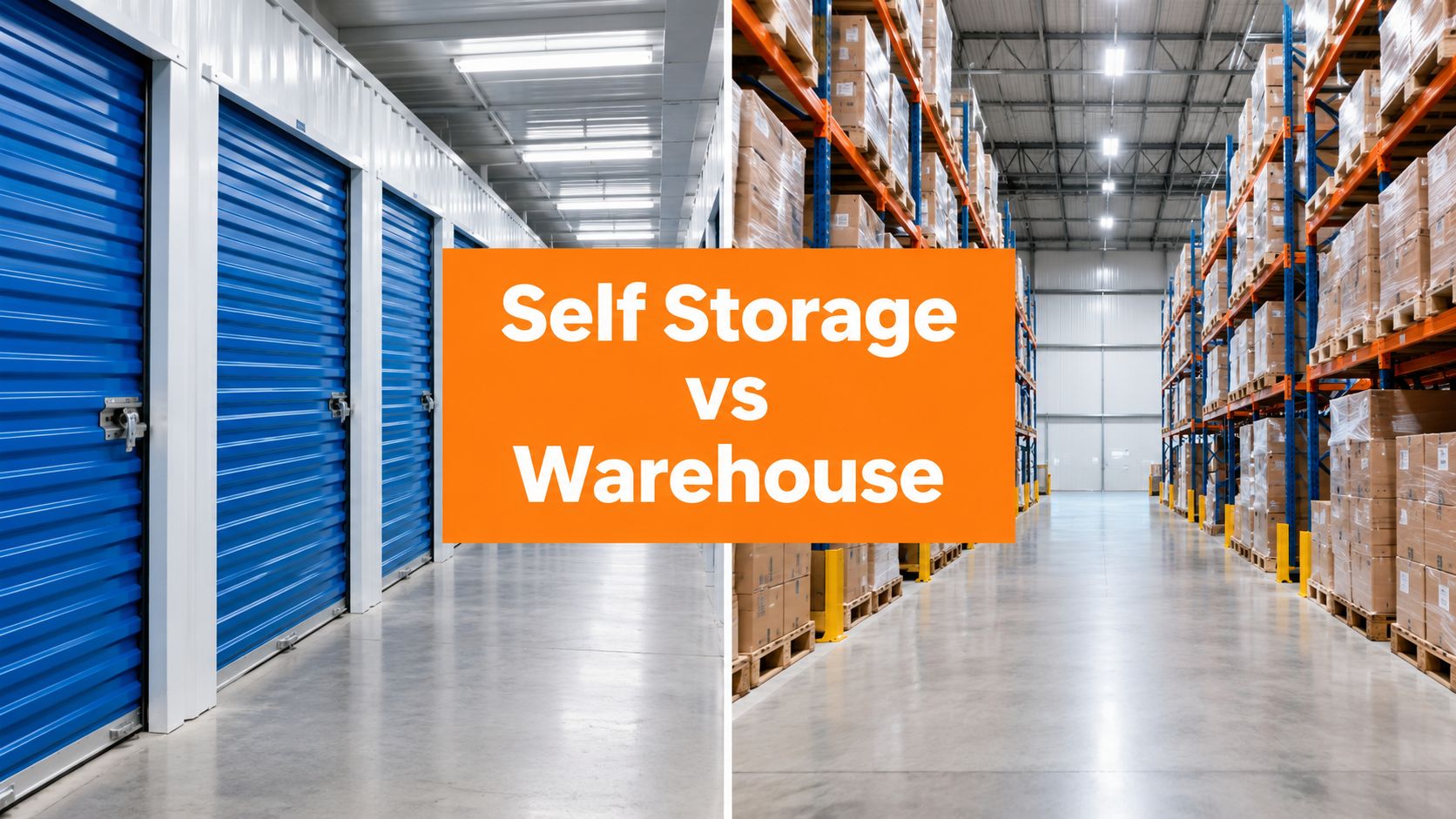
Temporary storage isn't the same as a warehouse lease. A warehouse generally involves taking responsibility for a larger commercial space and committing to a more formal arrangement. Self-storage is usually more modular. You rent the amount of room you need, keep control of your own unit and can adjust your plans as the project changes.
A clear inventory also prevents frustration. Photograph valuable items before they go in, label boxes on more than one side and keep a note of where essential documents, seasonal clothing or tools are positioned. You can find further guidance on short-term storage units before comparing providers and access arrangements.
Exploring Temporary Storage Options Near Crawley
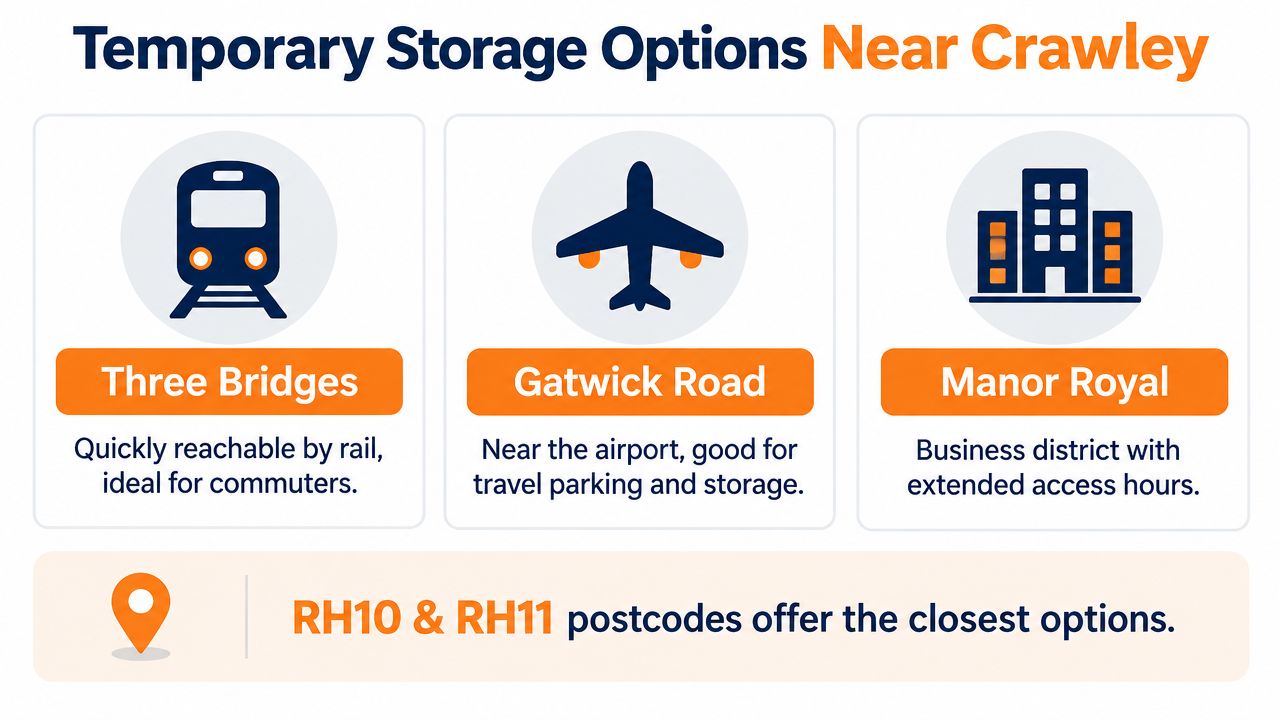
Crawley searches often produce facilities around Three Bridges, Gatwick Road, Manor Royal and the RH10 and RH11 postcodes. Those clusters reflect practical travel patterns. Three Bridges may suit someone combining a storage visit with a rail journey, Gatwick Road can be convenient for airport-linked work, and Manor Royal may work well for businesses already travelling through the commercial district.
Location matters most when you'll visit often. A tradesperson collecting tools each morning has different priorities from a household storing furniture until a property is ready. The first user may value direct vehicle access and early availability. The second may care more about a simple loading route and a rental that can end once the move is complete.
Compare the whole journey
Don't judge a unit by distance alone. Compare:
- Travel route: Can a van reach the site without awkward turns or restricted loading?
- Access hours: Do they fit around shifts, removals, school runs or trade work?
- Loading arrangements: Look for parking, trolleys, lifts or drive-up access where relevant.
- Booking process: Online quotes and reservations can help when dates are changing quickly.
- Support: A reachable team is useful if access codes, payments or authorised visitors need attention.
- Alternative sites: A short drive to Horsham, Reigate, Croydon or Worthing may be sensible if the facilities or terms better match your schedule.
Crawley's supply profile deserves attention. The borough had about 124,008 residents across roughly 45,502 households, with around 42.7% of households renting, and local self-storage provision was measured at 0.66 square feet per resident versus a UK benchmark of 0.9 square feet, about 27% below the national benchmark (Crawley self-storage market data from Storage Compass). That combination can make availability more sensitive when several moving or business needs arrive together.
For a house move, it can also help to review practical guidance on short-term storage for house moves before deciding whether you need a small holding space or room for the contents of several rooms. Landlords with changing occupancy dates can review landlord storage in Crawley as a separate use case.
Choosing the Right Unit Size and Price Range
Size decisions become easier when you describe your belongings in groups rather than guessing from the number of boxes. A student may have compact cartons, bags and a desk. A one-bedroom renter may add a bed, sofa, appliances and dining furniture. A tradesperson may need fewer household items but more awkward equipment, while a small business may need space for cartons that must remain easy to count and collect.
The local supply picture makes accurate estimates useful. Crawley has an estimated 0.66 square feet of storage per resident compared with a UK average of 0.9 square feet, roughly 27% below the national benchmark (the Crawley storage figure listed by Job Today). In a tighter market, leaving the decision until the last moment may reduce your choice of sizes or locations.
Use the contents, not the label
| Unit size | Best for | Example contents |
|---|---|---|
| Locker or compact unit | A few boxes, documents or seasonal items | Suitcases, archive cartons, small appliances and personal files |
| Small unit | Student belongings or a modest room clear-out | Boxes, clothes, a desk, chair and dismantled shelving |
| Medium unit | A flat move or renovation | Sofa, bed frame, mattress, tables, appliances and packed cartons |
| Larger unit | Multi-room contents or business overflow | Several furniture items, stock cartons, display materials and equipment |
| Large commercial unit | Bulky trade or business requirements | Tools, machinery, larger stock volumes and workplace equipment |
These categories are guides, not guarantees. A dismantled wardrobe uses less space than one left assembled, and neatly packed cartons can fit more efficiently than loose bags. Measure the largest item, identify anything that can't be stacked and allow room to reach the back.
Understand what changes the price
Price normally reflects unit size, rental length, location, access arrangements and insurance. A larger room costs more because it reserves more capacity. A flexible short stay may have a different rate from a longer prepayment arrangement, so compare the total cost for the period you expect to use.
Avoid choosing the smallest possible unit if it forces you to unpack and reload everything later. At the same time, don't pay for empty height and floor space that you can't use. Ask the provider to check your list, then request a quote for the closest two sizes. That gives you a realistic choice without turning the estimate into guesswork.
Security Insurance and Access You Should Check
A low price doesn't tell you whether a facility suits your belongings. Before booking, check how the site controls entry, monitors activity and handles a problem outside staffed hours. You don't need to become a security specialist, but you do need clear answers.
Crawley has experienced sustained pressure on industrial and logistics space. A Crawley Borough Council employment paper reported that availability had remained below the 8% equilibrium level since 2012 and had repeatedly fallen to critically low levels of 2% to 3% over the last decade (West Sussex commercial property research). For contractors and small businesses, that helps explain why an off-site unit can be more practical than waiting for a larger permanent premises.
Ask these questions before you sign
Security should be specific. Ask whether the site has perimeter fencing, CCTV monitoring and controlled entry. Find out how your individual unit is locked, who can access it and what happens if you lose a key or access code.
Insurance needs its own conversation. Storage cover may be separate from the rental price. Check whether your home, business or specialist policy covers items away from the property, then confirm exclusions, valuation rules and claims procedures. Keep receipts, photographs and an inventory for valuable contents.
Access must match your routine. A student visiting occasionally can work with different hours from a contractor collecting tools every morning. Confirm opening times, vehicle access, loading arrangements, visitor rules and whether extra charges apply for particular services.
Create a written record
Save the quote, agreement, insurance information and contact details in one folder. Photograph the unit before loading, record the lock arrangement and keep your inventory outside the unit as well as digitally. If another person may collect items, ask how authorised access is added and removed.
Before moving in: If the provider can't explain security, insurance or access in plain language, pause the booking until you have the answer in writing.
Packing and Access Tips for Every Type of User
Good packing reduces the time you spend searching, lifting and rearranging. Clean furniture before storage, make sure fabric is dry, dismantle large items where possible and protect corners with suitable coverings. Put heavier boxes low, avoid unstable stacks and leave a clear route from the door to the items at the back.
Students between terms
Use smaller boxes that one person can lift. Label each box by category, such as kitchen, winter clothing or study materials, rather than writing only “room”. Keep documents, medication and anything needed immediately in a separate bag that travels with you.
If you know your return date, place non-essential items at the rear and everyday items near the entrance. Don't store damp laundry, open food or liquids that could leak.
Renters and homeowners
Start with the furniture that blocks work first. Photograph assembled items before dismantling them, place screws in labelled bags and tape those bags to the relevant furniture. Cover sofas and mattresses with breathable protection, and keep a small “first night” group outside storage with bedding, chargers, toiletries and basic kitchen equipment.
A simple room-by-room inventory prevents a common mistake: treating the unit as a mystery cupboard. Number the boxes and note the contents in your phone.
Small businesses and online sellers
Separate active stock from reserve stock. Put fast-moving cartons near the access route, group products by range and keep a count outside the unit. Archive boxes should be labelled with dates or project names, while confidential paperwork should remain sealed and access should be limited to authorised people.
Use shelving only if the facility permits it. Keep stock raised from the floor where suitable, protect packaging from dust and leave enough space to inspect cartons without unloading the entire unit.
Tradespeople and contractors
Tools need an access plan, not just a lock. Store frequently used equipment near the front, group specialist tools together and record serial numbers and photographs. Avoid creating a stack that requires heavy lifting before an early start.
For every user, maintain a clear walkway, don't overload boxes and tell the facility about any item that may be restricted. If you expect daily visits, test the route with your vehicle before moving everything in.
Your Quick Checklist to Book and Move In
A temporary unit becomes much less stressful when you make the decision in the right order. Start with the gap in your calendar, then match the space and location to that gap.
- Confirm the dates. Write down when belongings leave the old property and when they can enter the new one.
- Separate the contents. Decide what will be stored, donated, sold or kept with you.
- Shortlist the size. Use a size guide and request quotes for two realistic options.
- Choose the route. Compare Crawley clusters with nearby facilities in Horsham, Reigate, Croydon or Worthing if travel time and access make that worthwhile.
- Check protection. Confirm fencing, CCTV, controlled entry, insurance terms and your own responsibilities.
- Confirm access. Match the facility's hours and loading arrangements to your moving day and normal routine.
- Ask about the agreement. Check payment dates, cancellation rules, notice requirements and any additional charges.
- Prepare the load. Label every box, photograph valuable contents and place essentials where you can reach them.
- Book only when the details are clear. An online quote or support conversation should leave you knowing the unit, price basis and move-in instructions.
The right choice isn't always the closest unit or the largest room. It's the option that safely holds your belongings for the period you need, with access that fits your life and terms you understand. Temporary storage is a low-commitment way to absorb a difficult handover, renovation or relocation without making every date match perfectly.
If you're still uncertain, prepare a short contents list and ask the provider to review it before you reserve. That small step can prevent paying for unused space or discovering on moving day that your largest item won't fit through the door.
Standby Self Storage offers flexible personal and business units, online booking and support for people who need a practical bridge during a move, renovation or stock change. Visit Standby Self Storage to compare options, request a quote and arrange your temporary storage in Crawley.