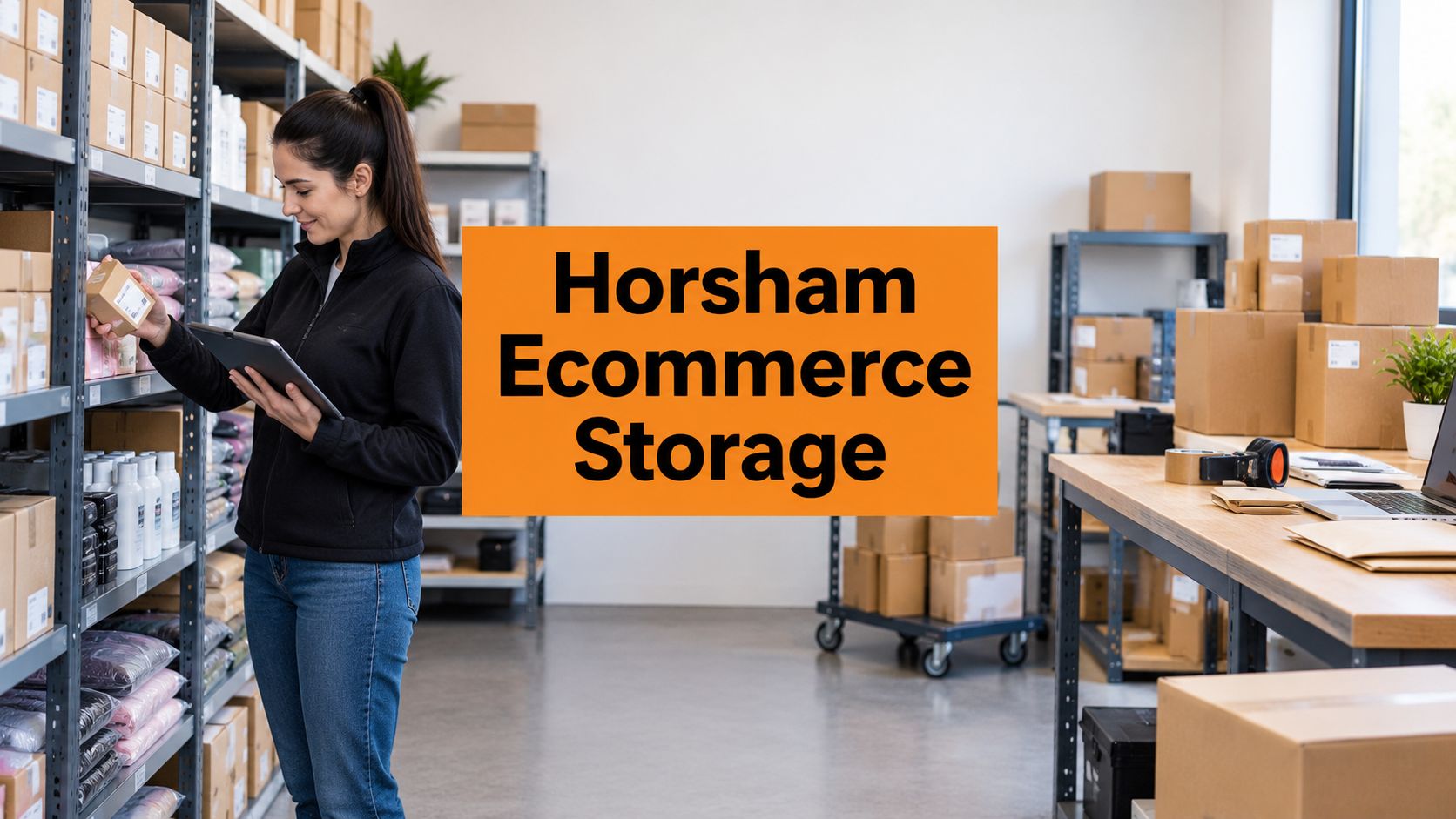
Your spare room stopped being a spare room months ago. Stock's on the landing, returns are under the stairs, and you're packing orders on a kitchen table that's never clear. That setup works until one busy week exposes it. Moving into ecommerce storage in Horsham fixes the space problem, but only if you design the workflow first. Book square footage without a plan for returns, picking and dispatch and you'll move the chaos to a unit you're paying for.
Why Horsham Ecommerce Sellers Are Rethinking Storage
Most sellers I advise don't outgrow home storage in one dramatic moment. They outgrow it carton by carton. A delivery that won't fit in the garage. A returned parcel opened on the sofa and left there because there's nowhere logical to put it. Packaging stored in three rooms, so every order becomes a small scavenger hunt before you've printed a label.
That's not a housekeeping failure. It's a layout failure, and it costs you picks, refunds and repeat courier trips.
Treat Storage as an Operating Decision
Your unit isn't a cupboard for surplus boxes. It's where stock arrives, gets counted, sits in a known location, gets picked, packed and leaves. Returns come back through the same door and need inspection before anyone sells them again. If you don't plan those movements before you sign, you'll plan them badly afterwards, around shelving that's already in the wrong place.
The national picture explains why this pressure isn't easing. ONS figures showing online transactions represented 27.8% of all retail sales in June 2025, with non-store retailers recording their highest monthly sales volume since February 2022 after a 1.7% monthly increase. More than a quarter of retail spending happening online means Horsham sellers aren't handling an occasional side channel. You're operating in the main market, with main-market expectations for speed and accuracy.
Practical rule: If you can't sketch where inbound stock, saleable stock, returns and packed orders will sit, you're not ready to choose a unit size.
What Good Looks Like in Practice
Start with three decisions before you view a unit.
- List your zones: Name every function the unit must hold, including packaging, not just products.
- Fix your packing standard: Decide how orders will be protected and sealed, and source materials deliberately. Sellers who standardise early often review options such as packaging film for ecommerce orders alongside cartons, mailers, tape and labels, then store each item in one labelled place.
- Decide how you'll count: Choose whether you'll track stock in your selling platform, a spreadsheet or dedicated software, and commit to updating it at the unit, not from memory at home.
That discipline sounds dull. It's what separates a seller who can find any SKU in under a minute from one who cancels orders because the system says two and the shelf says none. Get the workflow right and a modest Horsham unit outperforms a larger, disorganised one every week.
How UK Online Sales Shape Local Storage Demand
UK-wide numbers matter to a Horsham seller because your customers don't shop to a Horsham calendar. They shop to national promotions, payday cycles and Christmas. Your storage plan has to absorb that rhythm or it'll break at exactly the moment orders are most valuable.
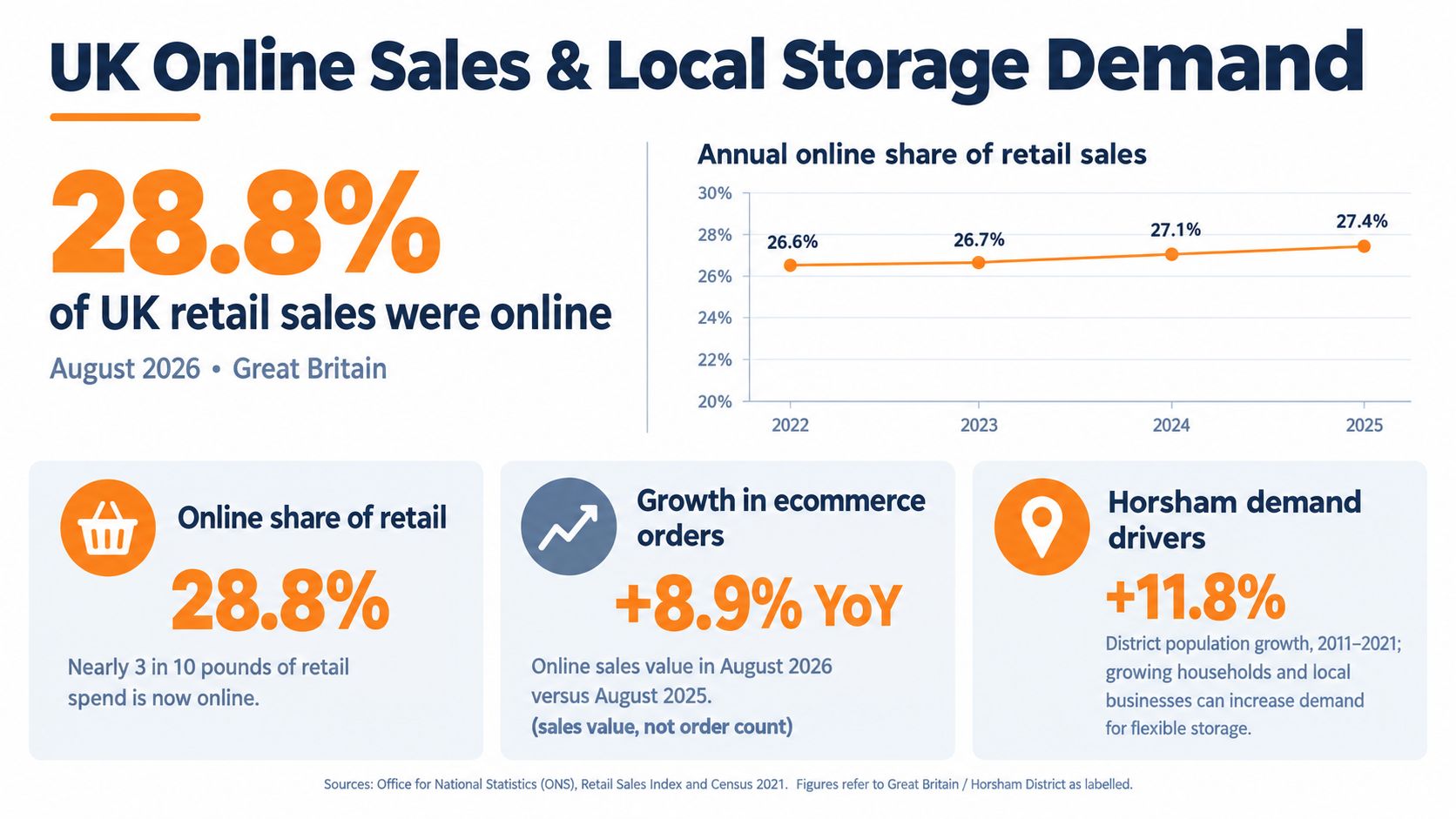
The seasonal swing is stark. ONS data showing monthly UK internet retail sales rose from £2,397.9 million in April 2025 to £3,439.2 million in November 2025, with November approximately 45% higher than June. December stayed well above the mid-year baseline too. Read that as an operator, not an economist. The space that feels comfortable in June can be overwhelmed in November by inbound stock, packed orders waiting for collection and the returns that follow peak dispatch.
Baseline Plus Peak, Not One Fixed Size
Don't size a unit for your average week and hope peak behaves. Don't rent for peak all year and pay for empty air either. Split your thinking into two layers.
- Baseline stock: Products you hold year-round, stored in fixed locations with stable shelving.
- Peak and launch stock: Promotional lines, seasonal bundles and forward-bought bestsellers, held in flexible space you can release afterwards.
That distinction is why seasonal business storage in Horsham suits online sellers better than a conventional warehouse lease for many small operations. You can add capacity for a launch or the Christmas run, then step back down without renegotiating a long commitment.
There's a second peak most sellers forget. Returns lag sales. Your busiest dispatch weeks create your busiest inspection weeks shortly afterwards, when the unit may look emptier of saleable stock but fuller of parcels awaiting decisions. Plan floor space for that wave when you plan for outbound volume. Sellers who only plan forward logistics discover reverse logistics standing in the aisle, blocking the shelving they need to pick from.
Sizing Your Horsham Storage Unit the Smart Way
Forget box count. Two sellers with identical stock volumes need different units if one packs inside the unit and handles returns there, and the other only stores sealed cartons. Size for workflow first, volume second.
Start with an audit. List every SKU, its carton dimensions and how fast it moves. Convert that into cubic volume rather than counting boxes, because shelving height is usable space you're already paying for. Then add the operational zones that don't appear on a stock list but consume floor space every day.
Storage Zone Planning for a Horsham Ecommerce Unit
| Zone | Suggested share of unit | Purpose |
|---|---|---|
| Saleable stock | Largest portion | Pickable inventory in fixed, labelled locations |
| Inbound receiving | Small, near the door | Checking deliveries before they join saleable stock |
| Returns quarantine | 15–20% of operational floor space | Holding uninspected returns away from saleable stock |
| Packaging materials | One shelving bay or wall section | Cartons, mailers, film, tape, labels and inserts |
| Packing and dispatch | Bench plus staging floor | Packing orders and holding them for courier collection |
| Aisle and access | Non-negotiable | Safe movement to every shelf without moving stock first |
That returns figure isn't guesswork. Analysis showing returns processing can require 15–20% of operational floor space, and reverse logistics can add 40–50% more handling touches per order compared with outbound fulfilment. Sellers who give returns no dedicated space don't save money. They pay in handling time, because every returned item gets moved repeatedly until someone finally decides what it is.
A unit that's technically big enough for your stock can still be too small for your business if there's nowhere to stand, pack or quarantine a return.
Translate the Audit Into a Unit
Walk your audit through a candidate unit in order of movement. Deliveries arrive at the door, so receiving belongs there. Fast movers belong nearest your packing bench. Slow, bulky or seasonal lines can sit furthest away or highest up. Keep heavy cartons low. Leave an aisle you can walk with a tote in your hands.
If that layout only works when every shelf is full and the bench doubles as storage, the unit's too small. Step up one size or plan overflow space for peak. A slightly larger unit with clear zones will save you more in picking time and errors than a cramped unit saves in rent.
Security Access and Contract Terms Worth Checking
Plenty of storage looks fine on a viewing and fails in daily use. You're not storing furniture you visit twice a year. You're running stock through this site weekly, sometimes daily, so access and contract detail matter as much as locks.
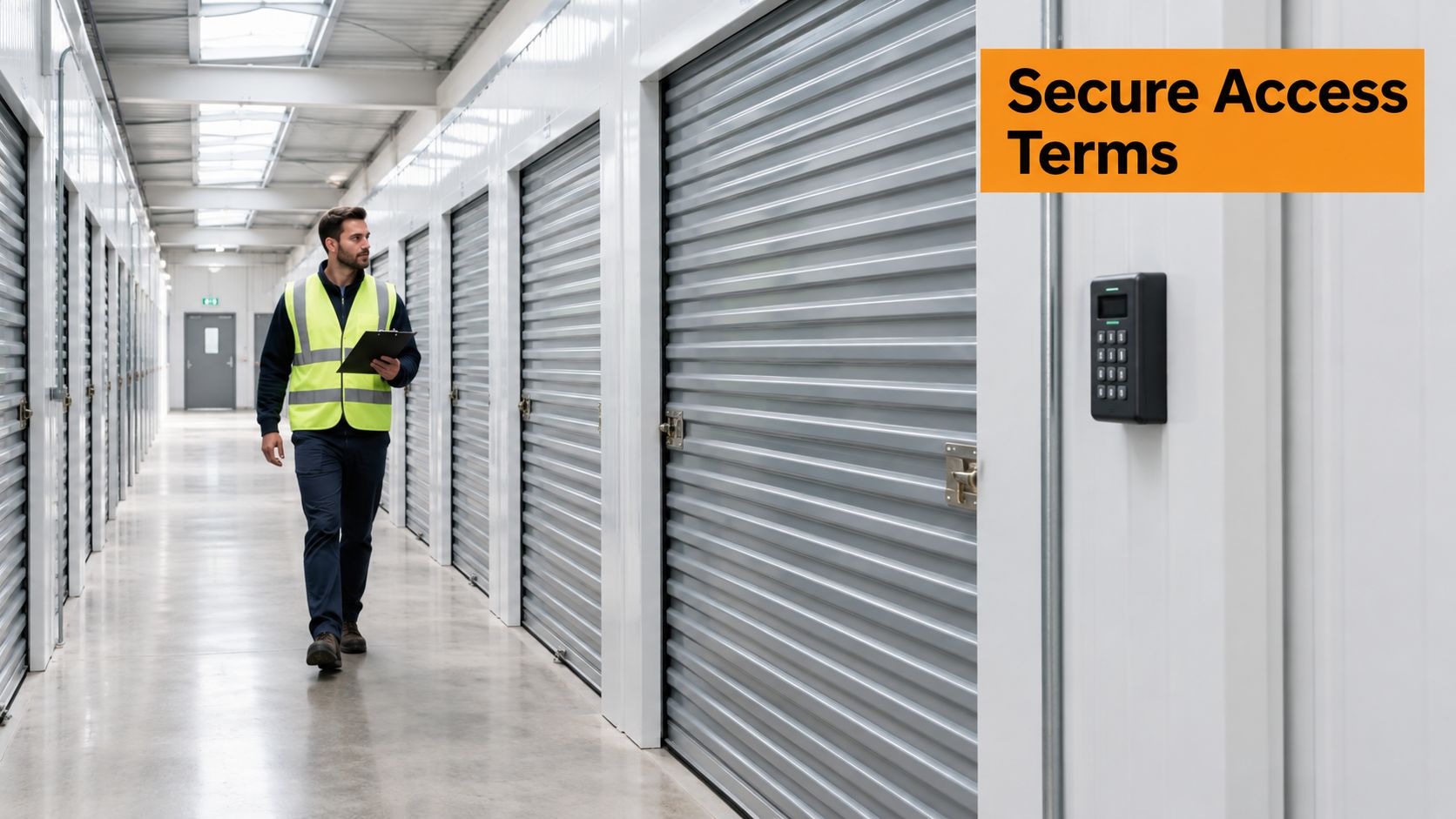
Business use is now mainstream, not an exception sites tolerate. UK self-storage data showing the sector exceeds 2,800 stores and 60 million square feet, with commercial users including small and online businesses occupying around 34% of space. You're entitled to expect a site set up for traders, not just household overflow.
Your Pre-Signing Verification List
Check these points in writing, not from a sales conversation.
- Security basics: Confirm 24/7 CCTV, controlled gated access and perimeter fencing cover your unit and loading area.
- Access hours: Verify you can reach the unit when couriers and customers need you to, including early mornings during peak.
- Loading practicality: Test drive-up access, turning space and whether shelving or racking can be rented or bought on site.
- Insurance position: Establish what's covered, what isn't, and whether your own business policy must note the storage address.
- Contract flexibility: Confirm notice terms, deposit, admin fees and whether you can change unit size without penalty.
- Booking process: Check whether you can reserve, book and move in online rather than waiting on office hours and paperwork.
Standby Self Storage in Horsham is one local reference point for that checklist, offering secure perimeter fencing, CCTV monitoring, controlled access, online booking and flexible terms with no notice period. Use that capability set as your benchmark whoever you choose.
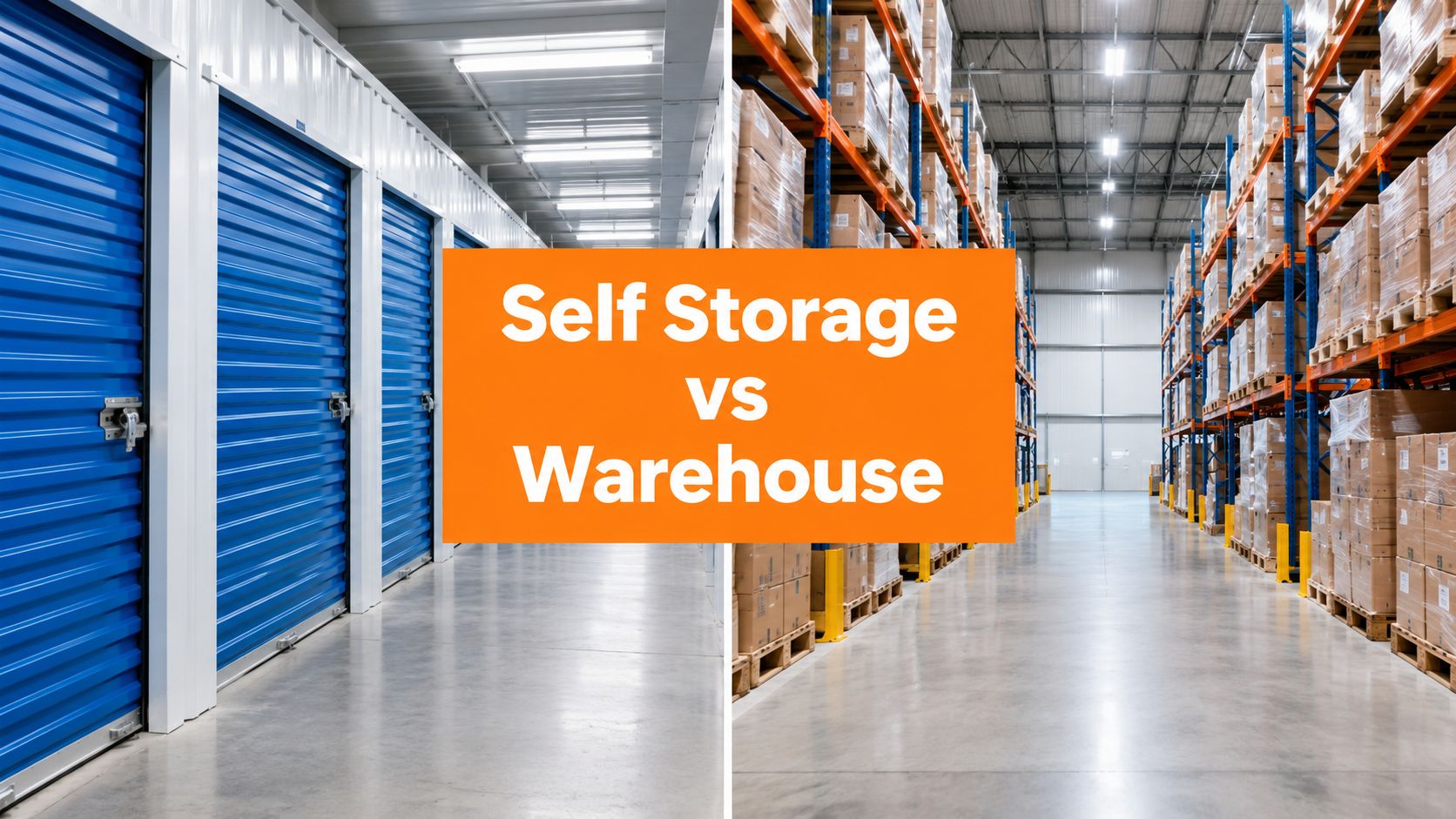
Comparing self storage versus warehouse rental usually settles the decision for small sellers. A warehouse gives you scale you may not need, tied to a commitment you definitely don't want yet. Self storage gives you a secure, flexible base while your order volume is still proving itself. Choose the warehouse when palletised deliveries and staff make a unit unworkable, not because it sounds more serious.
Designing an Inside-the-Unit Fulfilment Workflow
Treat your unit as a small warehouse from day one. Informal shelving and memory-based locations work for a handful of products. They collapse the moment you add variants, a helper, or a second sales channel.
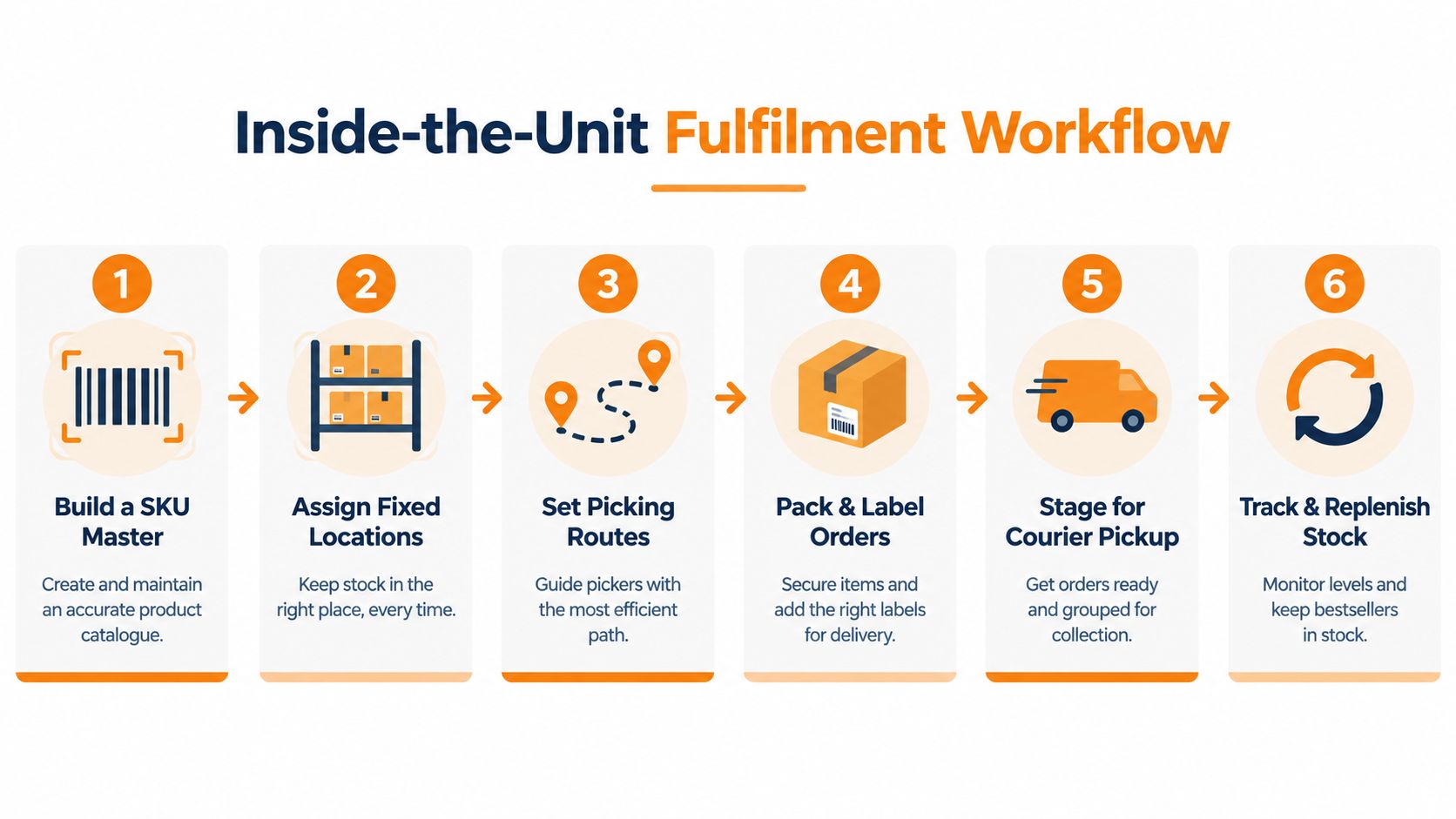
The Six-Step Operating Sequence
- Build a SKU master: Record dimensions, weight, supplier and reorder point for every product before it enters the unit.
- Assign fixed locations: Give every SKU a named bin or shelf position. One SKU per bin, no exceptions for similar-looking variants.
- Place fast movers nearest dispatch: Your bestsellers should involve the fewest steps between shelf and packing bench.
- Scan every movement: Use barcode scans for receipts, picks and adjustments. If scanning feels excessive for your size, at minimum record movements the same day, in the unit.
- Run ABC cycle counts: Count high-value and fast-moving A items most frequently, slower lines less often, on a rolling schedule rather than one annual stocktake.
- Reconcile before replenishing: Match physical counts to your ecommerce platform before reordering, so you don't buy stock that's sitting mislabelled two shelves away.
Benchmarks show why this discipline pays. The 2025 Descartes Warehouse Performance Benchmark reporting an average stock-take count of 1.00 for Peoplevox users and mean time to ship of roughly 28–35 hours, versus 1.56 hours for a high-performing UK online retailer. That gap isn't about warehouse size. It's about location control and process. A Horsham seller in one unit can ship fast precisely because the distances are short, if the stock data is trustworthy.
Define your measures clearly. Track inventory accuracy as correctly counted SKU locations divided by audited locations, and track order-line accuracy separately. A strong stock count can hide picking errors, and customers only experience the picking errors.
Control trigger: Investigate any SKU the moment its count is wrong. A small variance found today is a label or location problem. The same variance found at peak is cancelled orders.
Four pitfalls destroy accuracy in small units. Unlabelled overflow cartons that nobody can identify without opening them. Mixed SKUs in one bin, which guarantee mis-picks under time pressure. Receiving stock without system entry, so sellable products stay invisible online. Storing returns as available inventory, which creates phantom stock and overselling. Sealed totes, aisle and bin labels and a daily exception check control all four cheaply.
For the underlying stock disciplines behind this layout, best practices for inventory management covers the counting and replenishment habits that keep a small unit reliable as order volume grows. Adopt them before peak, not during it. You won't build a counting routine in your busiest week. You'll survive that week on the routine you already built.
Pricing Returns and Booking Your Horsham Unit
The cheapest unit per square foot is rarely the cheapest way to run your business. I make this argument to nearly every seller I advise, because headline rent is the only cost most sellers compare. Returns, mis-picks and duplicated courier trips don't appear on the storage invoice, so they get ignored until they've eaten the saving several times over.
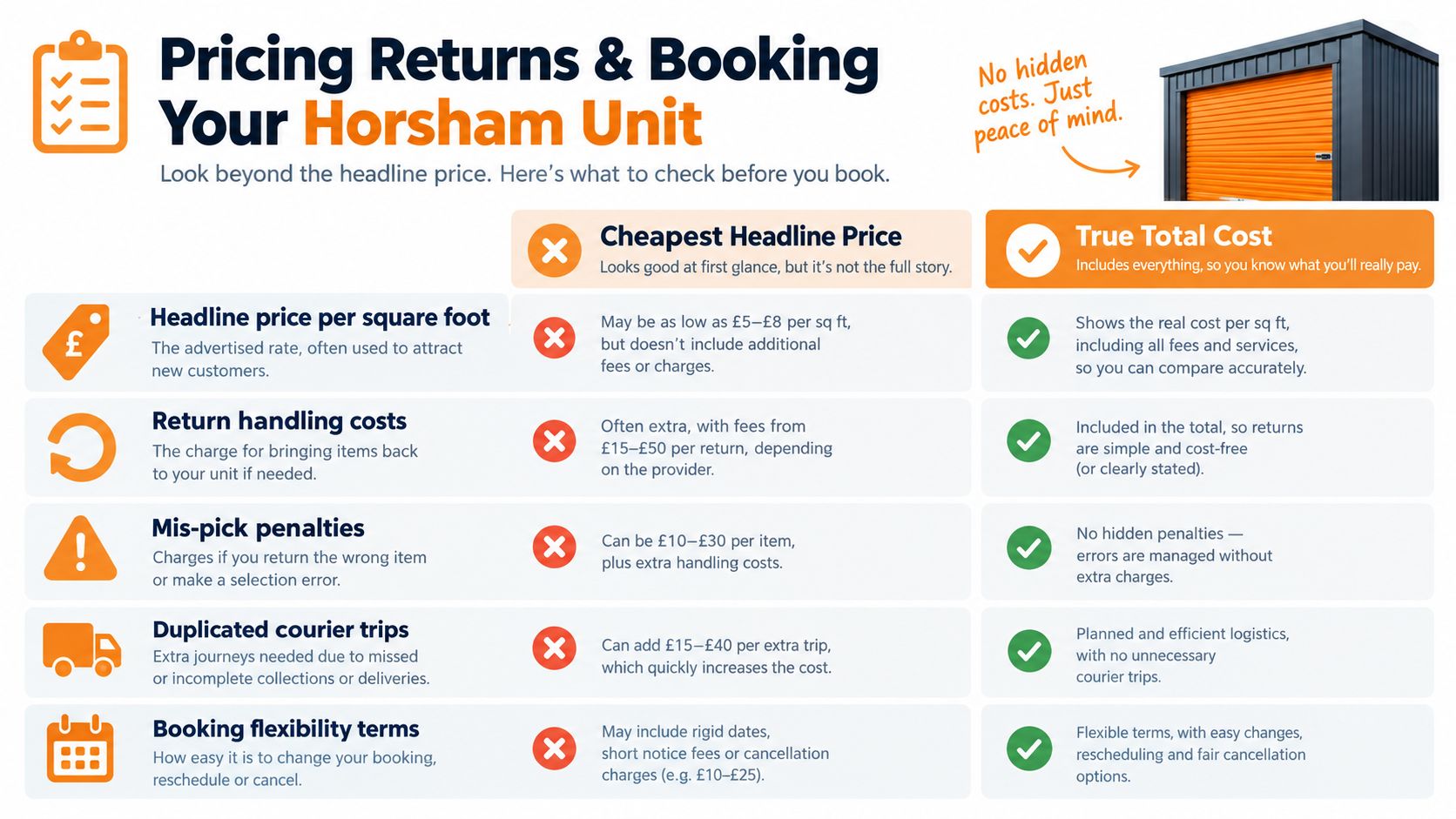
Returns are the clearest example. UK data showing non-food online returns were approximately 19.5% in 2025, with clothing nearer 23.6%, and processing costs of roughly £10–£25 per return before the refund is issued. Scale that to your own order book. At 1,000 monthly orders and a 19.5% return rate, you're handling about 195 returns, with £1,950–£4,875 in direct processing exposure, excluding lost margin, markdowns and transport. Apparel sellers face more. A unit layout that slows inspection or mixes returns with saleable stock doesn't just annoy you. It delays refunds, delays restocking and turns recoverable products into markdowns.
Run Returns as a Defined Process
- Forecast by SKU and season: Expect returns where your sales were, and staff your unit time accordingly.
- Quarantine on arrival: Barcode each returned unit on receipt and keep it out of saleable locations until inspected.
- Inspect properly: Check packaging, product condition and accessories before any inventory update.
- Grade decisively: Classify each item as Grade A resale, repair, markdown or disposal, then move it once to the right zone.
- Track weekly: Monitor return rate by SKU, return-to-stock rate, median processing time and aged returns. A spike on one SKU usually points to sizing, description, packaging or quality problems you can fix at source.
Set yourself a working target of completing Grade A processing within 48 hours and refund resolution within 72 hours, using the same returns guidance cited above. Speed here protects both cash flow and reviews.
Booking and Move-In Checklist
Book for flexibility and workflow, not sticker price. Reserve through the online portal if available, confirm access hours against your courier cut-offs, agree how collections will work, and document your insurance before stock arrives. On move-in day, install shelving, label zones and locations, load slow movers first and fast movers last, then run a first cycle count before your first dispatch. That count is your baseline. Every accuracy measure afterwards depends on it being right.
Frequently Asked Questions About Ecommerce Storage in Horsham
Are Business Goods Automatically Insured in a Unit
Don't assume so. Ask what cover the site provides, what it excludes, and whether your own business insurance covers stock away from your trading address. Get the answer in writing and keep an up-to-date inventory list with values, because you can't evidence a claim for stock you never recorded.
Can I Scale Up Just for Black Friday and Christmas
Yes, that's the strongest argument for flexible self storage over a lease. Add a second unit or a larger one for peak trading, hold promotional and forward-bought stock there, then release it when volumes normalise. Confirm availability and notice terms before peak begins, not when the stock's already ordered.
Can One Small Unit Handle Returns and Dispatch Together
It can, if zones are physically separate and returns never enter saleable stock before inspection. It fails when both functions share one bench and one pile of cartons. Separation, labelling and a grading routine matter more than raw size.
When Should I Move to a Fulfilment Partner
Move when you're spending more time packing than selling, when order volume makes daily unit trips the bottleneck, or when you need delivery speeds your own routine can't sustain. Until then, self-managed storage keeps your stock visible and your costs under your control.
If your Horsham operation has outgrown the spare room, book a unit that's designed around picking, packing and returns rather than holding boxes. Standby Self Storage offers flexible ecommerce storage in Horsham with secure access, online booking and terms that let you scale space up or down as trading changes. Visit Standby Self Storage to check unit sizes, pricing and availability, and move your stock into a workflow that can handle peak season.