The new kitchen is on a pallet in the front room and the old one is stacked in the hall, so every trip to the kettle means stepping around a cabinet door. A few streets away, a sole trader has filled the spare bedroom with stock and started eating breakfast standing up. A student has a room's worth of belongings and nowhere to put them between the end of term and the start of a placement.
Different situations, same search. Each of them needs storage units in Aylesbury for a few weeks or a few months, and each will judge the shortlist on the same three things: whether the unit fits what is going into it, whether the security is a genuine set of layers rather than one camera above the gate, and whether the rental terms let them walk away when the job is finished. Size, security, terms. Get those right and the unit fulfills its purpose. Get one wrong and you're paying every month for a space that's too small, too exposed or too hard to leave.
What Aylesbury Storage Units Are For
Demand in this town comes from ordinary transitions rather than one customer type. A completion date lands before the buyer's own sale goes through, a bathroom refit turns the dining table into a workbench, a trader's stock outgrows the spare bedroom before the order book does.
The catchment behind those transitions is large and still filling. The district formerly known as Aylesbury Vale had 174,100 residents at the 2011 UK Census, 5% more than in 2001, and the council's plan forecast about 194,000 by 2031, according to the Vale of Aylesbury Plan. Roughly half of those residents lived in Aylesbury itself, which is why a single well-placed site can serve most of the town's demand, and the area has formed part of the unitary Buckinghamshire Council since 1 April 2020.
What you're really renting: four walls that stay dry, a door only you can open, and access that doesn't depend on someone being at a desk when you arrive.
Our Aylesbury units are clean, dry, secure and purpose-built for self-storage. That counts for more than it sounds when a mattress, a sofa and a dozen archive boxes have to sit through a damp Buckinghamshire winter; indoor space keeps fabric and paper away from condensation and dust in a way a steel container in a yard struggles to match. If you're weighing a container against an indoor unit, the Pacific Mobile Structures storage container guide sets out how the two formats are built and where each one earns its place.
Three decisions decide whether the rental works. Size comes first, because a unit one step too small costs you a second move. Security comes second, and it's a stack of layers rather than a camera count. Terms and booking come third, because the cheapest month is the one you don't pay after the job has finished.
Choosing a Unit Size That Fits Your Belongings
A unit that is one size too small shows up on move-in day, when the last sofa has nowhere sensible to go. Standby Self Storage Aylesbury runs seven unit sizes, from a 32 sq ft Garden Shed to a 160 sq ft 5-Bed Home, and every unit is on the ground floor with vehicle access. The question is whether you can load, stack and reach your belongings without paying for space you never use.
The Aylesbury sizes at a glance
| Unit | Size | Typical contents |
|---|---|---|
| Garden Shed | 32 sq ft | Boxes, garden tools and small seasonal items |
| Five intermediate sizes | Stepped between 32 and 160 sq ft | Lower-middle loads such as a room plus boxes; upper-middle loads such as several rooms or a small house before the top size |
| 5-Bed Home | 160 sq ft | Contents of a large family home |
The middle row rewards a written inventory. If the list is mostly boxes and a few pieces of furniture, stay lower; if it includes white goods, wardrobes and full room sets, move up until the largest items still leave an aisle.
A sizing method that holds up
- Inventory by volume. Sofas, bed frames and chests of drawers eat height as well as floor, and most units will take a stack. Measure the tallest single item first, then plan the floor area around it.
- Group by how often you'll be back. Monthly items live near the door; yearly items live at the back. With ground-floor vehicle access, that choice decides whether a quick visit takes minutes or turns into an unload.
- Label by contents, not by room. A box marked "kitchen" tells you nothing about whether the kettle is inside it. Write what is in the box, and keep frequently used items together regardless of which room they came from.
- Keep a working aisle. Leave a clear path down one side or through the middle so you can reach any box without unloading half the unit first. A modest unit with an aisle beats a packed one you cannot step into.
- Take one size up if the timeline is open. Renovations slip and stock grows. A slightly larger unit for an extra month is usually cheaper than a second move.
How much space is normal? The UK averages 0.94 sq ft of self storage per person, according to the SSA UK self storage annual report, which is a benchmark for comparing storage intensity between places rather than an allocation to aim for. A household of four is not owed 3.76 sq ft of anything; what fits depends on furniture, hobbies and how much you have kept in case it comes in useful.
Occupancy is the other pressure. The same report describes UK storage as well occupied, and at busy times of year the smallest and cheapest sizes tend to go first, so fixing a move-in date early protects the size you chose.
The storage unit size guide pairs each size with the furniture and box counts it typically takes, which is faster than guessing from floor plans. For a second opinion on the same trade-off, TLC Moving & Storage's Gardner guide works through contents-to-size matching from an operator's point of view, and the logic travels across markets.
Two quick comparisons to finish. A student's room, meaning a bed, a desk, a chair, clothes and a dozen boxes, sits comfortably at the small end. A three-bedroom house clearance with white goods, garden furniture and full room sets belongs up near the top of the range.
Security Checks to Make Before You Rent
Cameras are the easiest security feature to photograph and the least useful one to rely on alone. A monitored system helps after an incident and can sometimes prompt a response during one, but it doesn't stop anyone walking through an open gate. What protects your goods is a set of layers, each doing a different job.
The five checks below are the ones I'd work through before signing anything.
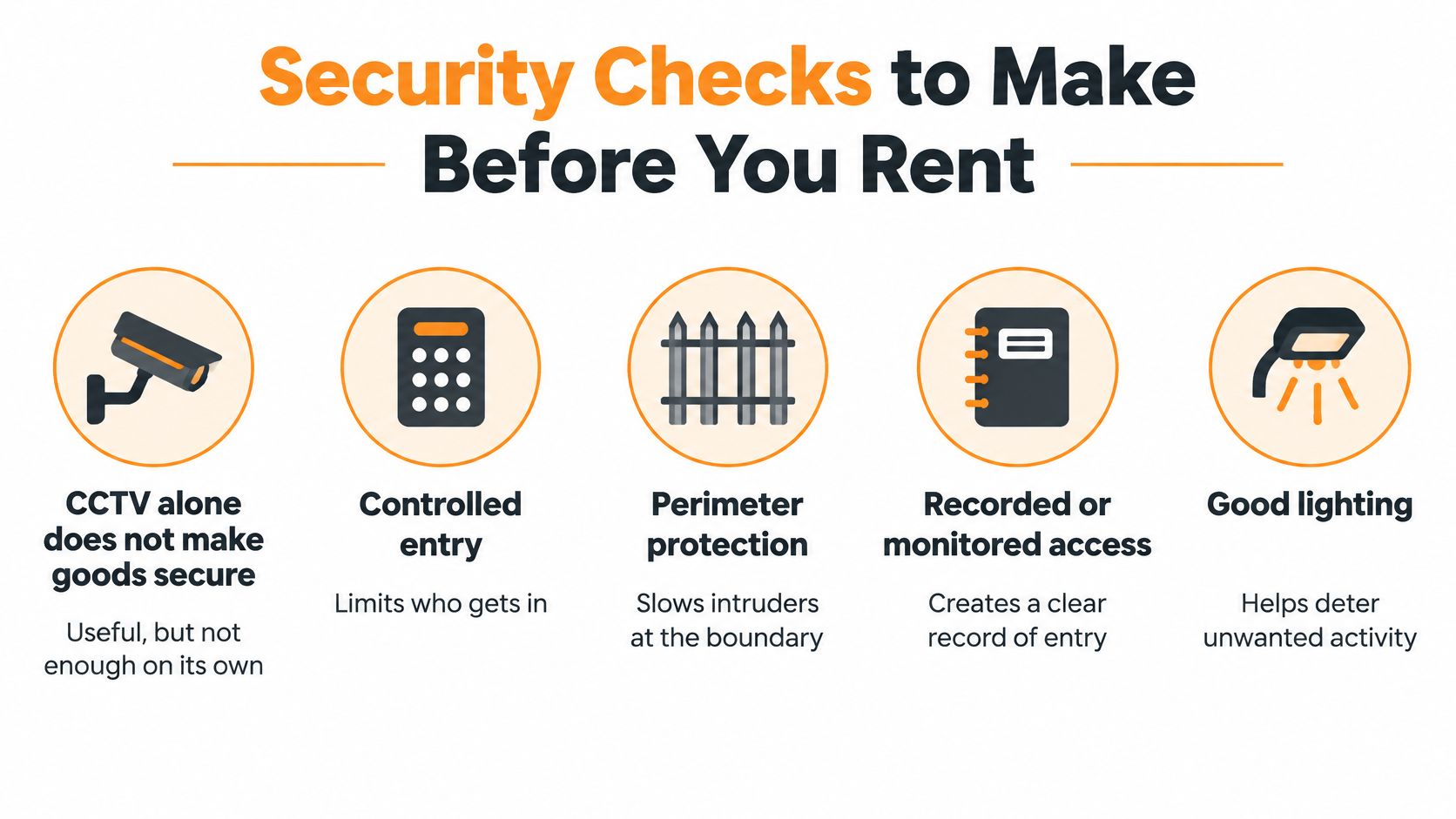
Most UK sites now claim the basics. 90.8% of facilities use monitored CCTV and 94.2% offer online booking, according to Cushman & Wakefield's 2025 UK self storage report. That's the point: when nearly everyone advertises the same feature, the feature stops separating sites and the detail behind it does the work.
What each layer actually does
| Security layer | What to confirm | Why it matters |
|---|---|---|
| CCTV | Whether footage is actively monitored or only recorded | Monitoring allows a response while an incident is happening |
| Access control | How codes or keys are issued and revoked | Former users should lose access the same day they leave |
| Perimeter | Fencing, gates and lighting | Delays intrusion and deters casual access |
| Emergency procedures | Whether they're written down and who is contacted | Keeps the response quick when an alarm or fault occurs |
| Insurance | What conditions apply to stored goods and whether cover is required | Clarifies what's covered if something goes wrong |
Business users should care most about the automation behind those layers, because the sector runs lean. The same report records an average of 2.6 staff per site, which means controlled entry and recording equipment do most of the operational work that a receptionist would do in a shop.
Ask for it in writing: a provider who answers your access, insurance and emergency questions in an email has told you something a brochure can't. One who won't, has also told you something.
For a wider view of how facilities harden a site, these storage facility security tips from Colorado Art Services cover the operational side, from lighting to logging who came and went.
Compare the answers, not the feature lists. Two sites can both tick "CCTV" while one records an empty gate and the other watches the corridors and sends an alert. If you want the longer version of this, our post on how secure self storage is goes through what each measure stops.
Flexible Rental Terms Explained
Length is the part people get wrong, and it's rarely about the unit. Three shapes of job cover most rentals. A renovation has a finish line that moves by a week or two. A house move has dates set by other people's solicitors. The gap between two tenancies has a start you know and an end you don't.
A flexible rental suits all three, provided you know how to end it. Standby Self Storage lets you cancel when the job is finished rather than tying you to a long commitment, and the current wording on notice, deposit and refunds sits in the portal, so read it before you book rather than the week you want to leave.
The questions to take into a booking
- Is there a minimum rental period? A short minimum is fine for a six-week refit and irrelevant for an open-ended move, but you need to know which you're signing.
- How is cancellation given, and when does it take effect? Ask whether the date you request is the date the charges stop, or whether there's a lag.
- Is the deposit returned, and when? Get the timing in writing, plus what would cause a deduction.
- Is there a charge for leaving early or late? Confirm both directions, because an overrun on a renovation is common.
- Does access end on the cancellation date? You want to know the last day you can physically clear the unit.
A stop date you set on day one costs nothing and saves the most common mistake in self storage: paying for an empty unit because nobody wrote the end date down.
Plan the exit while you're still planning the move-in. Put the end date in your calendar with a reminder a week earlier, empty the unit in one session rather than three trips, and confirm the cancellation in writing so the account closes on the day you expect. If you're comparing what a few months will cost at different sizes, our breakdown of self storage prices in Aylesbury shows how size and length combine.
Who Rents Storage in Aylesbury and How They Use It
Four kinds of customer fill most of the units here, and each one stores differently. Knowing which you are changes what you book and how you pack it.
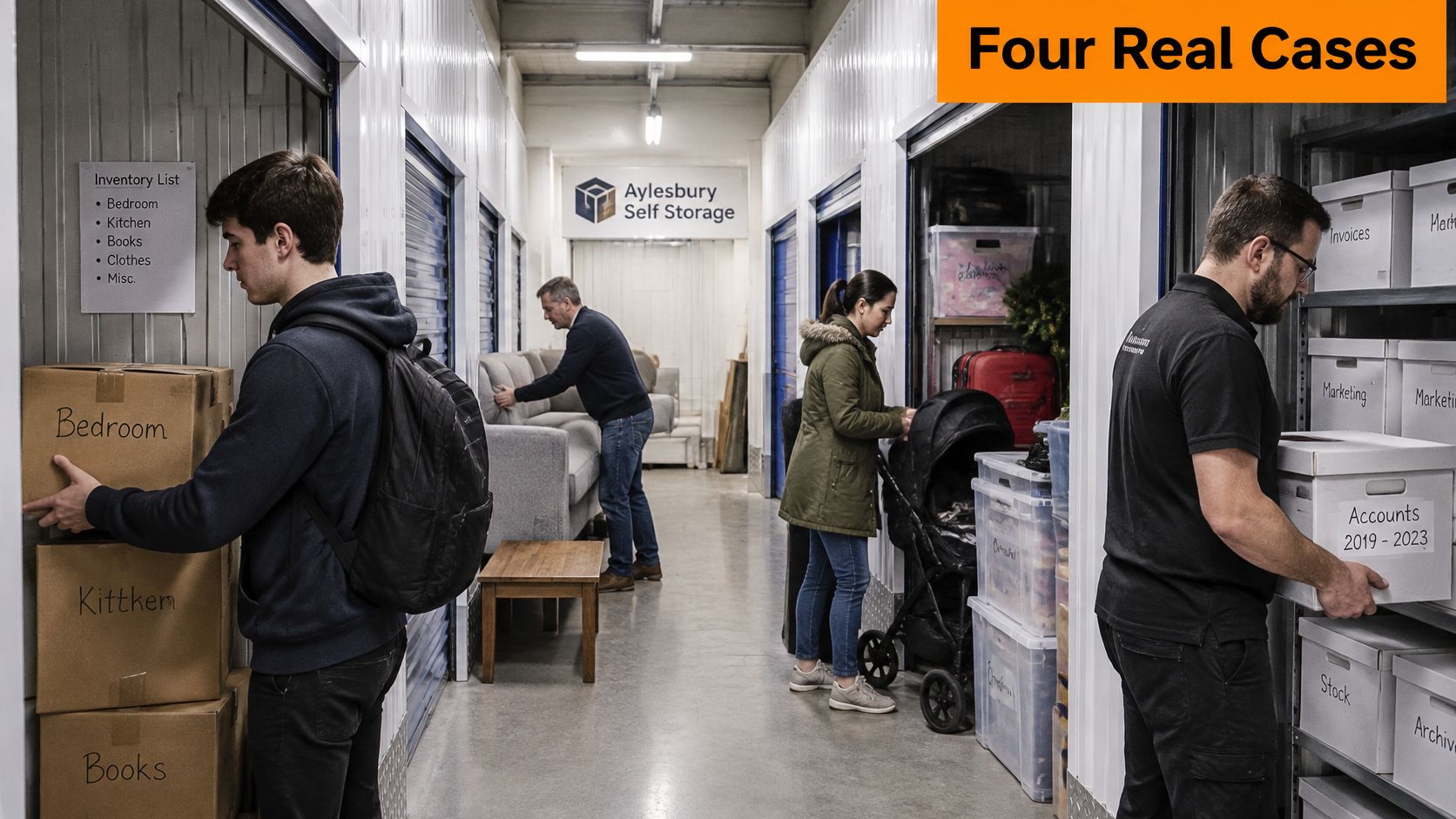
Four situations that come up again and again
A student between terms needs the smallest workable unit and a system. Boxes labelled by room, a list of what's inside taped to the inside of the door, and a note of which box holds the bedding. The mistake is packing in a hurry at the end of term and spending the first week of the next one guessing.
A homeowner mid-renovation is storing furniture they want back in the same condition, so covers matter as much as space. Dust sheets over upholstery, legs wrapped, and a route through the unit that lets the builders collect and return items without moving everything else. Book the size that lets you walk in, not the size that just fits.
A mover with a gap between dates has the most to gain from sequencing. Pack the things you'll need in the first fortnight last, so they sit at the front, and put the move-out and move-in dates on the same page before you book anything.
A small business storing stock, tools or records needs the unit to stay dry and the contents to stay findable. That means shelving or stacked labelled boxes rather than a floor-to-ceiling wall of mixed cartons.
When storage makes sense for a business, and when it doesn't
Small firms are the sector's fastest-moving customers, and the local numbers explain why. Buckinghamshire has about 30,535 businesses, and 91% of them are microbusinesses, the highest concentration among England's enterprise regions, according to Buckinghamshire Business First's 2025 business population report. The same report records the total falling 2.1% in the year to March 2025, which tells you fixed costs are biting.
| Factor | Self-storage unit | Conventional commercial unit |
|---|---|---|
| Trading model | Stock or records held, not sold on site | Space for trading, workshop or office use |
| Stock turnover | Suits slow-moving or seasonal stock | Suits stock sold and replaced regularly |
| Delivery frequency | Occasional drops and collections | Regular deliveries and customer callers |
| Term length | Set by the rental agreement, so confirm the minimum | Usually a longer fixed lease |
The contrarian point is worth making plainly. More space is not automatically better. For a microbusiness, a smaller unit plus disciplined stock rotation usually beats a larger one filled with dead inventory you're paying to house every month. Ask what your stock turn is before you size the unit around a good month.
Storage is the wrong answer in four situations. If you need customers to visit, you need a commercial unit. If you're storing anything requiring planning permission, hazardous material handling, food-safety compliance or temperature control, a standard unit isn't built for it. In each of those cases, the question isn't which size, it's whether self storage is the right category at all.
How to Book a Unit in Aylesbury
Booking takes minutes once the first two decisions are settled. Work through these seven steps in order and nothing on the list will surprise you later.
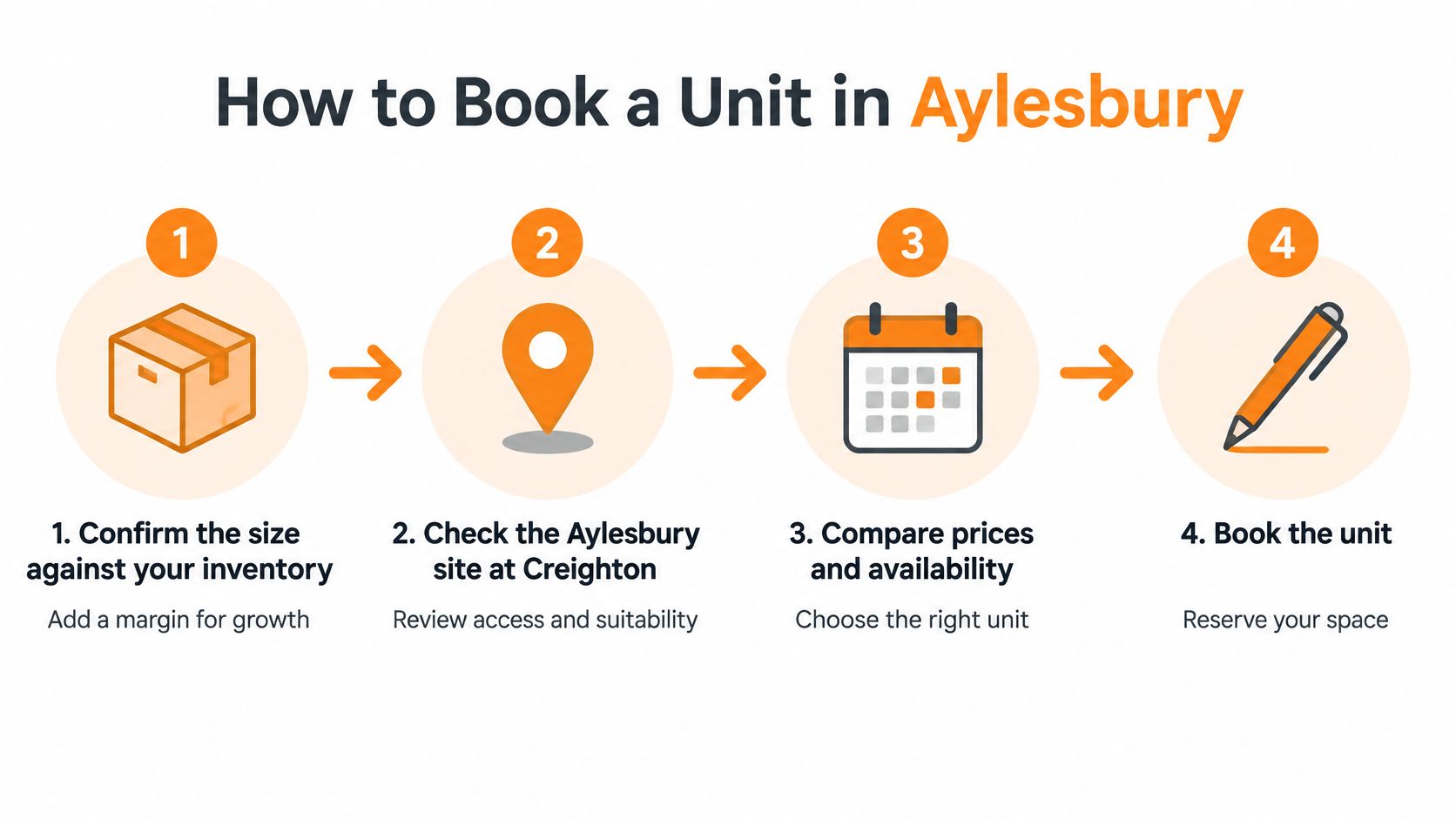
- Confirm the size against your inventory. Take the list you built and add a margin for growth, then match it to a size. The common slip is a rough inventory, guessed in a hurry, that books one size too small and forces a move three weeks in.
- Check the site and your route. We're at Creighton Road, Buckinghamshire, HP18 0QE, so plan the van, the loading time and how many trips you'll need. The slip is hiring a vehicle that's awkward for the access, then carrying heavy items further than you planned.
- Confirm the access arrangement. All our Aylesbury units are on the ground floor with vehicle access, which means a sofa or a chest freezer doesn't go up a staircase. The slip is assuming every facility works that way and discovering on moving day that it doesn't.
- Read the price and the terms in the portal. Check the minimum period, the deposit, the cancellation rules and what happens to access at the end. The slip is skipping the exit terms because the entry price looked right.
- Book online and lock in your move-in date. The booking creates your access record and your invoice, so set a date you'll use rather than a placeholder. The slip is booking a provisional date and forgetting to change it when the move shifts.
- Move in with a loading plan. Heavy items at the back, labels facing the aisle, one session rather than three. The slip is loading the light boxes first because they were nearest the door, then rebuilding the unit around them.
- Save the stop date and check your access details. Put the end date in your calendar and keep the confirmation email where you'll find it. The slip is forgetting the stop date and paying for a unit you emptied a fortnight ago.
A well-booked unit looks unremarkable from the outside. Inside, it has a confirmed size with a little headroom, a ground-floor door you can back a van up to, written answers on security and insurance, terms you've read, and a stop date in the calendar. That's the whole job.
Shortlist one size with a spare option behind it, check live availability in the portal for the date you need, and use the phone or web chat if anything about access, cover or cancellation is unclear. Sort those out before you book and moving day becomes a loading exercise rather than a negotiation.
Standby Self Storage runs its Aylesbury site on the three decisions above: a size that matches what you're storing, security answers you can get in writing, and a rental you can end when the job ends. If you know what's going into the unit and when it's coming out, the rest is a short booking form and a loading plan. Visit Standby Self Storage to see current availability, read the terms in full and reserve the move-in date that fits your schedule.