The spare bedroom in your West Molesey house stopped being a spare bedroom about a year ago. It's a desk, a monitor and two filing boxes now. The garage holds everything else: the dining table from the flat you sold, a bike nobody rides, and the cartons you labelled "kitchen, misc" and haven't opened since. The loft conversion starts in three weeks, and the builder wants the garage clear.
That middle state, where belongings have nowhere to live but aren't ready to be thrown out, is what storage units in Molesey are built for.
What a Molesey Unit Solves and What It Cannot
You've exchanged contracts on a terrace in East Molesey, completion is five weeks out, and the removals firm wants the sofa, the wardrobe and eleven boxes out on Friday. The rented flat goes back to the landlord on Saturday. That gap, measured in weeks rather than months, is the classic local case.
Molesey is a dense place to solve it in. The 2021 Census recorded approximately 20,533 residents across 5.87 square kilometres, about 3,498 people per square kilometre, on the south bank of the Thames roughly 19 kilometres from Charing Cross (Molesey population and housing profile). Elmbridge's population rose 6.0% between 2011 and 2021, from around 130,900 to 138,800, and private renting climbed from 15.1% to 17.5% of households over the same decade. That mix produces short-notice moves and tenancy gaps by its nature.
A storage unit is a lockable room inside a fenced, access-controlled site, rented by the week or month, with you holding the only key. It handles five jobs well: the gap between exchange and completion, a spare room turned into an office, a tradesperson's tools, an online seller's stock overflow, and a student's belongings over the summer. It doesn't handle three things: poor packing that lets damp in, insurance cover you haven't arranged, and a decluttering problem you'd rather not face.
Five decisions settle the rest: size, security and insurance, access and terms, cost over three months, and protection from damp and flood. Take them in that order and the booking takes an afternoon.
Matching a Unit Size to What You Are Storing
Start with the table. The eight rows below map the common sizes from a locker for a wardrobe's worth of clothes up to a unit that swallows a five-bedroom house.
| Size | Typical dimensions | What it holds | Best for |
|---|---|---|---|
| 20 sq ft | 5ft × 4ft | A few boxes or a wardrobe's worth of clothes | Students, lockers, spare furniture |
| 30 sq ft | 5ft × 6ft | Studio flat contents without white goods | First moves, decluttering, short tenancy gaps |
| 40 sq ft | 5ft × 8ft | One-bedroom flat, part contents | Renovations, between tenancies |
| 50 sq ft | 5ft × 10ft | One-bedroom flat, full contents | Moves, landlords between lets |
| 60 sq ft | 6ft × 10ft | One-bed flat with appliances, or small stock | Tradespeople, small businesses |
| 80 sq ft | 10ft × 8ft | Two-bedroom flat or a small house | Family moves, e-commerce stock |
| 100 sq ft | 10ft × 10ft | Three-bedroom house contents | Full house during renovation |
| 160 sq ft | 20ft × 8ft | Five-bedroom house or substantial business use | Whole-house moves, business warehousing |
Guessing from the table alone goes wrong in one direction: people book small, then discover the sofa fits but the walkway to reach it doesn't. Here's the method that gets a reliable row.
- Walk each room with a marker pen and three labels. Every item gets keep, store or go. Be honest about the go pile, because it shrinks the unit more than any discount will.
- Measure the three bulkiest pieces, not the room. The sofa's length, the wardrobe's height and the mattress's width decide whether the unit works. So does door width.
- Count the boxes and total the floor they occupy, stacking no more than four high. Stable stacks beat tall ones, and the 20 sq ft row is defined by a box count you can carry.
- Add 20 to 30% headroom for aisles, airflow and the things you buy after the move. A packed unit with no air gap is a damp unit.
- Size up rather than stack to the ceiling. An extra row on the price list is cheaper than replacing a mattress that got crushed or a printer that fell.
Check the result against the anchors: a studio's contents fit the 30 sq ft row without white goods, a two-bedroom flat or small house needs 80 sq ft, and a five-bedroom house needs 160 sq ft. Two adjustments catch most mistakes.
The door-width rule: a narrow unit door will not admit an American fridge-freezer however much floor sits behind it. Ask for the clear opening width in centimetres before you book.
A partial move, say a flat's contents minus the furniture going to a family member's spare room, usually needs one row smaller than a whole-house estimate. A tradesperson storing tools plus racking should go one row up, because racking wastes the floor area it stands on. Our storage unit size guide walks the same logic through each unit we offer, and if you're clearing a room to rebuild it as a study or boot room, you can browse built-in shelving and cabinetry ideas to help you decide what comes back into the house and what stays in storage.
How Security and Insurance Work on Site
"Secure" appears on every storage page and is almost never defined. A good site gives you perimeter fencing, gated entry, cameras covering corridors as well as the gate, an access log, and motion-sensor lighting. None of that touches the temperature inside your unit. Security and insurance are two different risks, and confusion starts there.
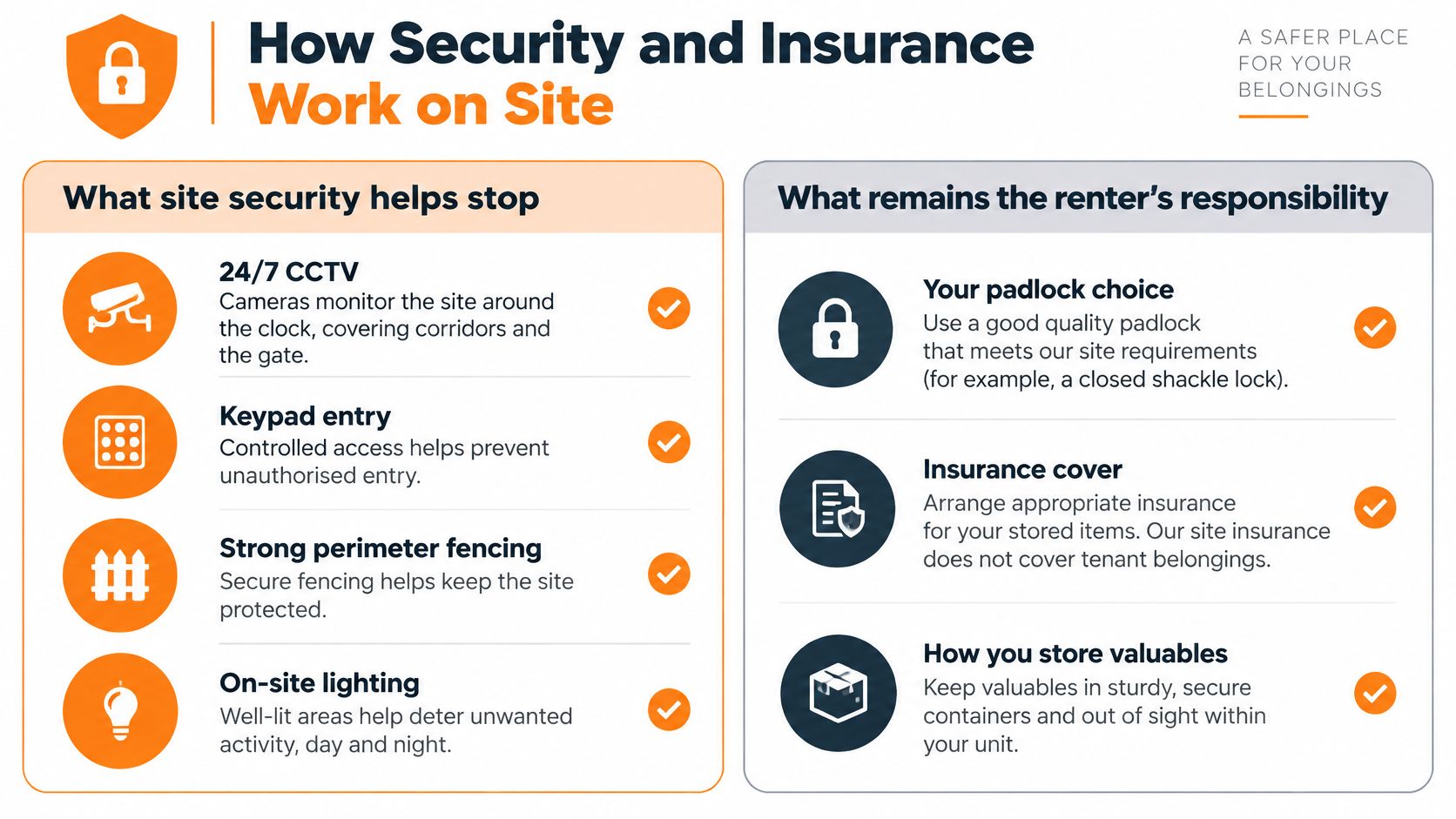
| Feature | What it stops | What it does not cover |
|---|---|---|
| 24/7 CCTV on entrances and corridors | Break-ins and disputed incidents | Damp, condensation or pests inside your own unit |
| PIN or fob access control with an entry log | Tailgating and unauthorised entry; records who was on site | Anyone you have shared your PIN with |
| Perimeter fencing and gated entry | Casual intrusion and after-hours loitering | Theft from an unlocked or poorly padlocked unit |
| Motion-sensor lighting | Concealed activity after dark | Bad packing that traps moisture or attracts pests |
| Your own padlock and key | Anyone opening the unit without your knowledge | Lost keys, unless the site can cut and replace the lock |
| Staff on site during opening hours | Deliveries, queries and first-line incidents | Out-of-hours incidents unless monitoring is live |
The right-hand column is the one that costs people money. A camera records a broken lock; it does nothing about a leather sofa stored against a cold concrete wall for eight months.
Insurance is where the gaps widen further. Which? on getting the most out of self storage reports that storage cover isn't legally mandatory, but that providers can require it, and it warns customers to check what each policy demands. The same guide notes specialist FCA-regulated alternatives can be more economical, and cites sector data showing that almost half of container-storage operators offer no insurance option at all.
So assume nothing. Check the declared value against replacement cost, not what you paid. Read the exclusions for moisture and condensation, theft from an open unit, business stock, tools and documents. Then confirm whether your home contents policy already extends to goods held in storage. That's the same principle set out in the Stay Norwich Apartments host cover guide: the building's cover protects the building, and your goods need their own arrangement.
One habit serves both insurance and any later claim. Photograph every item before it goes in, note the value and the date, and keep that list somewhere other than the unit. A claim with photos and dates moves; a claim from memory stalls. Our guide to how secure self storage really is covers the site-side features in more detail.
Access, Location and Flexible Terms to Check
Three sets of questions decide whether a unit works week to week, and every one of them can be asked on a viewing.
Access
Ask whether entry is 24-hour or limited to staffed hours, and get the answer in writing if you work shifts or run deliveries. Ask for the clear door width of the unit and the corridor. Ask whether trolleys and a lift are available, and whether a ground-floor unit with vehicle access lets a van reverse close to the door. That last point is the difference between one trip and six.
Location and loading
Our Molesey facility sits at 4 Island Farm Avenue, Surrey, KT8 2UZ, a short drive from East and West Molesey, Hampton Court, Thames Ditton, Esher and Walton, with the A3 and M25 close by. Ask about parking and loading space at busy times, particularly month-end when several customers turn up with vans at once. A site that's easy to reach but impossible to park at costs you an hour per visit.
Terms
Read the minimum term, whether the agreement is a rolling monthly licence, and how much notice you give to leave. Ask when and how often the rent can be reviewed, and whether you can move to a larger or smaller unit mid-move without signing a new contract. Our rentals run without notice periods or long-term commitments, so leaving is a cancellation rather than a negotiation.
The question many people forget concerns access restrictions. Ask what happens during a flood event or site maintenance, whether entry is suspended, and what happens to the rent if it is. Get that answer before you sign, not during the week the river rises.
What You Pay For and How Prices Are Built
Storage is a large, established market, which matters because it means pricing is competitive and the offers are real. A 2025 industry report based on 2024 data counted 2,915 self-storage stores, around 64 million square feet of space and roughly 1,480 operators, with industry turnover just under £1.2 billion and average occupancy at 75.1% (UK self-storage industry report). Domestic customers accounted for 73% of UK storage space, and 40% of domestic users were renting during a move.
That tells you who you're bidding against for space: people in the middle of moving house, exactly like you. What the report won't tell you is what your first three months cost, because the headline rate isn't the total.
| Charge | How it usually appears | What to check |
|---|---|---|
| Rent | Weekly rate, billed monthly | What the rate reverts to when the introductory offer ends |
| Deposit | Typically one to four weeks' rent | Refund conditions and how long the return takes |
| Administration fee | One-off charge at sign-up | Whether it is waived for online bookings |
| Padlock | Sold on site, or bring your own | Disc lock versus padlock; insurance may require a specific type |
| Insurance | Weekly or monthly premium | Whether home contents cover already extends to goods in storage |
| Packaging | Boxes, tape, bubble wrap and covers | Whether the site stocks them, and the bulk-buy alternative |
| Access and vehicles | Included, or charged for parking and van hire | Whether 24-hour access and loading bays cost extra |
Five questions turn four quotes into a comparison you can trust.
- Ask every provider for the total cost of months one, two and three. One number each, in writing.
- Ask what the rate reverts to when any introductory offer ends, and the date it changes.
- Ask whether the deposit is refundable, and how long the return takes once you've moved out.
- Ask whether the administration fee is waived for online bookings. Many sites would rather have the self-service booking.
- Ask whether loading bays and 24-hour access are included or charged. These are the lines that add a tenner a week.
The comparison rule: a cheap first month can cost more than a higher headline rate across a full three-month stay. The three-month total is the only fair comparison.
Local demand, floor area, ground floor versus upper floor, power and lighting, vehicle access and length of stay all move the price. None of them are worth arguing about until you've settled the three-month figure. Our guide to storage unit costs near you breaks the same lines down charge by charge.
Protecting Paperwork, Stock and Damp-Sensitive Goods
A padlock doesn't stop humidity. This is the part of storage that damages the things people can't replace, and it splits into three practical jobs.
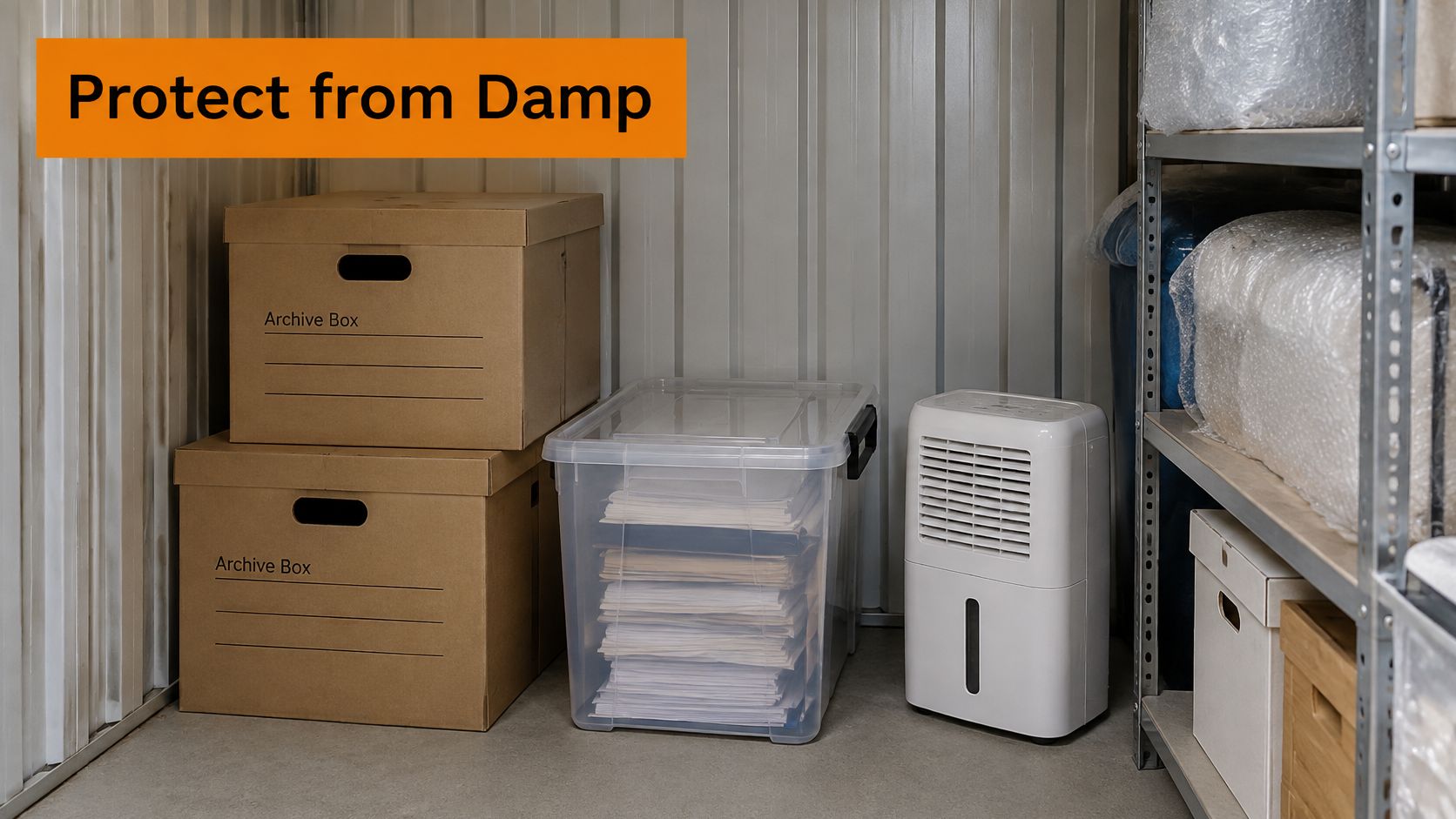
Paper, contracts and archived files
The National Archives identifies roughly 13 to 20°C and 35 to 60% relative humidity as a suitable broad range for sensitive mixed archival material, and its guidance warns that humidity above 65% lets mould germinate and spread while prolonged humidity below 40% makes paper and parchment brittle (The National Archives environmental management guidance). Stable conditions matter as much as the readings themselves, because repeated seasonal swings make materials absorb and release moisture.
So: acid-free or archival boxes, cartons raised off the floor and away from external walls, a periodic inspection, and a temperature and humidity data logger if the files must survive several years. A dehumidifier helps in a persistently damp unit, but it needs maintenance to avoid leaks and secondary water damage.
Flood risk on the Thames and the Mole
GOV.UK's flood-warning areas cover the Thames at East and West Molesey and the River Mole around Esher and East Molesey, and the service treats river, sea and groundwater flooding as separate risks with postcode-level status and five-day forecasts (GOV.UK flood warning area for Molesey). A clear forecast today isn't proof the unit is flood-free.
Put vulnerable goods in sealed plastic totes, stand stock on pallets or shelving above floor level, and keep a digital copy of anything irreplaceable off site. Before signing, ask about floor level, drainage and emergency response.
Textiles, leather and electronics
These need breathable covers, not plastic sheeting pulled tight, which traps condensation against the surface. Upholstery and mattresses go on their edge with air around them, not flat against a wall. For sealed totes holding paper or textiles, size the desiccant to the box volume rather than guessing, and the Material Handling USA desiccant sizing guide sets out the ratio.
What You Must Not Store in a Unit
Some items a unit won't hold safely or legally, and the cost of finding out is a voided policy or a terminated licence.
The excluded list at most sites covers perishable food and anything that rots or attracts pests, flammable liquids, gas cylinders, paint and fuel, cash, jewellery and valuables that insurance excludes or caps, live animals and plants, and hazardous or regulated stock. Each site's terms set the definitive list, so read the prohibited-items clause before you pack rather than after.
Trade and e-commerce users need a second check, because tools and stock often contain batteries, chemicals or residual fuel. Confirm in advance that the goods aren't restricted.
Three questions before anything goes in the van:
- Is it perishable, or likely to attract pests?
- Is it flammable, gas, or hazardous in any way?
- Is it cash, valuables, or something the policy excludes?
Any yes goes to a different solution: a home cupboard, a safe, or a specialist provider.
Book Your Unit and Move In With Confidence
Seven steps take this from research to a unit you can use this week.
- Shortlist one or two sites and view the actual unit. Look for water staining, a damp smell, a door that opens cleanly and a corridor wide enough for your bulkiest item. A photograph of the size guide is not the size.
- Confirm what's included: padlock, insurance, access hours, power and lighting. Write it down.
- Book online for a specific move-in date and ask for the three-month total in the same message.
- Bring photo ID, payment and a disc padlock if the site requires a specific lock type.
- Pack to the unit's shape, heavy items at the base, a walkway down the middle, and the things you'll need first nearest the door.
- Photograph the empty unit on day one, then file those photos with the contract and the inventory you made before packing.
- Review the size after three months. If you're climbing over boxes to reach the back, move up a row; if half the floor is bare, move down.
For the final step, our Molesey site offers ten unit sizes from 20 sq ft to 160 sq ft, currently with 50% off the first two months, and rentals that end when you say so rather than at the close of a fixed term.
Standby Self Storage's Molesey site has ground-floor units with vehicle access, power and lighting, boxes and packaging on the shelf, plus customer toilets and a mailbox service, so a move or a stock drop doesn't turn into a day of errands. Book online for a date that suits you, or come and walk the unit you're considering before you commit. Start at Standby Self Storage.