

The tenancy ends on Friday, your next room won't be ready until September, and your belongings are somehow spread across a bedroom, kitchen and hallway. Going home may not be practical, particularly if you're moving abroad, starting a placement or studying in another city. Paying for a room you can't use can feel simpler, but it may be one of the most expensive ways to solve a short storage gap.
I learned this through several student moves. The smoothest transitions started with checking dates, counting possessions and comparing the total cost, not just the monthly storage price. Student storage between tenancies works best when you treat it as part of your move planning rather than an emergency arranged after checkout.
Navigating the Gap Between Student Lettings
The UK student housing cycle creates a recurring gap between where you need to live and where your possessions can stay. HESA data cited in parliamentary evidence recorded 2,356,915 students studying in the UK during the 2022–23 academic year, with 54%, or 1,265,170 students, living in rented accommodation. That rented group included 731,790 students in ordinary off-street housing and 533,380 in purpose-built student accommodation (parliamentary evidence on UK student accommodation).
A private house, flat or hall usually comes with a fixed checkout date. Your next contract may begin later, or you may not know the address until after exams, a placement decision or an overseas study arrangement is confirmed. Returning everything to your family home isn't always possible, especially when distance, travel costs or limited space are involved.

Practical rule: Treat the checkout date and the next move-in date as two separate appointments. The space between them needs its own plan.
The mistake I made on an early move was assuming that a few days of uncertainty would resolve itself. It didn't. Friends had their own move dates, landlords wanted rooms cleared and transport became harder to arrange at short notice. A written inventory and an early storage quote would have saved both stress and rushed decisions.
The basic principles also apply beyond the UK. If you're comparing approaches to temporary furniture storage, these options for furniture storage in NSW offer useful context on assessing space, access and duration. The location differs, but the decision remains the same: identify what must be stored, for how long and who will move it.
The Hidden Cost of Summer Accommodation
Paying for a room through the summer can feel cheaper than arranging storage, especially when your belongings are already packed inside it. That calculation changes if the agreement charges rent while limiting access, banning overnight stays or requiring you to remove everything. Before treating the room as storage, ask the accommodation provider to confirm in writing what July and August payments include.
I learned this after several student moves. An apparently convenient room can become paid space you cannot use, while transport and external storage remain separate expenses. In 2025, average UK student rent was reported at £563 per month, with average rents of £615 in university halls and £650 in private halls. The same Vordex's student tenancy agreement review reports an average new deposit of £387, while 15% of surveyed students who had paid a deposit said they had struggled to get it back. One inaccessible month in university or private halls can therefore cost more than £600, before moving or storage costs.
Compare the complete cost of each arrangement:
- Unused accommodation: Count rent during restricted access, along with fees for extending or changing the agreement.
- External storage: Include the unit, collection or delivery, packing materials, insurance and travel to the facility.
- Moving twice: Budget for the time and transport required to remove possessions from the old property and deliver them to the next one.
- Cash-flow pressure: A new tenancy deposit may be due before the previous deposit is returned, leaving less money available for transport or storage.
Use this UK storage cost guide to see which factors shape a storage quote. Then compare the delivered total with rent for accommodation you cannot access. For international students, include travel, visa timing and uncertain arrival dates. A room that looks convenient on paper may cost more than storing your belongings externally until you can use them again.
Comparing Your Storage Options
There isn't one correct answer for every student. The right option depends on how much you own, whether you need access during the gap, how far you're travelling and whether another person can reliably help.
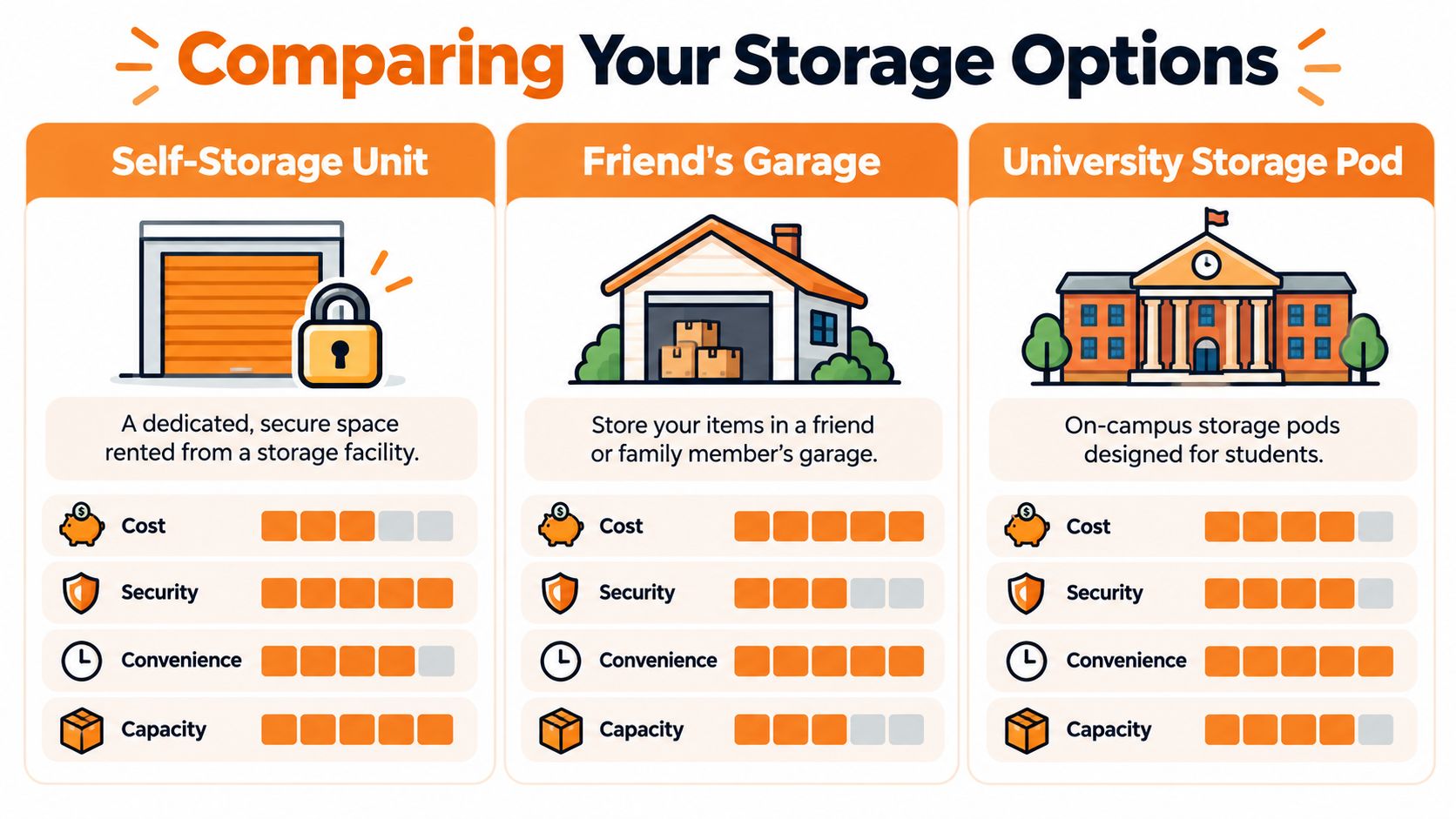
| Option | Cost | Effort | Main risk | Works well when |
|---|---|---|---|---|
| Self-storage unit | Paid, with the price shaped by size, location and duration | You arrange transport and loading | Choosing too much space or overlooking insurance terms | You want controlled access and a clear end date |
| Friend's garage | Often free or informal | Usually requires several favours and a suitable vehicle | Disagreements about access, damage or timing | The arrangement is written down and the gap is short |
| University storage pod | Varies by provider and capacity | Often simpler than arranging a private move | Limited availability, collection windows or restricted access | The provider covers your route and dates |
A friend's garage can look like the obvious saving, but free storage isn't free if it requires multiple long journeys, inconvenient collection times or replacement accommodation for items that don't fit. Agree in writing where everything will go, who can access it, what happens if plans change and how damage will be handled. Housemate consolidation can reduce transport costs, but it also creates shared liability.
A university pod may reduce the amount of organising you do, although you'll need to check its collection process and terms. A private unit gives you more direct control, which can help if your next tenancy date changes.
Whatever you choose, use proper cartons rather than loose bags. A supplier such as Storage & Removal Boxes Ltd offers home removal boxes and storage supplies, which can make stacking and labelling easier. For smaller loads, compare nearby facilities and formats using this guide to temporary storage near you. The useful comparison is the total delivered cost and effort, not the headline monthly rate.
Picking the Right Unit and Location
Start with an inventory, not a unit size. Bedroom dimensions are a poor guide because they include space you may not need to store, while a shared house often contains communal furniture and kitchenware that belongs to several people. Count actual items and separate them into boxes, suitcases, bedding, kitchen equipment, bicycles, small furniture and fragile goods.
Build a realistic capacity estimate
Write down how many cartons you have, then measure the awkward items. A bicycle, desk or shelving unit can determine the layout even when the total number of boxes looks modest. Disassemble anything designed to come apart, and keep screws in a labelled bag attached to the relevant item.
HEPI reports that university accommodation averages about 40 weeks, private purpose-built student accommodation about 46 weeks, undergraduate contracts commonly run 38–44 weeks, postgraduate contracts 50–51 weeks, and HMOs range from 40–52 weeks (HEPI's student accommodation report). Those differences affect the storage period, but they don't tell you how much space your belongings occupy. Your itemised list does.
Assess the facility as well as the unit
Choose a location that keeps transport manageable from your current property or your next home. Check whether the vehicle can park close to the entrance, whether the access route includes stairs or lifts, and whether you can load without rushing through a narrow collection window.
Ask about access hours, controlled entry, CCTV, insurance requirements, cancellation terms and unit access during the rental. A cheaper facility becomes less useful if a friend collecting your boxes can't enter, or if the unit is too far away for a second trip. If you're comparing two sizes, sketch the inventory on paper and leave a route to the back. A tightly packed unit may hold everything, but it won't let you reach the suitcase you forgot to keep accessible.
Measure the load, not the bedroom. Capacity is determined by the possessions you're taking with you, not the floor area you occupied during term.
Smart Packing and Moving Strategies
Good packing reduces two problems at once, damage and wasted space. Start by removing anything you won't use again, then clean clothes, kitchenware and sports equipment before boxing them. Dirt and damp become much harder to deal with after months in a closed container.
Pack in an order that helps later
Create a simple inventory as you go. Give each box an identifier, record its category and photograph the sealed box before it leaves the property. Label at least two sides, because one side will usually face a wall or another carton.
- Travel essentials: Keep passports, identity documents, medication, course materials and clothes needed before the next move with you.
- Fragile items: Wrap crockery, mirrors and delicate equipment in protective material, then fill empty spaces so contents can't shift.
- Electronics: Use rigid cartons and padding. Keep cables with the relevant device, and don't leave laptops or other valuable electronics loose between heavy boxes.
- Daily-access boxes: Put bedding, towels, basic kitchen items and one change of season in a clearly marked carton near the front.
- Heavy goods: Load books and dense kitchenware low down. Don't overload cartons to the point that their bases bow or handles tear.
- Furniture: Disassemble desks and shelving where possible, protect edges and attach fasteners to the frame.
Don't store perishable food, hazardous materials or important documents. Keep identification and essential paperwork with you, even if the storage facility offers strong security.
Schedule collection before the property's final handover, not during the last hour. Leave enough time to sweep the room, check cupboards and photograph its condition. For a separate end-of-tenancy checklist, Top Cleaners' tenancy cleaning tips can help you organise the final clean without mixing it into the packing process.
For a compact load, this guide to student box storage can help you think about cartons and access instead of automatically booking a full room-sized unit. The principle is straightforward: store only what you'll use again, protect the vulnerable items and leave a clear record for your future self.
Booking Your Storage and Final Checks
Book storage once your next tenancy is confirmed and its move-in date is reasonably clear. Parliamentary evidence on student renting notes that students commonly sign PBSA and private-rented tenancies 6–9 months before occupation, with 57% of private-rented-sector students having begun looking and signed contracts by December despite moving the following summer or autumn. The same evidence reports that 47% of surveyed private-rented students had 12-month contracts, while 28% had contracts lasting 6–11 months, and identifies April to August as the highest-risk planning period (parliamentary evidence on student renting). Use that information to start comparing storage before the gap becomes urgent.
Confirm the dates and terms
Write down your old checkout date, collection date, storage start date and expected delivery date. Book for the full gap, including a buffer in case your next landlord delays key collection. Check cancellation rules, access hours, insurance requirements, collection arrangements and whether someone else can retrieve your belongings.
Match the booking to the actual gap. Paying for a full summer when you need only a short transition can cost more than necessary. On the other hand, a cheap booking that ends before your new room is ready may create another collection, delivery or accommodation expense. Compare the storage total with the cost of keeping a room or summer accommodation you cannot use. Include transport and delivery fees, not just the advertised unit rate.
Use a final handover checklist
Before collection, confirm:
- Your inventory is complete: Match each box identifier to a written contents list and photograph.
- The transport plan is clear: Confirm vehicle size, parking, lift access, loading help and the collection window.
- Personal necessities stay with you: Keep documents, medication, valuables and travel items out of storage.
- The account details are correct: Check unit size, dates, payment method, access permissions and insurance.
- The old room is ready: Clear cupboards, balconies and shared areas, then photograph the empty space.
- The new move is reconfirmed: Check key collection and delivery instructions before arranging the final trip.
Exams, graduation, visa timing or a delayed tenancy can change your schedule. Contact the provider as soon as a date moves, rather than relying on the original booking.
Standby Self Storage offers self storage across UK locations, with online booking, small-unit options, controlled access and 24/7 CCTV. These features can suit students arranging short or longer storage between tenancies.
If checkout is approaching, compare inaccessible summer accommodation with the complete cost of collection, storage and delivery. Visit Standby Self Storage to check available units and organise a more predictable move between student homes.