Effective document archiving best practices safeguard institutional knowledge, maintain regulatory compliance and improve operational efficiency. A structured archive reduces search time, lowers storage costs and minimises risk of data loss. By treating records as strategic assets you can transform cluttered filing rooms and unmanaged servers into reliable information sources.
This roundup presents 10 core strategies, each with practical implementation steps, real scenarios and clear H3 headings.
- Classification and categorisation frameworks with real examples
- Digital preservation tactics and format migration
- Metadata standardisation, security and access protocols
- Retention scheduling and disposition procedures
- Redundancy planning and disaster recovery strategies
Whether you’re a student storing term-time materials, an SME organising client records or a homeowner decluttering before renovation, these guidelines adapt to any context. Implementing robust electronic document management systems is a critical step in modernising your archiving approach, enabling centralised control, version tracking and audit trails. For UK businesses needing off-site storage, partnering with Standby Self Storage can secure physical documents.
Each section features bold summaries, blockquotes for key insights, and step-by-step checklists tailored to varied storage environments. Follow this listicle to build a future-proof archive that keeps your organisation’s memory safe, searchable and compliant with UK regulations.
1. Classification and Categorization System
Before a single document is archived, establishing a robust classification and categorisation system is arguably the most critical step. This foundational practice involves creating a logical, hierarchical structure for all organisational records. Think of it as the blueprint for your archive; without it, you're building a library with no Dewey Decimal System, leading to chaos and lost information. A well-designed system ensures every document has a designated place, making retrieval swift and intuitive.
This approach is central to effective document archiving best practices because it imposes uniformity across all departments. By defining clear categories, subcategories, and standardised naming conventions, you eliminate ambiguity and ensure everyone files documents in the same way.
Implementation in Practice
A successful system reflects how your organisation operates. For instance, a law firm might categorise files by client, then case type, then document type (e.g., Client > Smith, J > Litigation > Pleadings). A hospital using Electronic Health Records (EHR) would categorise by patient ID, then encounter date, then record type (e.g., Lab Results, Imaging).
Here are actionable tips to build your system:
- Involve Stakeholders: Collaborate with heads of different departments (e.g., Finance, HR, Legal) to ensure the structure meets their specific workflow and compliance needs.
- Document Everything: Create a clear policy document that outlines the entire classification scheme, including naming conventions and examples.
- Standardise Naming: Use a consistent format. A common best practice is
YYYY-MM-DD_Department_DocumentType_Version. For example,2023-10-26_Finance_Q3-Report_v1.pdf. - Incorporate Identifiers: Include unique identifiers like project codes or case numbers directly in the file or folder names for quick identification.
By standardising how you organise your records from the outset, you create a future-proof archive that remains manageable as it grows. This principle of structured organisation is just as vital for physical records as it is for digital ones, a concept explored further in this guide on how to effectively organise a storage container.
2. Digital Preservation and Format Migration
Beyond simple storage, true digital archiving requires a strategy for long-term accessibility. Digital preservation and format migration address the inherent risk of technological obsolescence. Software and hardware evolve, and a file format that is standard today could become unreadable in a decade. This practice involves proactively converting documents into stable, open-standard formats designed for longevity.

This proactive approach is a cornerstone of effective document archiving best practices because it ensures your information remains usable, regardless of future technological shifts. By choosing formats like PDF/A (Archival PDF) or TIFF, you decouple your documents from proprietary software, guaranteeing they can be opened and read for decades.
Implementation in Practice
A robust preservation strategy anticipates change. For example, the National Archives mandates PDF/A for many electronic records transfers, ensuring government documents remain accessible to future generations. Similarly, libraries and research institutions convert various digital formats into a limited number of standard archival formats to simplify long-term management.
Here are actionable tips to implement this:
- Standardise on Archival Formats: For text-based documents, adopt PDF/A (specifically ISO 19005) as your standard. For images, use uncompressed formats like TIFF.
- Maintain Data Integrity: Use checksums (like MD5 or SHA-256) to verify that files have not been altered or corrupted during migration. This process creates a digital fingerprint for each file.
- Establish a Migration Schedule: Don't treat format migration as a one-time event. Review your file formats every 3-5 years and plan for migrations as standards evolve.
- Keep Meticulous Logs: Document every migration event, including the date, software used, and verification results. This audit trail is crucial for compliance and proving data authenticity.
By regularly migrating your data to current, stable formats, you protect your organisation’s valuable information against the inevitable march of technology, ensuring its integrity and accessibility for years to come.
3. Metadata Standardisation and Documentation
Beyond simple file names, metadata provides the rich, searchable context that turns a static archive into a dynamic information resource. Standardising and documenting metadata involves creating a consistent set of descriptive data for each file, capturing critical details like its creator, date, purpose, and retention schedule. Think of it as the digital label on a folder, but far more powerful; it allows for intelligent searching, automated policy enforcement, and proper lifecycle management.
This structured data is a cornerstone of effective document archiving best practices because it ensures long-term accessibility and usability. Without standardised metadata, finding a specific document relies on guesswork and memory, rendering your archive inefficient. A formal metadata policy ensures every record is tagged with the essential information needed to manage it correctly from creation to disposal.
Implementation in Practice
A robust metadata scheme provides clarity and control. For instance, a financial services firm might use metadata to tag transaction records with the client ID, transaction date, value, and compliance code. This allows auditors to instantly filter and retrieve all relevant documents for a specific regulation. Similarly, a creative agency could use metadata to track project codes, client names, and usage rights for its digital assets.
Here are actionable tips to implement your system:
- Adopt a Standard: Use an established framework like the Dublin Core Metadata Element Set as a baseline. It includes 15 core elements like 'Creator', 'Date', and 'Subject' that cover most needs.
- Define Your Fields: Determine which metadata fields are mandatory (e.g., retention date) versus optional (e.g., project notes). Document these definitions clearly for all users.
- Automate Extraction: Use software to automatically extract metadata where possible, such as pulling the author and creation date from a document’s properties to reduce manual effort and errors.
- Include Lifecycle Data: Ensure metadata includes crucial lifecycle information, such as the document’s official retention period and any legal holds placed upon it.
By embedding detailed, consistent metadata into every file, you create a self-documenting archive that is easy to search, manage, and audit for years to come.
4. Access Control and Security Protocols
Once documents are archived, protecting them from unauthorised access, alteration, or deletion is paramount. This is where robust access control and security protocols come into play. These measures create a multi-layered defence system around your archive, ensuring that sensitive information remains confidential and its integrity is maintained. Think of it as the digital equivalent of a secure vault with guards, surveillance, and specific key-holders for different sections.
This approach is a cornerstone of modern document archiving best practices, particularly with the rise of data protection regulations like GDPR. It involves implementing a combination of encryption, user authentication, role-based access, and detailed audit trails to create a secure and compliant environment. Without these controls, even the most organised archive is vulnerable to internal and external threats.

Implementation in Practice
A successful security framework is tailored to the sensitivity of the data and regulatory requirements. For example, a healthcare system compliant with the HIPAA security rule would grant a doctor access to patient records, but restrict a billing clerk from viewing clinical notes. Similarly, a legal firm using a platform like LexisNexis would use role-based access to ensure only the assigned legal team can view confidential case files.
Here are actionable tips to bolster your security:
- Implement Strong Encryption: Use industry-standard AES-256 encryption for data at rest (stored documents) and TLS 1.2+ for data in transit (when files are accessed or moved).
- Enforce Role-Based Access Control (RBAC): Assign permissions based on an individual's job function. Employees should only have access to the information strictly necessary to perform their duties.
- Establish Audit Trails: Enable detailed logging of all activities, including who accessed a document, when they accessed it, and what actions were taken.
- Conduct Regular Reviews: Perform quarterly or semi-annual reviews of all access rights to remove permissions for former employees or those who have changed roles.
By layering these security protocols, you create a fortified archive that not only protects valuable information but also demonstrates a commitment to regulatory compliance and data governance.
5. Retention and Disposition Scheduling
A core principle of effective document archiving best practices is knowing not just what to keep, but for how long. Indefinite storage creates unnecessary costs, clutter, and significant compliance risks. Establishing clear retention and disposition schedules addresses this by defining the official lifecycle for every document type based on legal, regulatory, and operational requirements. This systematic approach ensures you keep what is necessary and securely dispose of what is not.
This practice is crucial for managing liability and maintaining a lean, efficient archive. Without a formal schedule, organisations often hoard documents "just in case," exposing them to greater risk during legal discovery and violating data protection principles like those in GDPR, which mandate that data should not be kept longer than necessary.
Implementation in Practice
A retention schedule acts as a definitive guide for your entire organisation, outlining specific timeframes for different records. For example, financial records subject to Sarbanes-Oxley (SOX) compliance must be kept for seven years, while certain medical records may have much longer retention periods.
Here are actionable tips to create your schedule:
- Create a Retention Matrix: Develop a comprehensive table listing each document type (e.g., invoices, employee contracts, project plans), the legal or business justification for its retention period, and the final disposition method (e.g., shred, delete).
- Automate Reminders: Set up automated system alerts or calendar reminders to notify records managers when specific documents are eligible for disposition.
- Implement Legal Holds: Ensure you have a process to suspend the destruction of relevant documents if litigation or an audit is anticipated or ongoing.
- Use Certified Destruction: For both physical and digital records, use certified services that provide a certificate of destruction, offering a verifiable audit trail for compliance.
By systematically managing the document lifecycle, you not only ensure compliance but also optimise your storage space. Professional services can simplify this process, offering secure solutions that align with your retention policies, a key component of effective document storage.
6. Redundancy and Disaster Recovery Planning
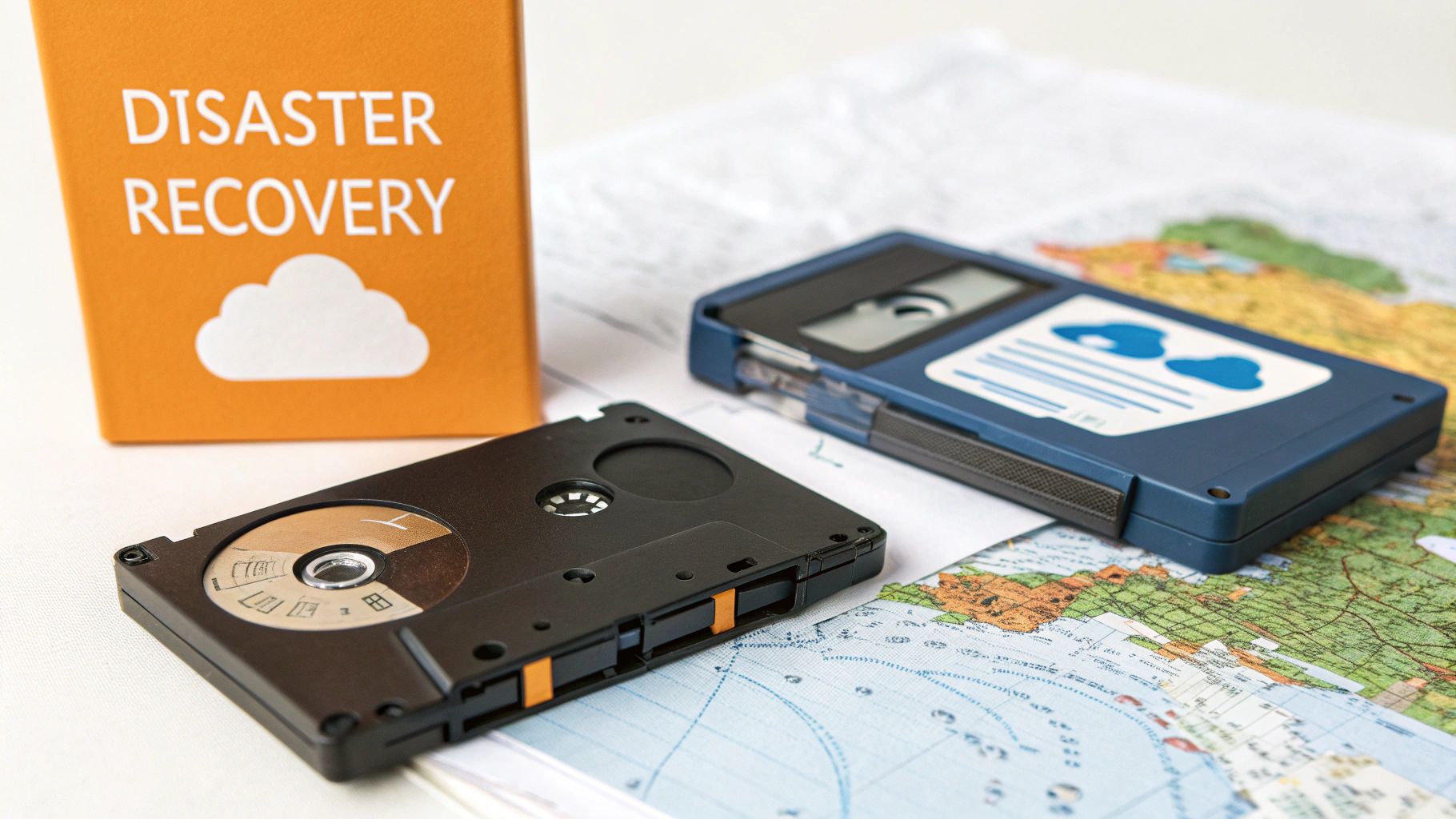
An archive without a contingency plan is a single point of failure waiting to happen. Redundancy and disaster recovery planning involves creating and maintaining multiple copies of archived documents, often in geographically separate locations, to ensure business continuity. This proactive strategy safeguards your critical information against catastrophic loss from fires, floods, cyberattacks, or severe hardware failures.
This practice is a non-negotiable component of modern document archiving best practices because it guarantees data availability. By systematically duplicating your records and establishing clear recovery protocols, you build resilience into your information management system, ensuring that a disaster at one site does not spell the end for your entire archive.
Implementation in Practice
The core principle is to eliminate reliance on a single copy or location. A financial institution, for instance, might use real-time data replication to a secondary, secure data centre miles away. For physical documents, a business might keep original copies in their main office while storing microfilmed or scanned duplicates in a secure, offsite facility. Proper preparation of these physical records is crucial, and you can find guidance on how to correctly pack a storage unit for long-term preservation.
Here are actionable tips to build your system:
- Adopt the 3-2-1 Strategy: Maintain at least three copies of your data, on two different types of media, with at least one copy stored offsite.
- Define Recovery Objectives: Document your Recovery Time Objective (RTO) and Recovery Point Objective (RPO) to clarify how quickly services must be restored and how much data loss is acceptable.
- Test Your Plan Regularly: Schedule and perform quarterly or bi-annual disaster recovery tests to ensure your procedures work as expected and your team is prepared.
- Geographically Disperse Backups: Ensure your offsite copy is far enough away to be unaffected by a regional disaster that might impact your primary location.
7. Audit Trails and Compliance Documentation
Maintaining a comprehensive audit trail is a non-negotiable component of modern document management, particularly in regulated industries. An audit trail is an immutable, chronological record detailing who accessed, modified, viewed, or deleted a document and when. This creates a transparent history of every interaction, which is fundamental for accountability, security investigations, and demonstrating regulatory compliance.
This practice is central to robust document archiving best practices because it provides verifiable proof of your organisation's data governance. In the event of a data breach, internal dispute, or regulatory audit, these logs are your primary evidence. They transform your archive from a simple storage repository into a secure, defensible, and transparent system of record, protecting your organisation from legal and financial risk.
Implementation in Practice
A successful audit trail system is automated, comprehensive, and tamper-evident. For instance, a financial services firm must adhere to FINRA requirements, which mandate detailed logs of all electronic communications. Similarly, healthcare providers under HIPAA must log every access to patient records to prevent unauthorised viewing. The core principle is creating an unbroken chain of custody for every archived document.
Here are actionable tips to implement effective audit trails:
- Implement Centralised Logging: Use a system that automatically captures all user actions across your archive in a single, central location. This prevents fragmented and incomplete records.
- Ensure Immutability: Logs must be tamper-evident. Use write-once-read-many (WORM) storage or blockchain-based solutions to guarantee that records cannot be altered after creation.
- Separate Log Archives: Store audit logs in a different, highly secure location from the primary documents. This prevents an intruder from deleting both the data and the evidence of their actions.
- Schedule Regular Reviews: Generate and review summary reports of access and activity on a monthly or quarterly basis to proactively identify unusual patterns or potential security threats.
By meticulously documenting every interaction, you build an archive that not only stores information but also protects its integrity and provides a complete, auditable history.
8. Quality Assurance and Validation Procedures
Archiving a document is not simply about saving it; it’s about preserving a reliable, accurate, and usable record. Implementing systematic quality assurance (QA) and validation procedures is a non-negotiable step to guarantee the integrity of your archive. This involves verifying that archived documents are complete, accurate, uncorrupted, and correctly indexed. Without this verification, you risk creating an archive filled with unusable or incomplete data, undermining the entire purpose of long-term storage.
This proactive approach is fundamental to trustworthy document archiving best practices because it acts as a safeguard against data degradation and human error. Processes like checksum verification and sampling ensure that what you retrieve in the future is an exact, unaltered copy of the original, maintaining its legal and operational value.
Implementation in Practice
A robust QA process combines automated checks with manual oversight. For instance, legal firms digitising court documents often use a multi-level review process where one team scans and a separate QA team validates the output for clarity and completeness. Similarly, large-scale digitisation projects, like those in libraries, often aim for accuracy targets exceeding 99.5% through a combination of software and human review.
Here are actionable tips to build your QA system:
- Implement Checksums: For every digital file, calculate and store a cryptographic hash (like SHA-256). Periodically re-calculate the hash to verify the file has not been altered or corrupted over time.
- Set OCR Accuracy Thresholds: If using Optical Character Recognition (OCR) for scanned documents, set a minimum accuracy standard (typically 95% or higher) and use software that flags documents falling below this threshold for manual review.
- Conduct Random Audits: Schedule regular, random sampling of your archive. Monthly or quarterly, pull a small percentage of documents to manually check their indexing, legibility, and completeness.
- Document All Findings: Maintain a log of all QA checks, noting any errors discovered and the corrective actions taken. This creates an auditable trail of your commitment to archival integrity.
9. Storage Infrastructure and Technology Selection
Choosing the right storage medium is a cornerstone of effective document archiving best practices, as not all technologies are created equal. The ideal choice depends on a delicate balance of cost, retrieval speed, longevity, and regulatory compliance. This practice involves selecting the physical or digital infrastructure where your archived documents will reside for their entire lifecycle. Getting this wrong can lead to data degradation, excessive costs, or an inability to retrieve critical records when needed.
A strategic approach to technology selection ensures that your archive is both secure and cost-effective. By matching the storage medium to the data's access frequency and retention period, you avoid paying for high-speed access for records that are rarely, if ever, needed. This tiered approach is fundamental to a sustainable long-term archiving strategy.
Implementation in Practice
Your selection should align with specific use cases. For instance, a video production house might use LTO (Linear Tape-Open) tape for cost-effective, long-term cold storage of massive project files. Conversely, a financial services firm needing frequent access to seven-year-old records might opt for cloud object storage like Amazon S3 Glacier Flexible Retrieval for a blend of accessibility and economy.
Here are actionable tips to guide your selection:
- Tier Your Storage: Use a Hierarchical Storage Management (HSM) approach. Keep frequently accessed archives on faster, more expensive media (like hard drives) and move older, "cold" data to cheaper, long-term options like LTO tapes.
- Plan for Obsolescence: Technology evolves rapidly. Schedule a technology refresh every 7-10 years to migrate data from older formats to modern, supported ones, ensuring you can always read your files.
- Diversify Your Media: Don’t rely on a single storage type. A best practice is the 3-2-1 rule: three copies of your data on two different media types, with one copy off-site.
- Consider Extreme Longevity: For records requiring permanent preservation, consider specialised optical media like M-DISC, which boasts a projected lifespan of over 1,000 years, far exceeding magnetic media.
By carefully evaluating and selecting the appropriate storage infrastructure, you build a resilient and efficient archive designed to stand the test of time.
10. Staff Training and Documentation Management
Even the most sophisticated archiving system is only as effective as the people who use it. Comprehensive staff training and detailed documentation are essential document archiving best practices that turn policy into consistent action. This approach ensures that every employee understands their role in the document lifecycle, from creation to disposal, preventing errors and maintaining the integrity of the archive. Without proper training, procedures become inconsistent, and vital knowledge is lost when team members leave.
This practice is crucial for organisational resilience and compliance. It transforms archiving from a niche task into an embedded, company-wide discipline, ensuring procedures are understood, repeatable, and adaptable. For comprehensive documentation management, it's crucial that all personnel receive effective compliance training related to handling sensitive documents and adhering to regulations.
Implementation in Practice
A successful training programme combines clear documentation with regular, engaging instruction. For example, a financial services firm could implement mandatory annual training on data retention policies, supported by a searchable online knowledge base with step-by-step guides for archiving client records. Similarly, a manufacturing company might use visual workflow diagrams in its quality control department to show how inspection reports should be filed and tagged.
Here are actionable tips to implement this practice:
- Create a Centralised Knowledge Base: Maintain a single, accessible repository (like a company wiki) for all standard operating procedures (SOPs), workflow diagrams, and policy documents.
- Assign Department Champions: Designate an "archive champion" in each department to provide peer support and ensure procedures are followed correctly.
- Schedule Refresher Sessions: Conduct quarterly or biannual training sessions to cover system updates, policy changes, and reinforce core principles.
- Document Lessons Learned: When an archiving error occurs, document the cause and the solution to continuously improve your processes and training materials.
Document Archiving: 10-Point Best Practices Comparison
| Item | Implementation complexity | Resource requirements | Expected outcomes | Ideal use cases | Key advantages |
|---|---|---|---|---|---|
| Classification and Categorization System | Medium–high (design + governance) | Stakeholder time, taxonomy tools, training | Consistent organization and faster retrieval | Large document collections, legal/EHR contexts | Improves search, reduces duplicates, supports audits |
| Digital Preservation and Format Migration | High (ongoing technical processes) | Format tools, migration expertise, monitoring | Long-term accessibility and reduced obsolescence risk | Libraries, archives, long-term institutional records | Prevents format loss, reduces vendor lock-in |
| Metadata Standardization and Documentation | Medium–high (schema design & enforcement) | Metadata tools, staff effort, validation systems | Enhanced discovery, context, and lifecycle control | Digital archives, repositories, research data | Enables powerful search and regulatory compliance |
| Access Control and Security Protocols | High (policy + technical controls) | Security infrastructure, admin overhead, monitoring | Protected sensitive data and auditability | Healthcare, legal, government archives | Prevents unauthorized access, supports compliance |
| Retention and Disposition Scheduling | Medium (policy + automation) | Legal expertise, workflow automation, documentation | Controlled retention, reduced storage of unnecessary records | Regulated industries, financial and HR records | Lowers storage costs, reduces legal risk |
| Redundancy and Disaster Recovery Planning | High (architecture + testing) | Multiple storage sites, backup systems, testing resources | Increased availability and rapid recovery after failures | Critical business continuity, financial services | Prevents data loss, ensures continuity |
| Audit Trails and Compliance Documentation | Medium (logging + retention) | Secure log storage, reporting tools, storage capacity | Verifiable history of actions and compliance evidence | Regulated industries, litigation-prone environments | Legal defensibility and forensic traceability |
| Quality Assurance and Validation Procedures | Medium (process + tooling) | QA tools, specialists, processing time | Higher data integrity and searchable content quality | Digitization projects, courts, libraries | Early corruption detection and OCR reliability |
| Storage Infrastructure and Technology Selection | Medium–high (strategy + procurement) | Capital expenditure, vendor management, refresh planning | Optimal cost/performance balance and scalability | Any organization scaling archives or choosing media | Flexibility, cost optimization, reduced vendor lock-in |
| Staff Training and Documentation Management | Low–medium (ongoing effort) | Training programs, documentation systems, time | Consistent processes and preserved institutional knowledge | Organizations with multiple users/process owners | Reduces errors, improves continuity and efficiency |
Building Your Archival Blueprint
Transitioning from theory to practice is the most critical phase in mastering your organisation's information lifecycle. The document archiving best practices we have explored are not merely a list of tasks to be ticked off; they are the fundamental pillars of a resilient, secure, and efficient information management strategy. By moving beyond ad-hoc filing and embracing a structured archival blueprint, you convert your historical data from a potential liability into a powerful strategic asset, ready to inform future decisions and demonstrate compliance.
Synthesising the Core Principles
The journey to archival excellence begins with a clear framework. A logical classification system and standardised metadata are the bedrock, ensuring every document is findable and its context understood. Layered on top of this foundation are robust security protocols and access controls, which act as the guardians of your sensitive information, protecting it from unauthorised access or data breaches.
Simultaneously, a well-defined retention and disposition schedule ensures you are not holding onto records indefinitely, mitigating risk and reducing storage costs. This proactive approach is complemented by a forward-thinking digital preservation plan, which addresses the long-term challenges of format obsolescence, guaranteeing that your digital assets remain accessible decades from now.
From Plan to Action: Your Next Steps
Viewing these practices as interconnected components is key to successful implementation. Your archival system is only as strong as its weakest link. A state-of-the-art storage solution is of little use if staff are not trained, and a perfect retention policy cannot be enforced without comprehensive audit trails.
To begin building your own archival blueprint, consider these actionable steps:
- Conduct a comprehensive audit: Start by understanding what you have, where it is stored, and who has access to it. This initial assessment will highlight your most pressing vulnerabilities and priorities.
- Assemble a cross-functional team: Involve representatives from IT, legal, compliance, and key business departments. This ensures your archiving policy is practical and meets the needs of the entire organisation.
- Prioritise and phase your implementation: You do not need to solve everything at once. Begin with the most critical areas, such as securing sensitive data or establishing a clear retention schedule, and build from there.
Mastering these document archiving best practices is an ongoing commitment, not a final destination. It requires regular review, consistent training, and adaptation to new technologies and regulatory landscapes. By investing in this process, you are not just organising files; you are safeguarding your organisation’s legacy, enhancing operational efficiency, and building a foundation of trust with your clients and stakeholders. This strategic approach transforms your archive from a forgotten storeroom into a dynamic source of value and a testament to your organisation's integrity.
For UK businesses, homeowners, and tradespeople seeking to implement the physical storage component of their archiving strategy, Standby Self Storage offers a secure and flexible solution. Our clean, dry, and monitored units across eight locations provide the perfect environment to safeguard your important paper records as part of a comprehensive document management plan. Visit Standby Self Storage to find the right space to protect your assets today.