You're between homes in Leeds, your furniture is in the way, and the new property won't be ready for another few weeks. Or perhaps you run a Bristol online shop and Q4 stock has taken over the spare room. Maybe you're a Nottingham tradesperson with a van full of tools and nowhere secure to leave them overnight.
The obvious question is, “How much space do I need?” The better question is, how much working capital can you afford to lock away, and how quickly might you need to leave? Self storage usually costs more per square foot, but it can protect cashflow through flexible terms, smaller units and easier scaling. A warehouse may offer cheaper space at scale, but the lease can create a much larger financial commitment.
| Decision factor | Self storage | Warehouse rental |
|---|---|---|
| Headline cost | Higher revenue density per square foot, with smaller units | Lower rent per square foot for larger footprints |
| Contract flexibility | Rolling, service-style arrangement in many facilities | Usually a longer commercial lease |
| Access | Often designed for frequent personal or business access | Commonly organised around commercial loading and operating hours |
| Security | Controlled entry, CCTV and unit-level protection may be available | Building and estate security varies by property |
| Unit suitability | Modular space for personal items, tools and moderate stock | Larger areas for pallets, racking and structured logistics |
The rest of this guide applies five tests, headline cost, contract flexibility, access hours, security and unit suitability, then uses practical UK scenarios to show which option fits different cashflow and access patterns.
The Storage Decision UK Renters and Owners Face
A homeowner storing furniture for a house move may need one accessible room for a few months. Leasing a warehouse for that requirement adds a deposit, rates, setup costs and a contract that may outlast the move. A self-storage unit can carry a higher square-foot rate, yet keep the total commitment closer to the space and time you need.
A tradesperson with tools in the van faces a different calculation from an online seller dispatching stock daily. Write down what you will store, how much space it occupies and how often you will handle it. Furniture, electrical fittings, stock and archived documents each demand a different access pattern and layout.
The five questions that decide the outcome
What will the total monthly commitment be? Add rent, rates, VAT where applicable, utilities, insurance, legal costs and setup work. A warehouse quote rarely represents the full occupancy cost. Self storage is generally presented as a simpler recurring service, but check its insurance terms, fees and notice period.
How long can you commit? A project with a fixed end date or fluctuating stock needs an exit route. A longer lease makes sense only when the space will remain useful and the resulting commitment will not restrict other business spending.
How often do you need access? Daily loading, evening collections and weekend work favour a facility built around frequent customer access. Occasional pallet deliveries suit a warehouse model with suitable loading arrangements, operating hours and handling capacity.
What security arrangement do you need? Check gates, CCTV, lighting, alarms and access records before signing. Confirm that your insurance covers the goods and that the facility permits the items you plan to store.
Does the unit match the goods? A small, ground-level unit suits boxes, furniture and tools. Regular pallet operations require racking, forklift handling and a loading dock, which a standard self-storage unit will not provide.
Practical rule: Choose the smallest space that supports the way you work, not the largest space a landlord is willing to lease.
For movers and homeowners, start with self storage. Tradespeople should choose it when secure, frequent access matters more than floor area. Smaller online sellers should use it while stock and dispatch volumes remain manageable. Warehouse rental becomes the stronger choice when pallet volume, equipment and consistent logistics justify a larger, longer commitment. Judge the decision by turnover and cash tied up, not rent per square foot alone.
How the UK Self Storage and Warehouse Markets Compare
Self storage is no longer a fringe option used only during a house move. The UK sector grew from an estimated 815 facilities and 29.6 million square feet in 2011 to 2,915 stores and 64 million square feet by 2024, according to the SSA UK industry report. Turnover rose from £355 million in 2011 to just under £1.2 billion in 2024, and the later UK annual report recorded £1.3 billion in 2026, with occupancy at 75.1% in 2024 and 74.5% in 2026 in the same cited industry data.
That scale matters because mature sectors tend to offer clearer product choices. Customers can compare unit sizes, access arrangements, security features and booking processes rather than treating storage as an improvised arrangement. For a household or small business, that makes self storage a normal commercial decision, not a fallback when a warehouse is unavailable.
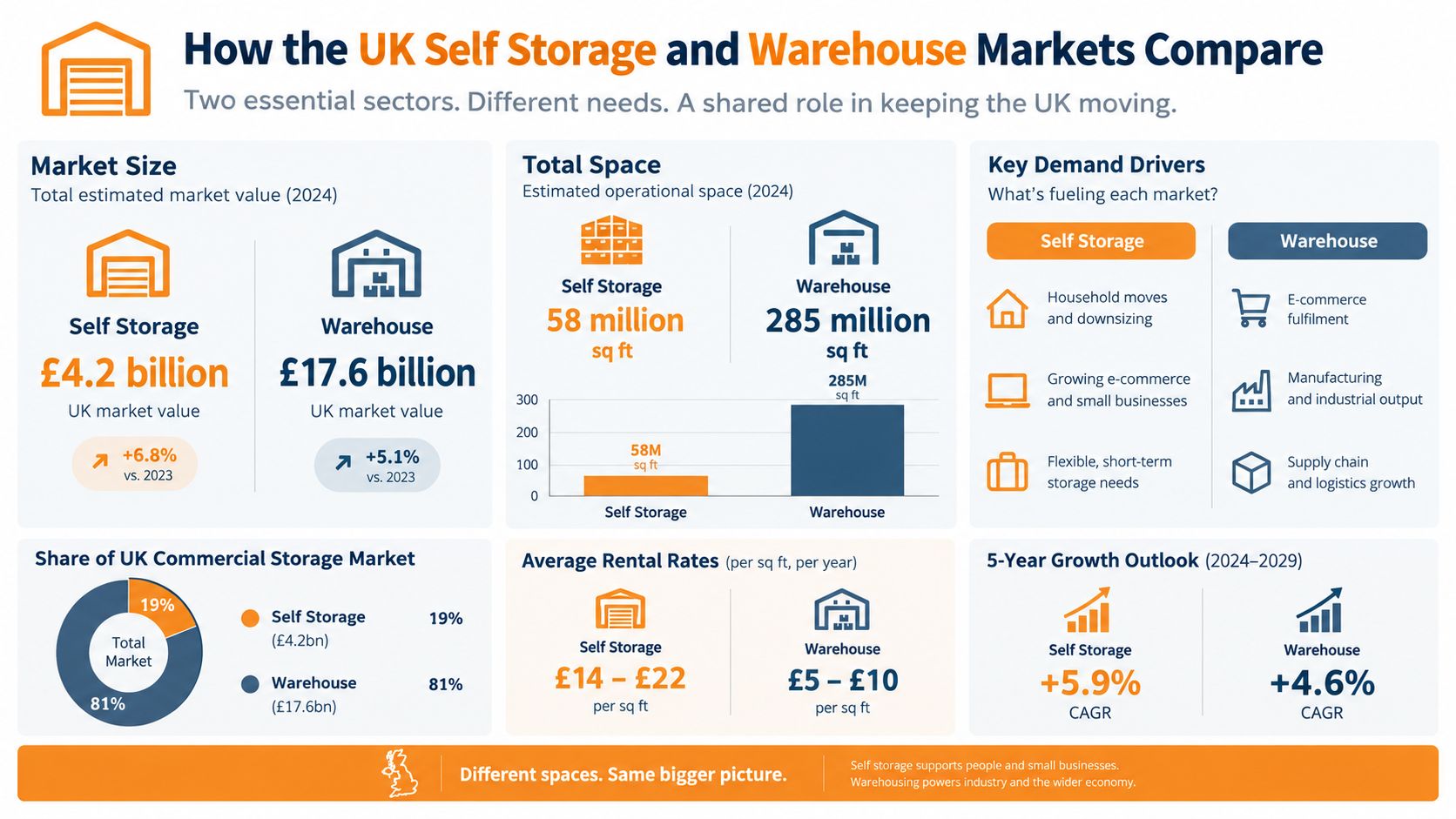
Warehouse rental serves a different market. It is built around larger footprints, freight movement, palletised goods, racking and longer-term occupation. Colliers reported average prime rents of £11.50 per square foot in 2025 for large distribution warehouses above 100,000 square feet, with year-on-year rent growth of 5.4%, as reported in this UK industrial rents analysis. The same market commentary placed average UK warehouse rents around £11.50 per square foot in 2024.
Self storage uses a different revenue model. The 2026 UK annual report recorded average revenue of £27.40 per square foot excluding VAT, alongside 74.5% occupancy and 96.6% churn, figures that point to smaller units, shorter customer stays and a high-turnover service model. Read the warehouse self-storage comparison for another practical explanation of how the two formats differ. For broader context on how storage businesses structure access and convenience, this storage Waltham Mass guide is useful, although UK pricing and lease practices still need to be assessed locally.
Cost Contracts Access and Security Side by Side
The headline comparison is simple. Warehouse space is normally cheaper per square foot, while self storage lets you buy much less space and leave with less financial friction. The right calculation is not rent divided by floor area. It is the total cost of usable space, access and exit risk.
Commercial warehouse occupiers can face business rates, VAT on rent and services, utilities, legal fees, insurance and dilapidations. Warehouse deposits can also run to three to six months' rent, according to this UK warehouse rental guidance. Self storage is commonly billed as a rolling monthly service, and the customer generally doesn't carry a separate business rates liability in the same way as a commercial warehouse occupier.
Contract terms change the cashflow calculation
Self storage is suited to uncertain timelines. You can often rent a unit, move in, add space when stock rises and reduce it when the project ends. Check the specific licence terms, notice requirements and payment conditions rather than assuming every operator follows the same model.
A warehouse lease gives you more control over layout and operations, but that control comes with obligations. Rent reviews, break clauses, dilapidations, maintenance responsibilities and legal work can all affect the actual cost of occupation. If your business is still testing demand, a warehouse can turn an operating decision into a property commitment.
Access and security must match the work
Self-storage facilities often provide extended access, ground-level units and drive-up loading. These features matter to a homeowner moving furniture, a tradesperson leaving early for a job or a small seller preparing orders outside standard office hours.
Warehouses are stronger where you need pallet movements, loading docks, forklifts, racking or coordinated deliveries. Security may include CCTV, perimeter fencing, alarms and controlled entry, but the exact arrangement varies by property. In self storage, ask whether the site uses PIN-controlled access, unit alarms, recorded entry and suitable lighting. Don't assume a secure building automatically provides the right protection for your goods. For insurance details, consult this guide to contents insurance for stored goods.
| Criterion | Self storage | Warehouse rental |
|---|---|---|
| Cost structure | Smaller commitment, often simpler to budget | Lower unit cost at scale, with more additional liabilities |
| Contract | Flexible licence or rolling arrangement may be available | Commercial lease with more formal obligations |
| Access | Often convenient for frequent loading and unloading | Better for organised freight and pallet handling |
| Security | Controlled site access and individual-unit protection may be available | Estate and building security depends on the property |
| Suitability | Boxes, furniture, tools, documents and moderate stock | Pallets, racking, machinery and larger inventory flows |
Pay more per square foot only when the flexibility, access and lower exit risk save you more than the headline rent difference.
Matching the Right Storage Type to Your Situation
The best option changes with the person using the space. A student doesn't need a distribution centre, and a manufacturer moving regular pallet loads shouldn't pretend a small unit can replace one.
The postgraduate student
A postgraduate student finishing a tenancy agreement may need to store clothing, books, kitchen equipment and a few pieces of furniture between terms or moves. A compact self-storage unit keeps the commitment proportionate to the belongings and avoids paying for unused warehouse floor.
The key benefit is not just physical capacity. The student can arrange collection, retrieve particular boxes and close the account when the move is complete. Self storage fits because the need is temporary, personal and space-sensitive.
The renovating homeowner
A homeowner clearing a kitchen or hallway needs reliable access for tradespeople. Boxes, appliances and furniture should be reachable without navigating a shared loading operation or waiting for warehouse staff.
A ground-level unit with drive-up access is the practical choice. It separates the household from the building work while keeping materials available when the next phase begins. Self storage fits because access and convenience matter more than warehouse-scale capacity.
The sole-trader electrician or plumber
A tradesperson often carries tools in a van but needs a secure reserve of fittings, cable, pipework or equipment. Weekend access and the ability to change unit size matter because workloads rarely stay constant.
A small business storage unit keeps stock close to the vehicle without requiring a full industrial lease. The tradesperson can load quickly, return unused materials and avoid converting the home garage into an inventory room. Self storage fits because the operation is mobile and access is more important than a permanent warehouse layout.
The growing e-commerce seller
An online seller whose spare room is full of stock needs more than domestic overflow space. The seller needs organised shelves, a clear packing area, reliable courier collection and the ability to increase capacity as sales develop.
A larger business storage unit can provide a controlled step up before a dedicated warehouse becomes necessary. It may not offer the full logistics infrastructure of a distribution centre, but it can remove stock from the home and make daily fulfilment manageable. Self storage fits while volume is growing and warehouse utilisation isn't yet predictable.
The light manufacturer
A manufacturer moving regular pallet loads has a different requirement. Production materials need racking, forklift handling, delivery coordination and enough room for goods to move through the operation without constant reshuffling.
A warehouse earns its keep here. A proper industrial unit supports structured logistics and gives the business control over layout, receiving and dispatch. Warehouse rental fits because volume and handling requirements outweigh flexibility.
Sample Monthly Cost Scenarios You Can Replicate
Start with the cash you will tie up, then add the costs that sit around the headline rent. A warehouse quote that looks cheap on paper can become expensive once you include rates, VAT where relevant, insurance, utilities, legal fees, deposit terms, fit-out and the cost of being locked in if the space stops fitting the business. Self storage is simpler, but you still need the full recurring charge, access rules, payment frequency and any insurance requirement.
For a real quote on self storage, use the UK storage cost guide and ask for the smallest unit that fits the job, with access terms spelled out clearly. For a warehouse, ask for heads of terms that show rent, service charge, rates position, deposit, lease length, break rights and repair duties.
| Persona | Unit size | Self storage monthly | Warehouse monthly | Working-capital verdict |
|---|---|---|---|---|
| Student between tenancies | Compact unit for boxes and personal items | £60-£95, all-in, for a small unit with standard access | £1,200+ minimum industrial unit, plus deposit and lease costs | Self storage keeps cash free and avoids paying for empty floor space |
| Homeowner during renovation | Ground-level unit for furniture and appliances | £95-£180 for a project-period unit | £1,500+ once deposit, rates and operating costs are included | Self storage keeps the commitment tied to the renovation, not a long lease |
| Sole-trader electrician or plumber | Small unit for tools, materials and reserve stock | £120-£220 with access that suits working hours | £1,800+ for a basic industrial unit with rates and longer commitment | Self storage keeps overheads aligned with actual workload |
| Online retail SME | Business unit for stock, packing and courier handover | £180-£350 for the active inventory footprint | £2,500+ for a larger warehouse before fit-out and lease exposure | Self storage is the better test phase until stock flow is steady |
These figures are illustrative ranges, not fixed quotes. Region, season, access level and unit type will move the price, and a warehouse can rise fast once you add parking, handling space and business rates exposure. The point is simple. If the operation needs only a modest footprint and regular access, self storage protects working capital. If the business truly needs pallets, racking and a permanent operating base, warehouse rental earns its higher cost through scale.
The student case is the clearest example of poor capital discipline. Paying warehouse-level minimums for a few boxes is wasteful, because most of the space sits idle while the bill keeps running.
The homeowner should price the full renovation period, not just month one. A warehouse deposit ties up cash before the first item is stored, and the exit cost can linger after the furniture goes back home. A flexible unit ends when the project ends.
For a sole trader, access has direct value. A nearby unit supports early pick-ups, weekend loading and keeping stock separate from the home without turning the business into a property management job. A warehouse only makes sense once the stock volume and workflow justify the fixed overhead.
An online retailer should test the model against real order patterns. Modest shelving, packing space and courier access point to self storage. Pallet movements, staff traffic and regular dispatch processes point to a warehouse. Do not pay for industrial capacity until the turnover justifies it.
Choosing Between Self Storage and Warehouse Rental
Use this checklist before you request quotes:
- Lease tolerance: Can you comfortably remain responsible for the space if the project ends early?
- Access frequency: Will someone load or retrieve goods daily, weekly or only occasionally?
- Handling equipment: Do you need a forklift, loading dock, racking or pallet movement?
- Pallet volume: Are goods stored as cartons and individual items, or do they arrive and leave in regular pallet loads?
- Budget ceiling: Have you included rates, VAT, utilities, insurance, deposits and fit-out?
- Trading status: Are you established enough to forecast inventory and occupancy, or are you still testing demand?
Choose self storage when you need modest capacity, regular personal access, a rolling arrangement and a clean exit. It's the stronger option for movers, renovators, students, tradespeople and smaller businesses holding stock or documents. The service model also makes it easier to add or remove space without renegotiating an industrial property.
Choose a warehouse when your operation depends on scale. That means sustained inventory, regular pallet movements, racking, forklifts, loading infrastructure or a layout that supports production and dispatch. A warehouse shouldn't be the default just because the price per square foot looks lower.
A hybrid can work for seasonal businesses. A small racked warehouse can hold core inventory and support fulfilment, while a satellite self-storage unit can handle overflow, promotional stock or equipment near customers and staff. That arrangement only works if each site has a clear job and the combined cost remains lower than taking one oversized warehouse.
What to check before booking
Ask the storage provider about unit dimensions, ground-level access, opening hours, vehicle loading, security procedures, insurance, payment terms and how quickly you can change size. Use the earlier persona examples as a sizing starting point, then measure your largest item, allow an aisle and avoid renting space that only looks affordable because it is poorly usable.
A practical facility should let you check live availability, review pricing, arrange a move-in date and speak to a team member about unusual items or business stock. Confirm the contract terms in writing, especially cancellation, access and prohibited goods.
For most UK renters and smaller business owners, the decision is straightforward. Take self storage when flexibility protects your working capital. Take warehouse rental when logistics and volume make the extra commitment productive. Check live unit availability at your preferred Standby location, then phone the team with your goods, access pattern and expected storage period so they can provide a customized quote.
Standby Self Storage offers flexible units for personal storage, business stock, documents, tools and renovation projects, with online booking and secure controlled-access facilities. Visit Standby Self Storage to check availability, compare unit sizes and choose a storage arrangement that doesn't lock your working capital into an unsuitable warehouse lease.