You've got a completion date that won't line up, a renovation team arriving, or business stock taking over the spare room. The obvious answer is to hire a storage unit in Crawley, but choosing the wrong size creates a second problem. A unit that's too small turns moving day into a wall of unstable boxes, while an oversized unit leaves you paying for unused floor space.
The right decision depends on more than the number of bedrooms or boxes you own. Unit footprint, safe vertical stacking, aisle space and how often you'll need access all affect the size that works in practice. This guide gives you a candid way to assess Storage Unit Sizes in Crawley, whether you're a student, homeowner, tradesperson or growing business.
Navigating the Crawley Storage Market
A couple moving out of a Crawley flat often starts with a rough estimate: “We'll probably need something around the size of a garage.” That sounds reasonable until the sofa, wardrobes, white goods, bicycles and packed kitchen boxes arrive. If everything goes into a unit at once, the available space disappears faster than expected. If the couple then needs winter clothes or paperwork, reaching those items means unloading half the room.
Crawley's local market makes this decision more important. One market comparison lists three self-storage facilities, estimated lettable space of 81,492 square feet, and 0.66 square feet of storage per resident, compared with a UK average of 0.9 square feet per resident. The same source describes that level as about 27% below the UK average. Treat those figures as a historical market indicator, not a live availability guarantee, but they point to a practical conclusion: suitable units may not remain available when you need them. Crawley storage-market figures provide useful context.
Why guessing costs more
A rushed booking usually fails in one of two ways:
- Too small: Furniture blocks the entrance, boxes become difficult to lift, and every visit requires rearranging the load.
- Too large: You gain convenient floor space but pay for air around loosely packed belongings.
- Poorly planned: Frequently needed items end up behind long-term storage, creating unnecessary double-handling.
Crawley providers use a recognisable size ladder, with options ranging from compact units to large rooms. One local listing progresses from 10 square feet to 200 square feet, including 25, 35, 50, 75, 100, 125, 150 and 175 square feet, while another lists units from 15 to 200 square feet. Storage King's Crawley size guide shows how widely these standard categories are used.
Practical rule: Book around the way you'll use the unit, not just around the amount you own.
For a short gap between homes, tight packing may be sensible. For a business retrieving stock every week, an aisle and clear product zones are worth more than squeezing into the smallest possible room. In Crawley's comparatively constrained supply, right-sizing also improves your chances of securing a workable unit before moving day becomes urgent.
Standard Unit Dimensions and Real-World Benchmarks
Square footage helps compare rental options, but the figure means little until you relate it to the shape and use of the space. Separate floor area from usable capacity. Floor area covers the ground occupied by furniture and boxes. Usable capacity also depends on ceiling height, safe stacking, and the clearance needed to enter, reach, and remove items.
Crawley listings use familiar comparisons to make their units easier to judge. Smaller spaces resemble lockers or telephone boxes, medium units sit around shed or garage capacity, and the largest approach a double garage. These are practical benchmarks, not exact floor plans. Use them to form an initial view, then check the actual dimensions and your access needs.
Crawley storage size ladder
| Unit Size (sq ft) | Physical Benchmark | Typical Capacity |
|---|---|---|
| 10 sq ft | Telephone box or compact locker | A few boxes, luggage or seasonal items |
| 25 sq ft | Large cupboard or small walk-in space | Small van load, student belongings or compact flat contents |
| 35 sq ft | Garden shed range | Packed boxes, small furniture or light one-room overflow |
| 50 sq ft | Larger shed or compact garage area | One-bed flat contents or dense business stock |
| 75 sq ft | Small room | Furniture and boxes from a larger flat |
| 100 sq ft | Single garage | Two-bed household contents, including larger appliances |
| 125 sq ft | Large room | A fuller household move with additional boxes |
| 150 sq ft | Large garage range | Multiple bedrooms, furniture and business equipment |
| 175 sq ft | Oversized garage-style space | Bulky household contents with room for better access |
| 200 sq ft | Double garage | Large household move, multiple bedrooms or substantial stock |
This progression, including comparisons with a telephone box, garden shed, single garage, and double garage, provides a useful Crawley benchmark. Storage King's local unit information supports those comparisons.
Use dimensions before labels
A 40 square foot unit, described locally as 5 feet by 8 feet, suits furniture or business stock from one to two rooms. An 80 square foot unit, listed as 10 feet by 8 feet, is positioned around a Luton van load and the contents of a two-bedroom house. A 160 square foot unit, given as 20 feet by 8 feet, is associated with a three to four-bedroom house. Standby Self Storage's Crawley sizing guidance provides these practical examples.
Treat every label as a starting point, not a promise. Dismantled furniture and uniform boxes pack efficiently, while wardrobes, gym equipment, and awkward furniture consume floor area quickly. Measure the largest items, allow room for safe stacking, and decide whether you need an aisle before choosing a unit.
For a useful comparison of factors affecting price, see the unit cost tips from Get n Go. Compare the advertised size with access, packing density, and rental duration. In Crawley's tight storage market, a smaller unit only works when its footprint and vertical capacity match how often you will retrieve your belongings.
Balancing Footprint and Vertical Stacking
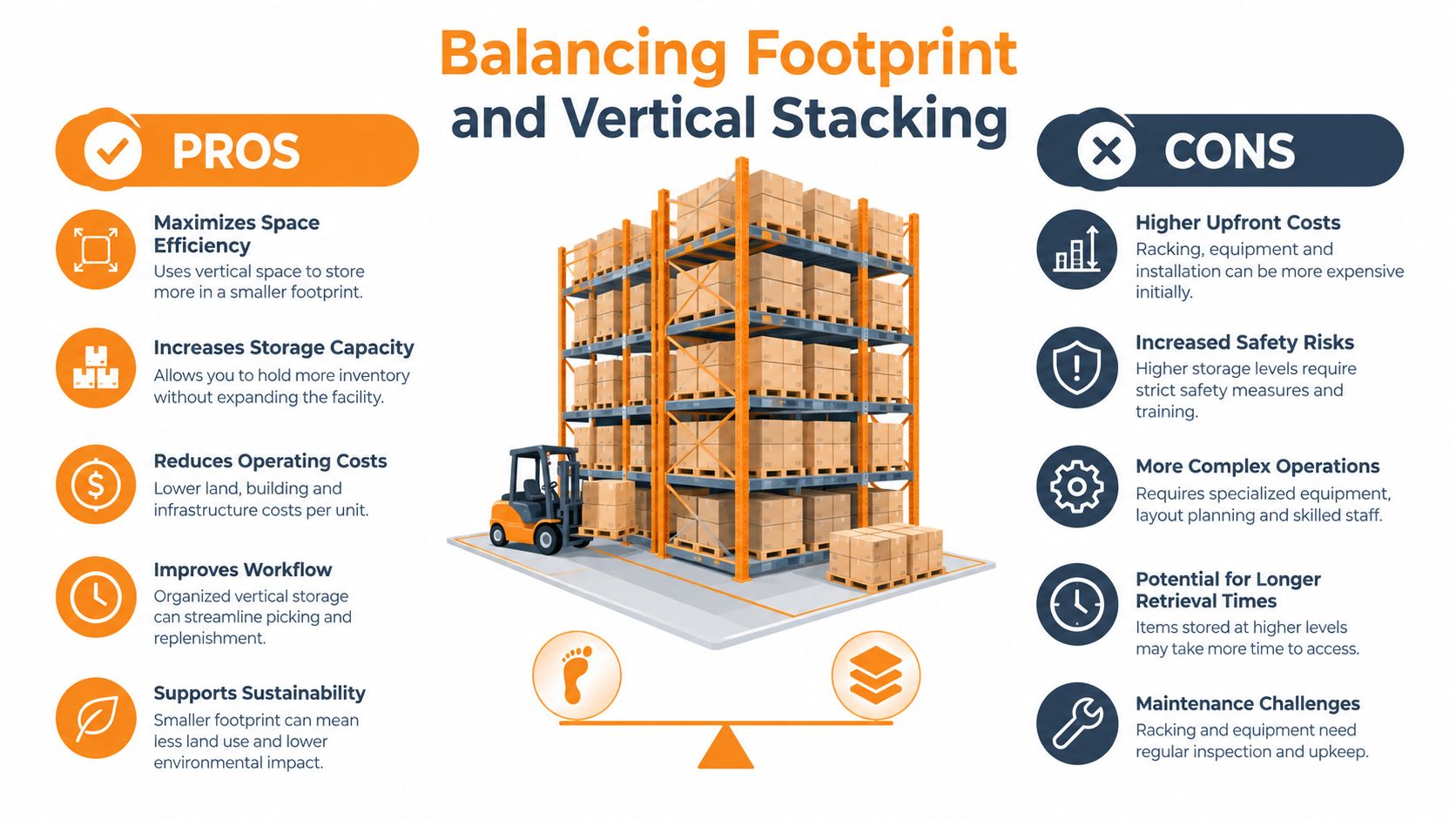
The cheapest-looking unit isn't automatically the cheapest solution. A compact room can hold a surprising amount if you stack upwards, but that saving disappears if you can't safely reach the boxes at the bottom or need to visit every few days.
Think of your storage in two modes. Stack-and-forget works for archived paperwork, spare furniture and possessions that won't be touched until the end of a move. Walk-in storage works for stock, tools, clothing, documents and anything you'll retrieve regularly. The first mode prioritises volume. The second prioritises access.
Smaller footprint versus larger floor area
A smaller unit with disciplined stacking has clear advantages:
- Lower wasted space: Matching box sizes creates stable columns and reduces gaps.
- Better cost control: You avoid renting floor area you don't need.
- Efficient for dense goods: Files, boxed stock and folded textiles use vertical capacity well.
It also creates limitations:
- Poor retrieval: Reaching a box at the back may require moving a stack.
- Safety risk: Heavy items cannot go high, and unstable towers can damage contents.
- Furniture problems: Sofas, wardrobes and equipment don't compress neatly.
A larger unit gives you room to separate categories and leave an aisle. That costs more, but it can save labour and frustration for an active business. A tradesperson who collects tools before each job shouldn't build a sealed wall of boxes just to fit a smaller footprint.
Design the unit around movement
For long-term storage, put heavy furniture around the perimeter and stack lighter boxes in stable columns. For frequent access, keep a clear route from the door to the items you use most. Put seasonal stock, tools or priority documents near the entrance, and place dormant items at the rear.
Guidance on maximizing warehouse floor space is useful here because the same principle applies in a small self-storage room. The aim isn't to fill every available cubic foot. The aim is to create a layout that uses height without sacrificing safe movement.
Access changes the answer: If you'll visit weekly, pay for usable circulation. If you won't open the unit until moving day, prioritise secure, stable volume.
Crawley's 40, 80 and 160 square foot examples create practical decision points. Choose around 40 square feet for compact, accessible overflow. Move towards 80 square feet when you're storing a household or a meaningful amount of stock. Consider the larger tier when furniture volume, not box count, drives the load.
Recommendations for Local Needs
A student with a dozen boxes may need less space than an online seller with fewer items. The seller needs quick access to individual products, while the student can pack tightly and leave belongings untouched. Unit size must reflect both volume and retrieval frequency.
Students and short-term personal storage
Students storing belongings between terms should begin at the compact end of Crawley's size range. A small unit can hold suitcases, bedding, boxes, a desk chair and dismantled furniture when everything is packed securely and access is limited.
Choose the next compact size if you will collect items during the break, or if the load includes a bed, wardrobe and substantial kitchen equipment. Keep a clearly labelled “first out” group beside the entrance. Summer clothing should not end up beneath books and room accessories.
Homeowners, renters and movers
For a moderately furnished one-bedroom flat, the 35 to 50 square foot range is a sensible starting point. UK guidance places 25 square feet around a small van load, 50 square feet around a one-bed flat, and 100 square feet around a two-bed house including white goods. Boxroom's Crawley storage guidance provides these benchmarks.
A two-bedroom home usually needs more than a compact overflow room, especially when the load includes beds, wardrobes, appliances and garden items. The local 80 square foot example suits a Luton van load and two-bedroom contents. 100 square feet matches the single-garage benchmark in the local size ladder.
Renovating homeowners should prioritise access over tight compression. Leave room to reach decorating supplies, keep furniture away from building dust and separate fragile items from tools and heavy boxes.
SMEs, tradespeople and online retailers
For SMEs archiving files or holding boxed stock, 40 to 80 square feet offers a practical working range. Dense cartons stack efficiently, but the unit still needs zones for archive material, active stock, returns and equipment. A slightly larger footprint can be cheaper in practice if it prevents repeated unloading and repacking.
Tradespeople need a different arrangement. Ladders, tools, fixings and protective equipment are heavy, awkward and often needed at short notice. Choose space for safe handling and a direct route to frequently used gear, even when the total volume appears modest.
Online retailers should size storage around dispatch frequency, not inventory alone. Keep fast-moving products near the entrance at hand height, then place slower stock farther inside. The average UK self-storage unit is about 80 square feet, according to the earlier UK benchmark, but your retrieval pattern matters more than that average. Use vertical space for reserve stock while protecting the floor area needed to reach daily orders.
Measuring and Packing for Maximum Efficiency
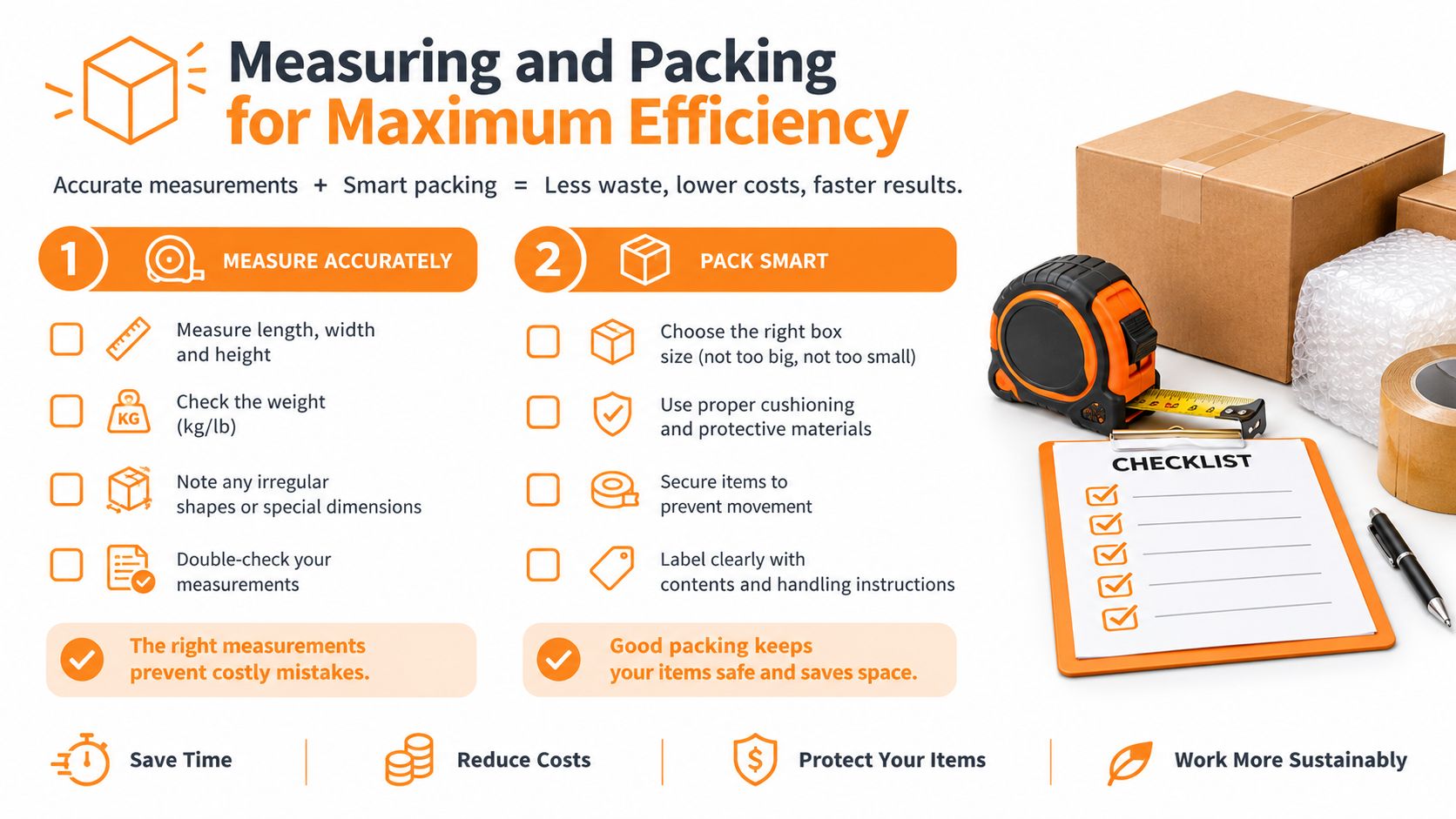
Measure the awkward items first. Boxes are forgiving, but a corner sofa, wardrobe, workbench or washing machine determines whether your planned footprint works. Record length, width and height, then note which pieces can be dismantled without damaging them.
Group the inventory into three lists:
- Large fixed items, such as beds, wardrobes, sofas and appliances.
- Stackable goods, including labelled cartons, archive boxes and folded textiles.
- Access-priority items, which you may need before the rental ends.
Use the fixed items to test the floor plan. Then estimate how the boxes will stack around them. A unit that technically fits everything may still be unusable if the door opens onto a solid wall of furniture.
Pack for stable height
Use boxes with similar footprints wherever possible. Put books and dense items in smaller cartons, while bedding, lampshades and cushions can go into larger boxes. Fill each carton properly, but don't make it so heavy that you can't lift it safely.
Dismantle tables, bed frames and shelving where practical. Place screws and fittings in a labelled bag, then secure that bag to the relevant item. Wrap furniture to prevent scratches, but only store items once they're clean and completely dry.
Load in retrieval order
Put long-term items at the back and priority items close to the entrance. Build heavy, stable columns low down and use lighter boxes higher up. Don't stack fragile goods beneath anything that could shift during handling.
For a unit you'll access often, preserve a route rather than filling every gap. For a sealed move, pack more tightly, but photograph each wall as you load it and keep a simple inventory on your phone. Label every box with its room, contents and priority, such as “Kitchen, open first”.
A good storage unit is organised before the first box crosses the threshold.
Before closing the door, check that nothing presses against fragile furniture, ventilation points or the access route. Revisit the plan whenever your inventory changes. A quick sketch with the door, aisle and zones marked is more useful than relying on memory.
Booking and Managing Your Standby Self Storage Unit
Once you've chosen a size, booking should be straightforward and transparent. Standby Self Storage offers 40, 80 and 160 square foot Crawley units, with descriptions linked to practical loads such as a garden shed, Luton van and double garage. Its online process lets customers check pricing, book a unit and manage the rental through a portal.
The useful feature for uncertain moves is flexibility. If a property completion slips or business stock changes, a rental without a notice period or long-term commitment is easier to manage than a rigid arrangement. You can cancel when the space is no longer needed, rather than planning your move around an arbitrary contract end.

Check the practical details before paying
Use the booking process to confirm:
- The exact unit size: Check the physical dimensions, not just the square-foot label.
- Access arrangements: Confirm when you can enter and whether the hours suit your work or moving schedule.
- Security controls: Ask about controlled access, perimeter security and CCTV monitoring.
- Insurance: Establish whether your existing policy covers stored belongings or whether separate cover is required.
- Upgrade options: Find out how a larger unit is handled if your inventory grows.
Standby's facilities are described as using perimeter fencing, 24/7 CCTV monitoring and controlled access. Those features don't replace careful packing, but they provide the security framework customers should expect when comparing a Crawley unit.
For a business, ask how vehicles load and whether the site layout suits repeated visits. For a household move, confirm who can access the unit and how authorised users are added. The correct size is only half the booking decision. The rest is whether the facility fits the way you'll move and retrieve your belongings.
Common Sizing and Rental Questions Answered
Is the advertised square footage enough information?
No. Treat it as the starting measurement. Ask for the unit's length, width and height, then compare those dimensions with your largest furniture and your planned aisle. A 50 square foot room packed with awkward items behaves very differently from one filled with uniform cartons.
Should I choose the smaller or larger unit?
Choose the smaller option when your contents are stackable and you'll rarely visit. Choose the larger footprint when you need access, store bulky furniture or handle stock regularly. If you're between sizes, first remove items you can sell, donate or recycle, then decide whether the remaining load needs height or circulation.
Will my stored belongings automatically be insured?
Don't assume they are. Storage insurance depends on the provider, the value of the contents and the terms of your existing policy. Ask for the insurance position before booking and make a written inventory of valuable items.
Can I access the unit whenever I want?
Access hours vary by facility. Standby's stated offer includes controlled access, so confirm the current Crawley arrangements before committing, especially if you run a business or need evening visits. A unit you can't reach when required isn't operationally useful, regardless of its size.
What happens if I need more room?
Ask whether you can move to a larger unit, and whether the provider can help coordinate the change. Don't wait until the doorway is blocked. If stock expands or a delayed move adds more furniture, an early size review is safer than forcing extra items into an already full room.
Is a smaller unit always cheaper overall?
Not necessarily. A lower rental can be cancelled out by repeated unloading, extra van trips or damaged goods caused by unsafe stacking. Compare the rent with the work involved, then choose the smallest unit that still gives you a stable, accessible layout.
Standby Self Storage offers flexible Crawley storage in practical 40, 80 and 160 square foot options, with online booking, portal management and controlled access. Review your inventory, match the footprint to your access needs, and visit Standby Self Storage to check the available unit options before your move or stock problem becomes urgent.