
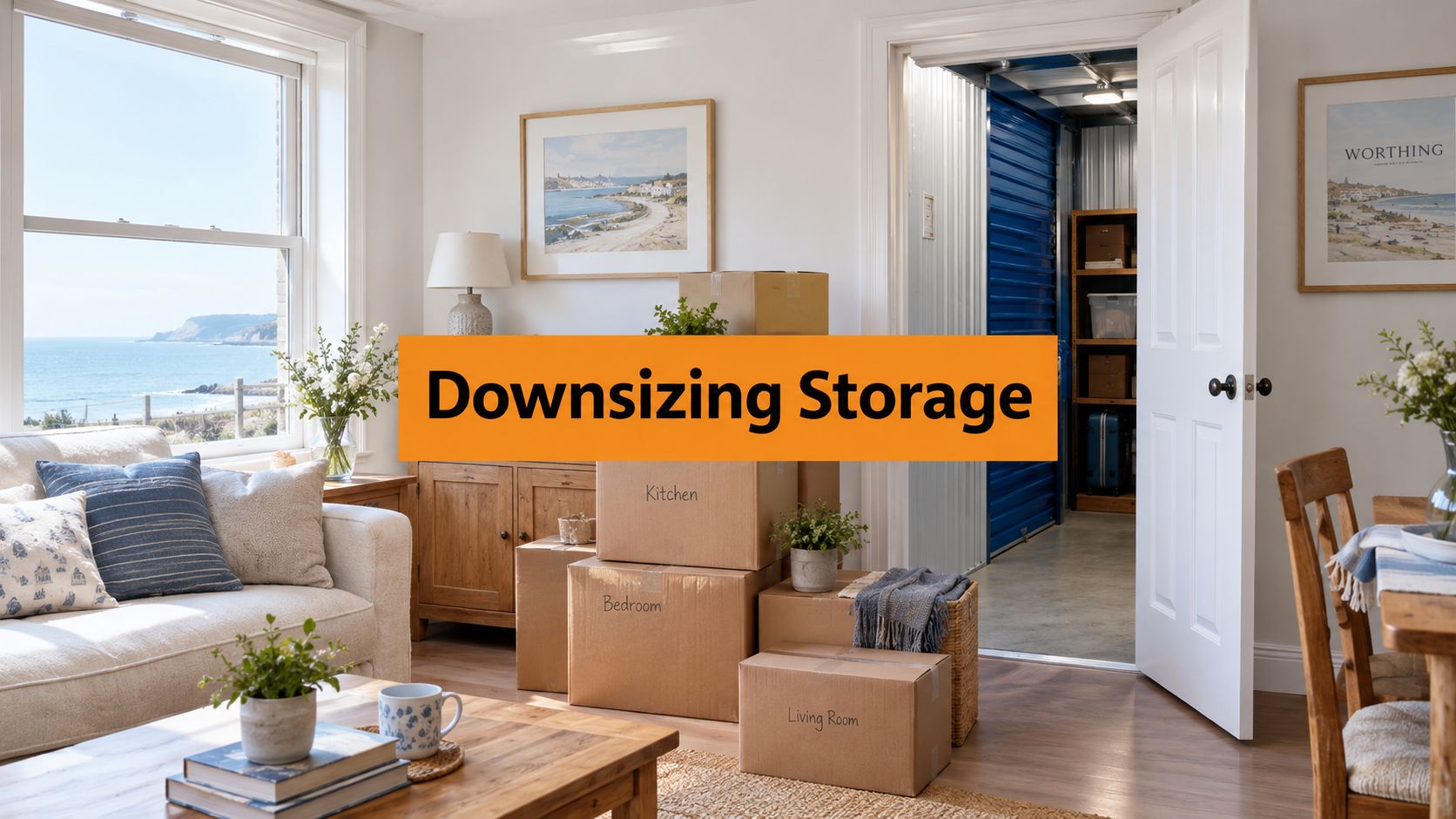
A family home in Worthing can hold decades of ordinary life: dining furniture bought for a growing family, boxes of photographs, garden equipment, spare beds, paperwork and possessions inherited from earlier generations. Then the sale completes before the smaller property is ready, or the new flat has less room than expected. Suddenly, the careful downsizing plan becomes a gap between two homes, with essential belongings, uncertain decisions and a removal date all competing for attention.
That gap needs more than a place to put moving boxes. Downsizing storage in Worthing works best as transition storage, a temporary, organised space that protects the items you still value while giving you time to decide what belongs in your next home.
Planning Your Downsizing Journey in Worthing
The removals van has gone, but the move isn't finished. A couple may be waiting for completion on a sale while staying with relatives, renting temporarily or living in a smaller property surrounded by labelled boxes. Furniture sits in storage because the new sitting room is narrower, family papers need sorting, and nobody wants to make an irreversible decision while dealing with solicitors, repairs and an unfamiliar layout.
That situation is common in principle, but Worthing has a particularly strong local reason to plan for it. The borough's median age rose from 42 to 44 between the 2011 and 2021 censuses, residents aged 50 to 64 increased by just under 3,600, and people aged 65 and over now account for about 24,900 residents, or 15.4% of the population, according to the Office for National Statistics' Worthing census profile. The same profile records a fall in household ownership from 69.3% to 67.5% and a rise in private renting from 19.3% to 22.0%, changes that point to more movement between homes and more need for flexible space during relocation and retirement transitions.

Treat storage as a decision-making space
Standard moving storage usually has a simple purpose, keep everything safe until it reaches the destination. Downsizing storage has a second job. It gives you breathing room while you separate what should go into the new home, what should go to relatives, what can be sold or donated, and what needs a respectful goodbye.
Start by identifying the dates that can change your requirements:
- Sale completion: Ask your solicitor or estate agent when access to the old property ends.
- New-home readiness: Check decorating, flooring, accessibility work and appliance installation before booking delivery.
- Family decisions: Allow time for relatives to collect heirlooms rather than storing them indefinitely.
- Final removal: Keep a realistic route from the storage unit to the new property, especially if parking or stair access is restricted.
A room-by-room plan makes the process less emotional. Write down the new home's storage limits, measure large furniture and mark items as move now, store temporarily, give away, sell, or dispose of responsibly. If an office, shop or inherited workspace also needs clearing, a specialist service such as Beyond Surplus office cleanout may be more appropriate than mixing commercial contents with household decisions.
For practical moving preparation, the moving house advice from Standby can help you build a checklist around access, packing and timing. The aim isn't to rush sentimental choices. It's to prevent every undecided item from automatically becoming a storage cost.
Strategic Decluttering Before You Pack
Downsizing becomes expensive when you measure the contents of the old house instead of the belongings that deserve a place in the next one. The most effective approach is to declutter before you book a unit, not after you've paid for space and filled it with decisions you've postponed.
Worthing's housing pattern supports this need. 83% of older-person households in Worthing are owner-occupied, and the borough needs 168 units of accommodation per 1,000 people aged 75 and over, with 57% of that need in the market sector, according to the Adur and Worthing strategic housing assessment. The assessment also reports that underoccupied dwellings increased by 3.6% over a 10-year period, with a shift towards homes containing two or more spare bedrooms. Many residents therefore aren't clearing a small flat. They're reducing the contents of a long-held family home.
Use a four-pass audit
Don't start with a skip or a storage unit. Start with one room and complete four passes.
Record the practical contents. Note dimensions, condition and likely destination for furniture, appliances, tools and boxes. A sideboard that fits a large hallway may block circulation in a compact flat, even if it remains in good condition.
Choose the next-home items. Use the floor plan, or draw each room on paper, and assign only what fits comfortably. Keep daily-use furniture together rather than preserving every matching piece from the old house.
Separate meaningful items from volume. Family photographs, letters and ornaments deserve attention, but sentimental value doesn't require keeping every duplicate. Select representative pieces, scan documents where appropriate, and ask relatives whether they want specific heirlooms.
Create an exit route. Sell suitable furniture through a local marketplace or auction service, donate usable household goods, and arrange responsible disposal for damaged items. Give family members a clear collection deadline so “someone might want this” doesn't become a permanent category.
Practical rule: If you can't name where an item will go in the new property, it belongs in the undecided group, not automatically in the long-term storage group.
Make the undecided group temporary
Put a date beside every undecided box. Review it after the first week in the new home, when you know what storage is missing and which possessions you haven't thought about. Keep irreplaceable documents, jewellery and essential medication with you rather than placing them in general storage, and check any facility's terms for restricted items before packing.
Photographs and papers need a separate approach. Remove damp, use clean folders or archival boxes where suitable, and avoid sealing anything that is already moist. Furniture should be measured with doors, drawers and handles included, then protected without trapping moisture against delicate surfaces.
Decluttering isn't a judgement on a lifetime's belongings. It's a way to give the important items enough space and attention. A smaller home can feel generous when you haven't filled it with furniture selected for rooms that no longer exist.
Choosing the Right Storage Unit Size
The right unit is determined by the volume left after decluttering, not by the number of bedrooms in the house you're leaving. Two homes with the same bedroom count can produce very different storage needs because one may have a full loft, workshop and garage while the other has already been cleared.
The UK self-storage benchmark records 67.5 million square feet of storage space and 74.5% average occupancy across all stores, with mature stores at 79.6%, according to the Cushman & Wakefield self-storage report. Those figures don't tell you which unit to rent, but they reinforce a sensible principle: availability shouldn't encourage you to take more space than your measured belongings require.
Build a volume map
Use a simple inventory sheet with four columns:
| Area | Items retained | Measurements | Access priority |
|---|---|---|---|
| Sitting room | Sofa, occasional tables, selected boxes | Length, width and height | Low |
| Bedroom | Bed frame, mattress, drawers | Disassembled dimensions | Medium |
| Loft or garage | Seasonal items, tools, records | Number and type of boxes | Low or seasonal |
| Essentials | Documents, lamps, chairs, personal items | Small items grouped together | High |
Measure the bulky pieces first. A dismantled wardrobe still needs floor space for its panels, and a mattress needs protection without being bent or buried under heavy boxes. For cartons, group similar sizes and estimate the combined footprint rather than counting boxes alone.
Then sketch the unit on paper. Place large furniture around the perimeter, leave a route to the rear, and reserve the front area for items you may need before the move ends. If everything only fits when stacked tightly to the ceiling, the unit is too small. If there is a wide unused area around a modest collection, it may be too large.
Match the unit to the transition
A downsizer with a few key furniture pieces and carefully selected cartons needs a different solution from someone storing a complete family home while a sale progresses. Don't pay for the old property's volume after the decluttering work has reduced it.
Ask the storage provider these questions before booking:
- Can you change to a smaller unit if family members collect items?
- Can you increase space temporarily if completion is delayed?
- Is the agreement flexible enough to end when the move is complete?
- Can you access the unit during the hours you expect to sort and collect?
- Are there restrictions on furniture, liquids, plants, food or electrical items?
The self-storage size guide from Standby can help translate an inventory into a practical starting point. Treat any guide as an estimate, then confirm dimensions and access requirements with the facility. A slightly less convenient arrangement with a clear walkway is safer and more useful than forcing possessions into a crowded unit.
Packing, Security, and Budgeting Tips
Good packing protects both the objects and your future decisions. Downsizing storage can last longer than expected, so a box that survives a short removal may still fail if it is damp, overloaded or impossible to identify later.
Begin with strong cartons of similar sizes where possible. Put heavier books and files in smaller boxes, lighter linens in larger ones, and avoid creating a carton that one person can't lift safely. Wrap glass and ceramics individually, fill gaps so items don't move, and mark fragile boxes on more than one side. Don't rely on a single label on the top, because stacked boxes hide it.
Pack for retrieval, not just preservation
Create an inventory on paper and keep a copy digitally. Use plain descriptions such as “blue album photographs” or “oak bedroom mirror” rather than “miscellaneous”, then group boxes by destination or priority. The labels for storage and organisation guide from InchBug offers useful ideas for making categories visible, particularly when several people will access the unit.
Place frequently needed items near the entrance. Keep documents, a lamp, basic tools and items required for the first days after completion out of an inaccessible rear corner. Wrap furniture with breathable covers, dismantle what can be safely dismantled, and keep screws, fittings and instructions in a labelled bag attached to the relevant item.
Avoid these common errors:
- Sealing damp items: Dry furniture, textiles and boxes before they enter the unit.
- Putting cardboard directly on the floor: Use pallets or shelving if the facility permits them.
- Leaning heavy items against fragile pieces: Stack by weight and stability, not convenience.
- Packing a mixed “last box”: Divide essentials from low-priority possessions so you can find what matters.
- Leaving no aisle: A packed unit becomes a problem when you need one box from the back.
Check security and cover
Ask how customers enter the building, whether access is controlled, how CCTV is monitored and what happens if an alarm or gate problem occurs. The UK annual report records that 90.8% of stores use monitored CCTV and 94.2% offer online booking, according to United Storage's UK self-storage report. Those figures describe the market, not every facility, so confirm the actual arrangements at the Worthing site you're considering.
Insurance needs equal care. Check whether your home policy covers goods away from the property, whether the storage provider requires separate contents cover, and whether exclusions apply to jewellery, documents, vehicles or high-value collections. This guide to contents insurance for storage is a useful prompt for questions before you sign.
Flexible terms matter because the end date is uncertain. Recent UK market updates show occupancy and rents moving in different directions, with Safestore's UK occupancy falling from 80.6% to 77.1% while rents rose 6.5%, and Big Yellow's occupancy falling from 79.1% to 77.0% while rents rose 4.0%, as reported by Savills' self-storage market update. Compare the total monthly cost, access arrangements, insurance and notice terms, then review the unit as soon as the new home is ready. Paying for space you no longer use is avoidable.
Finalizing Your Move with Confidence
The storage unit should have an exit plan from the day you move items into it. Without one, temporary storage becomes an extra room that nobody visits, and the original downsizing decisions remain unfinished.
Keep three records together: the inventory, the unit layout and the contact details for the removal company or helpers. Label the front of the unit with a simple map, leave a clear route, and place the next items you expect to collect where you can reach them. If relatives are taking heirlooms, record what has left and update the inventory immediately.
Use completion as the trigger
Don't wait for a vague feeling that the move is over. Tie each action to a property milestone:
- Before completion: Store items that cannot enter the new home yet and keep essential documents with you.
- At handover: Check measurements, doors, stairs and fitted storage before moving large furniture.
- During the first unpacking: Take only what has a clear place, then note what the new property lacks.
- After the first settled period: Revisit undecided boxes and make a final choice about sale, donation, family collection or disposal.
- At closure: Photograph the empty unit, remove labels and confirm cancellation or the required end-of-rental process.
A smaller home also changes what storage is for. It may hold seasonal decorations, a family archive or a few irreplaceable pieces, but it shouldn't become a substitute for deciding what your new life needs. The best transition plan lets you keep valuable memories without allowing every past purchase to occupy your present home.
A successful downsizing move isn't measured by how quickly every possession disappears. It's measured by whether the new home feels usable, calm and genuinely yours.
Worthing's ageing population and high level of older owner occupation make this a significant local housing transition, but the practical answer remains personal. Measure after decluttering, choose accessibly, protect the contents and review the unit whenever a sale, refurbishment or family collection changes the plan. With those controls in place, storage becomes a bridge between homes rather than a permanent holding pen.
Standby Self Storage offers flexible units in its Worthing facility, with online booking, controlled access and monitored CCTV for belongings held during a downsizing transition. Visit Standby Self Storage to check available space and choose a storage arrangement that can end when your move is complete.