Completion is set for the 14th, the buyer's solicitor wants the flat in West Molesey empty, and the new place isn't free until the middle of next month. Everything you own has to live somewhere in between, and the hallway isn't going to manage it.
That gap is where many people meet self storage for the first time. Then come the questions that decide the bill: what size, how it's measured, whether the site is dry, what happens when you need to get in on a Sunday, and whether the flexible monthly figure on the website is the number you'll really pay.
What follows is the order I'd work through it in, with the costs most price lists leave out.
Self Storage in Molesey at a Glance
The first question is nearly always about size, and it's the one that sets the bill. Molesey runs from riverside flats near Hurst Park to family houses off Walton Road, so the right unit follows your contents rather than the number of bedrooms you're leaving behind.
Molesey unit sizes and typical contents
| Unit size (approx. floor area) | Typical home equivalent | Typical contents | Common use |
|---|---|---|---|
| 25 sq ft (small locker) | One bedroom's boxes | Boxes, bags, seasonal items | Student belongings between terms |
| 50 sq ft | Studio flat or small room | Sofa, bed frame, 10 to 15 boxes | Short move or declutter |
| 100 sq ft | One-bedroom flat | Contents of a full room, desk, mattress | Move between homes or renovation |
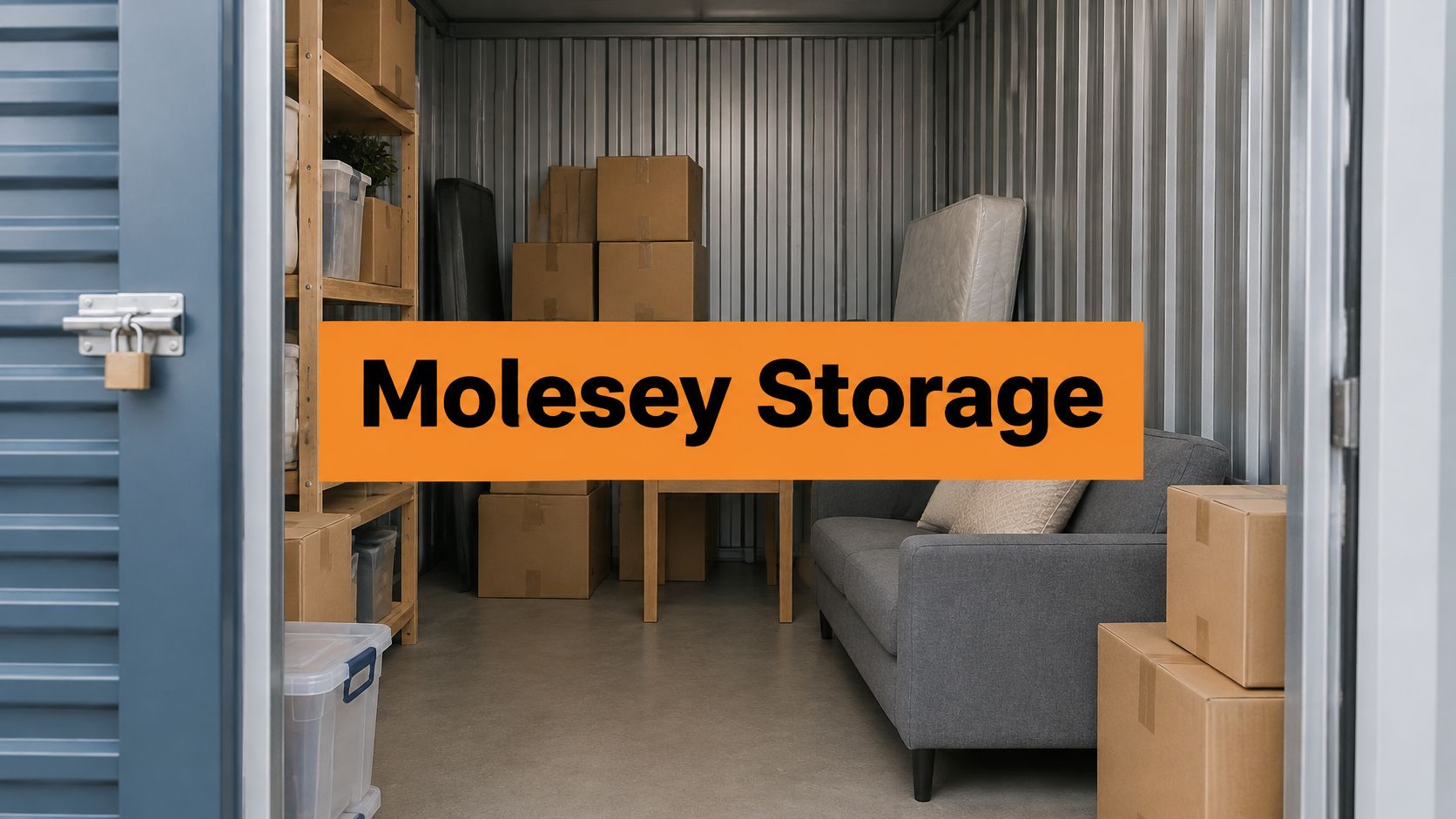
Floor areas are approximate and dimensions differ between sites, so confirm the exact measurements before you book. A unit is sold on floor space, not volume, which means the height is yours to use. Shelving and a stacked mattress turn a 50 sq ft unit into something that holds far more than the same floor left as a heap.
That's the difference between a locker and a garage. The floor plan reads the same on paper, the usable capacity doesn't. Bring a tape measure, not just a room count.
The local market also sits inside a mature national sector rather than a passing trend. The Self Storage Industry Report 2024 records UK capacity rising from roughly 18 million square feet in 2005 to around 60 million by the end of 2023, spread across about 2,706 stores run by some 1,400 businesses.
On the ground: the sites that work best around here are the ones you can drive up to, unload at ground level and walk into without a lift. That matters when a wardrobe is involved.
Standby Self Storage runs a Molesey facility at Island Farm Avenue in West Molesey, and publishes a unit size guide and Advice Centre articles that spell out measurements and packing order. Whichever operator you use, treat any chart as an estimate and the tape measure as the decision.
Next comes measuring what you own. It takes about twenty minutes and it's the difference between a unit that works and one you resent paying for.
How to Pick the Right Unit Size
List everything by room. Walk each room with a notepad and write down what goes, grouped by kitchen, bedroom, living room and so on. Working room by room rather than object by object means nothing gets forgotten and nothing gets counted twice.
Measure the awkward pieces. Sofas, beds, wardrobes, desks and table tops each take a footprint in square feet, and these are the items that eat space. Measure length and width rather than height, because footprint is what you're buying.
Add circulation space. Total the footprints and add 25 to 30 percent. That allowance is the walkway letting you reach the back of the unit without climbing over a sofa, and it's the most commonly omitted line in any sizing calculation.
Round up one size when the stay is open-ended or the items are odd. A curved sofa, a gym machine or a stack of irregular boxes wastes more floor than their measurements suggest. If the stay might run past a month, the extra size usually costs less than a second trip.
Check the door before you check the floor. Measure your largest item's height and width against the unit's door opening and the corridor width on the way in. A sofa that fits the floor plan can still fail at the doorway, and that's the mistake that ends with a loaded van and nowhere to put it.
Plan the layout before you load. Heavy items at the back and on the floor, boxes labelled on the side that faces out, a clear aisle from door to back wall. You'll be grateful the first time you need the box marked winter coats in July.
A right-sized unit lets you reach any box by moving no more than one stack, with roughly a fifth of the floor still open. Packing to 100 percent is the most common slip: retrieval slows to a shuffle and the risk of a dropped box or a scratched table climbs with it.
The twenty-minute test: if your list needs more than one page of footprints, you're probably between two sizes. Take the larger one for the first month and downsize once the awkward pieces are in.
If the chart and your own measurements disagree, the storage unit size guide shows the same sizes with photographs of what fits, which is easier to judge than a number on a page. And if you want a benchmark before you commit, you can find London storage units listed by area and size, which gives you something concrete to compare a Molesey quote against.
Who Uses Self Storage in Molesey and Why
A student finishing halls in June has a familiar problem. The tenancy restarts in September, the family home is a long drive away, and there's no sensible way to haul a mattress and eleven boxes home and back again. A 25 to 50 sq ft unit for the summer solves it, provided access is easy on the day term ends.
That single case shows the shape of the whole market. A unit works like a spare room you rent by the month, so the monthly figure only tells half the story. The trips in and out are where a short stay gets expensive.

Movers are the largest single group in any given month. Around 1.8 million English households moved home in the 12 months before the English Housing Survey 2024 to 2025, and a fair share of those moves involve a gap between the old keys going back and the new ones arriving. Even a short overlap means paying rent by the month plus the van hire and repeat trips either side of moving day.
Households still dominate the customer base nationally. The Property Week analysis of the UK self storage sector put the mix at roughly 73% domestic and 27% business in 2024, which matches the pattern at a Surrey-side site: mostly families and renters, with a steady minority of tradespeople and small e-commerce operations.
Typical stay and unit size by user
| User | Typical stay | Approx. unit size | Key need |
|---|---|---|---|
| Students between terms | 6 to 12 weeks | 25 to 50 sq ft | Easy access for returns |
| Movers with a gap between homes | 2 to 8 weeks | 100 to 150 sq ft | Access on completion day |
| Renovators and downsizers | 1 to 6 months | 50 to 150 sq ft | Dry, secure space for furniture |
| Tradespeople | 3 to 12 months | 50 to 100 sq ft | Tool security and equipment cover |
| Small online sellers | 3 to 12 months | 25 to 100 sq ft | Stock records and frequent access |
A renovator wants dryness and a locked door for six months; a tradesperson wants the mitre saw exactly where it was left and covered by insurance; an online seller wants to reach the fast-moving stock in under a minute. The same building serves all three. Match the access hours and unit type to your routine rather than to the category you think you fall into.
Each group pays differently, too. The mover's bill is short but stacks van hire and repeat access trips on top of the rent. The seller needs to check whether the quoted rent includes VAT, because the advertised figure and the invoiced figure on a business account can differ. The student's summer rate only saves money if collection day lands inside the rental window. I would judge every quote on the total of rent plus journeys, not on the monthly figure on its own.
Security and Flood Protection at Molesey Sites
Good security is layered, and each layer covers a different failure. Perimeter fencing stops casual entry at the boundary. Around-the-clock CCTV records the gate, yard and corridors when nobody is watching. Controlled access limits entry to account holders and logs who came and went. Individually alarmed units, where fitted, put a final alert on the door itself.
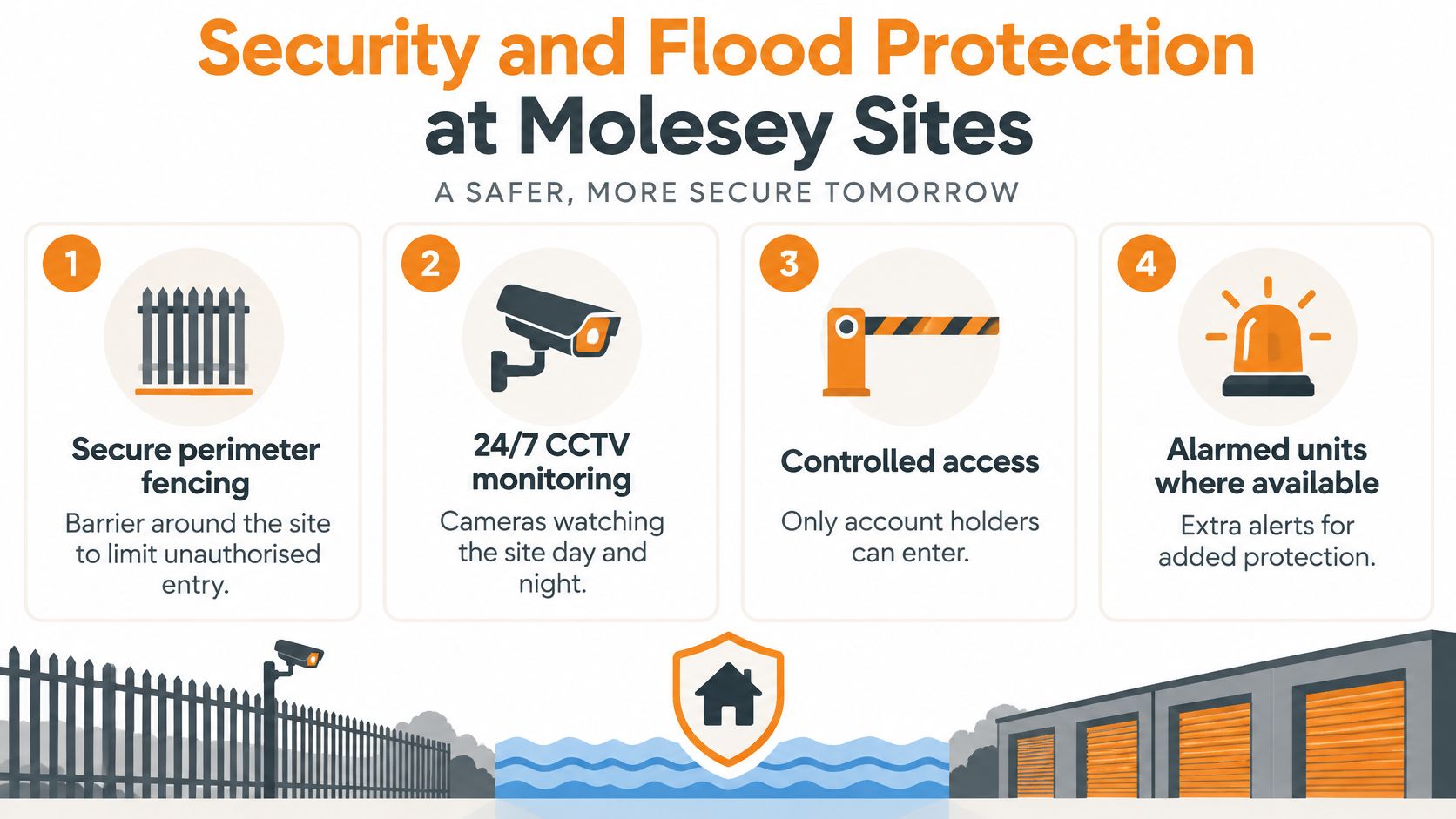
Ask to see the gate log and where cameras point. A camera over the entrance but not along the corridor behind the units tells you little if a lock is tampered with. For a short stay, weak security is also a cost problem: every extra trip to check a unit, replace a lock or move stock after an incident eats into the saving on rent.
Flood risk needs the same practical check. Molesey is low and Thames-side, and parts of East and West Molesey are exposed to river flooding, so a site can be dry inside while the approach road is not. Zone labels prove nothing about a particular facility. They still tell you the controls around it matter.
Ask the operator four things: how does the site drain, are the unit floors or thresholds raised, does water ever reach the access routes, and what is the written emergency procedure? Get the answers before you store paper, electronics or anything you cannot replace.
For your own goods, use sealed plastic crates rather than cardboard for archives and textiles, keep everything on pallets or shelving rather than the floor, and leave a gap between items and external walls where condensation forms. The site's guide to how secure self storage is covers the access and alarm detail if you want to compare facilities on more than a checklist.
Rental Terms and the True Cost of a Short Stay
Rentals in this sector usually run on rolling terms with no notice period, so you cancel when you've finished and pay for the time you used. That's a genuine advantage over a lease, and it's also where the pricing confusion starts, because flexible is not the same as cheapest.
Many individuals cannot estimate the full cost of a short stay, and that is not a guess. Research summarised by Cushman & Wakefield's self storage study found only about 10% of people know the true cost of self storage, with awareness lowest among 18 to 24 year olds at around 21%. The same work shows business-related use rising from 8.7% of customers in 2014 to 16.2% in 2025, which matters because business users carry costs households don't.
The headline rent is one line of a longer bill. Minimum billing periods can mean a four-week stay is charged as eight. Deposits and admin fees may or may not be refundable. Insurance for stored goods is usually required and rarely included. A lock is often a purchase. Then there's the van, the fuel, and the repeat access trips that a small unit forces on you.
For a business, add VAT and the paperwork that goes with reclaiming it. A sole trader storing stock will want a VAT invoice and a record of what's in the unit; a limited company will want the same for the accounts.
Worked budget for a short and a long stay
| Cost item | How to calculate | Four-week stay | Six-month stay |
|---|---|---|---|
| Monthly unit rent | Rate × months billed | Quoted rate × 1 | Quoted rate × 6 |
| Deposit or admin fee | One-off, check if refundable | Charged once | Charged once, refunded at the end |
| Insurance | Cover for stored goods, per period | Charged for 4 weeks | Charged for 26 weeks |
| Lock | One-off purchase or hire | One lock | Same lock, no second purchase |
| Van or transport | Trips × hire cost per trip | Two trips, in and out | Two trips, plus any stock runs |
| Access trips | Fuel or travel per visit × visits | Weekly visits × 4 | Weekly visits × 26 |
| Total | Sum of all rows | Rent plus fees, insurance, lock, transport and 4 visits | Six months' rent plus the same extras and 26 visits |
Fill the last two columns with the actual quote you're given before you compare anything, and count your realistic visits rather than your optimistic ones.
The contrarian bit: "no long-term commitment" doesn't automatically make a stay cheaper. A larger unit, a fortnightly trip across town or a second van hire can outweigh the saving on headline rent. Flexibility earns its keep on seasonal stock and short projects, where a lease would leave you paying fixed overhead for an empty room.
The full breakdown of what a local unit costs, line by line, is worth reading alongside the storage unit cost guide before you commit to a term.
Business Stock, Records and Paperwork
Business users need more than cubic volume. They need reliable access, protection for stock and the ability to retrieve one labelled item quickly; a unit arranged like a spare room fails on all three once stock starts moving.
This is a real slice of the local economy. The ONS business activity statistics classify transport and storage, including postal activity, as a distinct sector accounting for approximately 4.3% of UK businesses, and storage space is what lets many of the smaller ones trade without signing a commercial lease.

Set the unit up in three zones. Fast-moving stock goes nearest the door so a pick takes seconds. Long-term archives go to the back. Anything heavy or rarely touched goes on pallets or low shelving at the back, where it costs you nothing to leave alone and stays off a floor that may flood.
Then give everything an identity. An SKU or asset code on each box, a simple log with inbound and outbound dates, and a note of which zone it lives in. That log is what stops a stock count turning into an afternoon of unpacking, and it shows whether a fortnightly trip is buying convenience or just adding fuel, van time and staff hours to a short stay.
Paperwork matters as much as the shelving. Business customers often need VAT invoices, a stock record for insurance and accounts, and separate cover for high-value equipment or irreplaceable records, because standard policies don't automatically extend to everything you own. Read the conditions rather than assuming, and price the stay with those business extras included rather than judging it on rent alone.
One rule covers most of it: the most valuable and most frequently used items go in the most accessible position. Everything else is a storage decision you only have to make once.
Because parts of Molesey sit in Flood Zones 2 and 3, verify the site's flood resilience, insurance conditions and access continuity in writing before you store client records or expensive kit there. Then buy proper archive boxes rather than reusing supermarket cartons; Where can I buy archive boxes? is a practical starting point for cartons built to stack and take a label.
Book, Move In and Confirm Your Unit
A booked unit still fails at the gate if the timing, the paperwork or the lock is wrong. Work through the steps in order.
Check sizes and live prices on the facility's own website. Work from the measured list and door dimensions you already have, not from the room you're leaving.
Confirm the access hours against your move day. Arriving outside them is the most common booking-day problem, and it usually surfaces with a loaded van at the gate.
Book the unit. Online booking takes minutes and holds the size you chose rather than the one that happens to be left.
Have identification and contact details ready. The account has to be set up in a name, and missing paperwork stalls the handover.
Pay and confirm the start date. Check whether the first period is billed in full, whether the quoted total includes VAT and when the next payment falls, so a short stay isn't priced as a long one.
Arrive inside the access window with van, trolleys and a lock. Forgetting the lock is the second most common slip, and it costs a return journey.
Unload to the layout you planned. Heavy items at the back, labels facing out, a clear path to the door from the first box rather than the last.
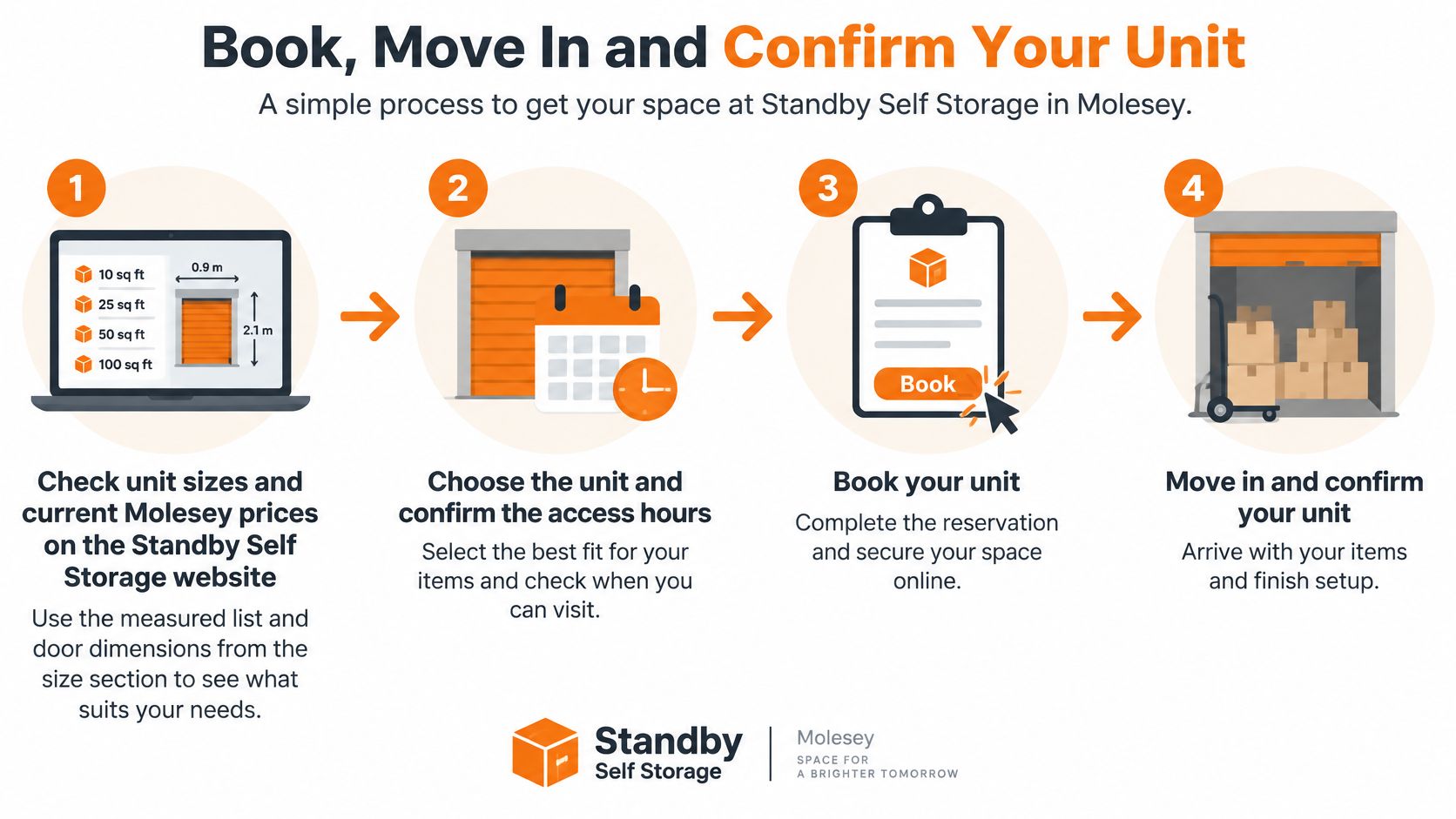
- Photograph the loaded unit and keep a contents list. Dated photos settle insurance questions later and take two minutes now.
Before you pay, confirm four things: the unit size against your list, the security and flood answers you have collected, the total from your budget rather than the headline rent, and the cancellation terms. A short stay favours a compact unit on rolling terms. A six-month project often justifies one size larger to cut access trips, because the trips are where the money goes: fuel, van time and the hour at each end of every visit.
A successful move-in looks unremarkable. Everything is inside, the path to the back is clear, and you have a record of what's there.
Storage in Molesey comes down to matching a measured list to a real unit and knowing the full cost before you sign anything. Standby Self Storage has a Molesey location with secure perimeter fencing, 24/7 CCTV monitoring and controlled access, you can check pricing and book a unit online, and a support team answers questions by phone or online chat. Visit Standby Self Storage and compare its size guide against your measured list before you pay.