
What will make you stop paying for storage: a finished renovation, a confirmed moving date, or deciding what to keep? Many renters compare unit sizes first, but how long you'll rent matters just as much as whether the sofa fits.
When comparing storage units in Horsham, start with a clear purpose and an exit plan. Then choose the space, access arrangements and protection that suit the job, rather than paying for a larger unit because you haven't measured the contents.
Horsham Storage Unit Sizes at a Glance
| Unit | Floor area and dimensions | Best for | Monthly price |
|---|---|---|---|
| Locker | 16 sq ft (4ft × 4ft) | Boxes, files and small items | Check the current online quote |
| Wardrobe | 28 sq ft (8ft × 3.5ft) | Seasonal clothes and small furniture | Check the current online quote |
| Large House | 120 sq ft (15ft × 8ft) | Contents of a four-bed house or trade storage | Check the current online quote |
| Commercial | 320 sq ft (40ft × 8ft) | Large commercial or industrial storage | Check the current online quote |
| Remaining nine sizes | Request the full size list and exact internal measurements | Loads that don't match these examples | Request a quote for the selected size |
Choose a likely size from your contents, then confirm it with measurements. Our Horsham range has 13 sizes, so these examples are starting points, not a reason to jump straight from a small locker to household storage.
A Locker suits a collection of boxes, files or small possessions. Books and paperwork become heavy quickly, so use manageable boxes rather than packing everything into oversized cartons that are awkward to lift.
The Wardrobe suits seasonal clothing and smaller furniture. Its narrow footprint makes furniture depth important: a piece might fit within the floor area but leave little useful room beside it.
Treat capacity descriptions as starting points
The Large House is intended for the contents of a four-bed house or trade storage. That description doesn't guarantee that every furnished home will fit, particularly if you have bulky garden furniture, workshop equipment or pieces that won't dismantle.
The Commercial unit suits large commercial or industrial storage. Plan how stock will enter, where it will stand and how you'll retrieve it, rather than treating the whole floor as one loading space.
Sizing rule: A unit that holds everything isn't necessarily a unit you can use comfortably.
Floor dimensions don't tell you the door opening, usable height or clearance needed to turn furniture. Confirm those details before arranging transport, especially for tall cabinets, long worktops or equipment on wheels.
If your load sits between the examples, shortlist both possibilities and compare their layouts. Ask for the remaining sizes rather than assuming the larger option is the only safe choice.
Use the price column as a reminder to obtain a current quote, not as a promise of a particular rate. Compare the full payable amount and billing period before committing.
Who Uses Storage in Horsham and What They Store
Horsham's growing population provides useful context, but it doesn't tell you what any individual household needs. The district's population grew 11.8% between 2011 and 2021, while private renting rose from 11.8% to 14.5% of households, according to Horsham District Council's census information.
The practical question is what's changing in your home or working life, and when that change will be complete.

Recognise the job you need storage to do
A renter leaving a tenancy before the next property is ready needs somewhere for a bed frame, kitchen boxes and perhaps a desk. The collection date should follow the new tenancy, so keeping moving essentials separate matters more than creating a permanent shelving system.
A homeowner clearing a room for builders might store a sofa, dining furniture and boxed ornaments. In that situation, the contents should be grouped by the order they'll return, particularly if decorating will finish at different times.
Students may need somewhere for bedding, books and cookware during a term break or placement. The useful comparison is storage near the next destination versus the effort and cost of transporting everything home.
For a tradesperson, the load might include tool cases, ladders and boxed fittings between projects. Retrieval matters: burying tomorrow's equipment behind surplus materials makes the arrangement frustrating even if everything fits.
Separate suitable contents from unsuitable ones
- Usually suitable: Clean, dry furniture, archive boxes, seasonal clothing and spare stock, subject to the rental agreement.
- Keep out: Perishable food and flammable materials, along with anything prohibited by the operator's terms.
- Check before storing: High-value possessions, specialist equipment and items needing controlled environmental conditions.
Don't assume that a physically secure unit is suitable for every material. Damp clothing, leaking containers and dirty equipment can damage neighbouring belongings inside your own space.
Identify your main use before choosing a size. Are you bridging a move, clearing working space, travelling between terms or organising equipment? That answer determines both the layout and the likely end date.
How to Choose the Right Unit Size in Five Steps
Measure the load you're keeping, not everything currently occupying the room. A tape measure, a written inventory and a rough floor sketch are more useful than guessing from the number of bedrooms.
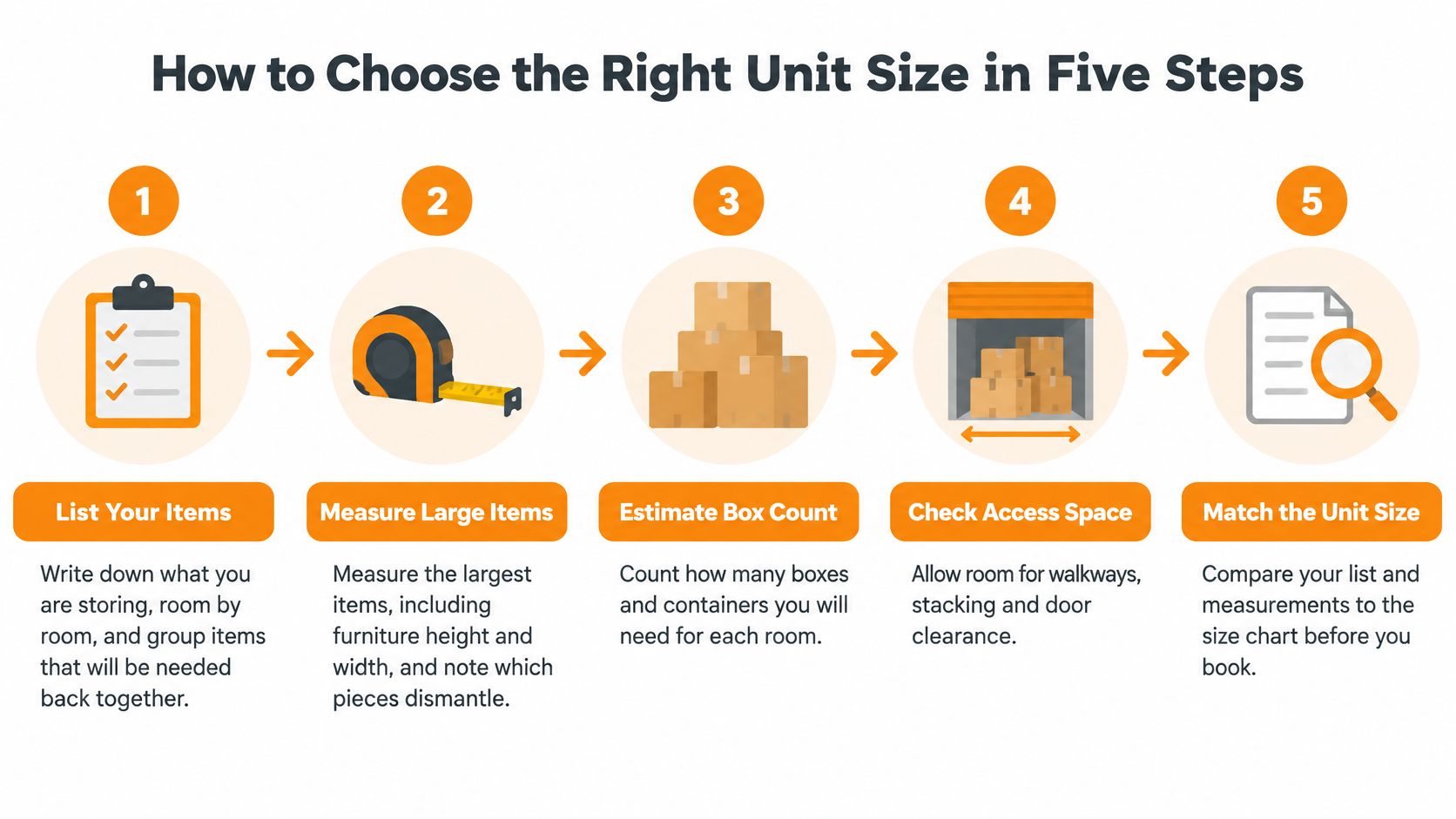
List the contents room by room. Give furniture its own entry and group smaller belongings into labelled boxes, keeping items together when you'll need them back together. The common mistake is overlooking cupboards, outdoor furniture and dismantled components until moving day.
Measure the awkward pieces first. Record length, width and height, then note which legs, shelves or frames can be removed safely. Don't assume a large item will turn through the entrance because its footprint fits inside.
Count boxes and plan safe stacking. Use reasonably consistent box sizes so you can sketch stacks rather than a loose collection of objects. Avoid treating fragile lamps, upholstered furniture and heavy archive boxes as interchangeable blocks.
Draw the retrieval route. Leave enough clear space to carry the items you expect to collect, including room to turn with them. Packing tightly can work for a single collection at the end, but it's a poor arrangement for regular stock picking.
Match the layout to an available unit. Include shelving, protective packing and anything you know will arrive later, then compare the sketch with the actual dimensions. Don't rent a much larger space merely to avoid making an inventory.
Make the floor plan workable
Put heavy boxes low down and keep fragile contents away from load-bearing stacks. Use sound freestanding shelving for items you'll retrieve repeatedly, checking its load rating before filling it with files or tools.
Raise suitable contents on clean pallets or a stable platform where appropriate. That can improve separation from the floor, but it won't correct an unsuitable or damp environment, so inspect the space rather than relying on packaging alone.
Our storage unit size guide can help you compare layouts before booking. Keep your own measurements alongside it, because furniture shapes and packing choices affect usable capacity.
An accessible smaller unit can be more useful than a larger unit filled without a plan.
You should finish with a chosen size, a contents list and the days you'll need access. If the layout still feels uncertain, mark the proposed footprint on the floor at home and position the largest pieces within it before committing.
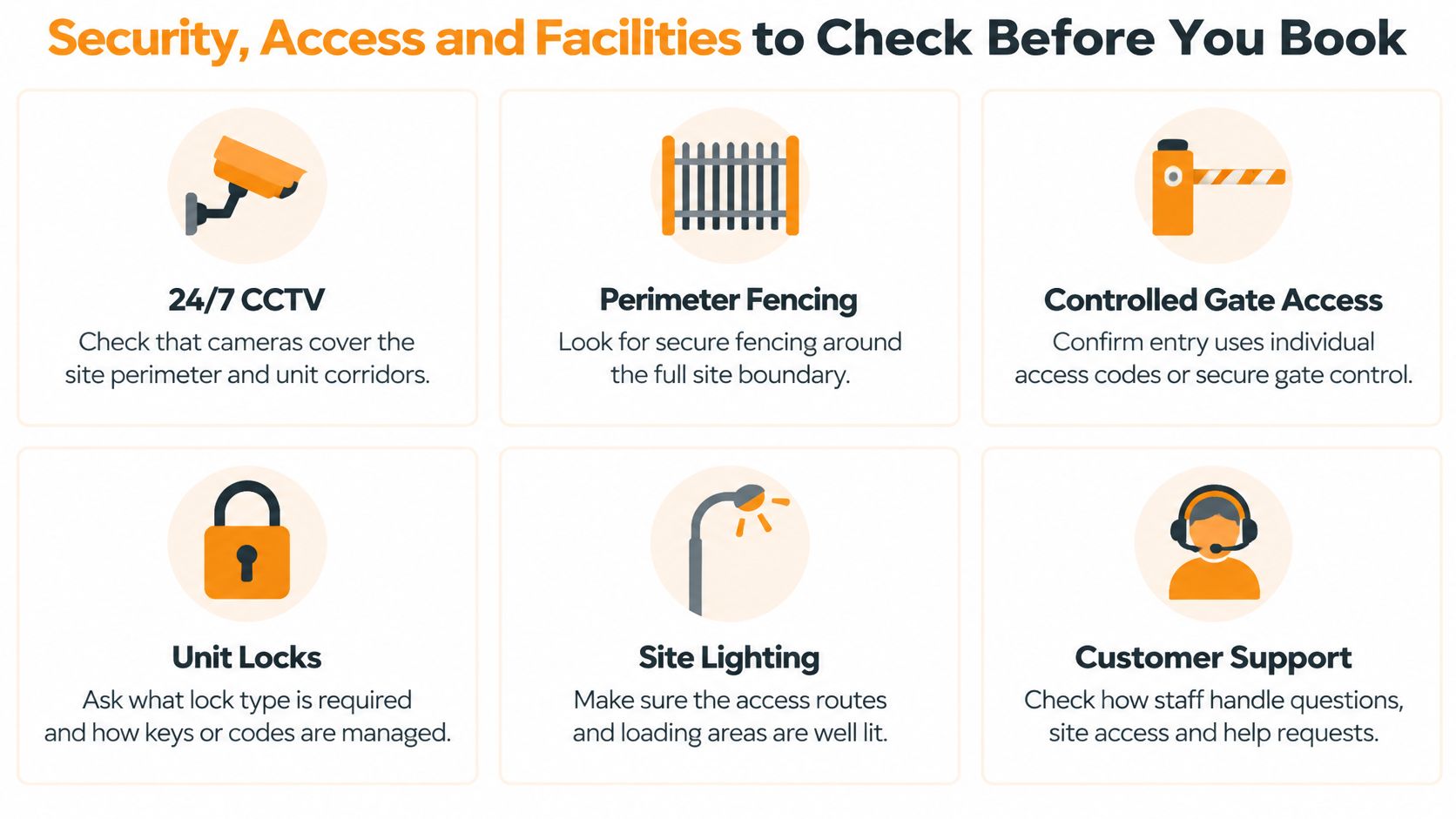
Security, Access and Facilities to Check Before You Book
Good security needs a practical explanation, not just a camera symbol beside the booking button. Ask how entry is controlled, what staff can investigate and who responds when something goes wrong.
Look for a defined response
CCTV coverage should include relevant entrances, boundaries and circulation areas. A useful answer distinguishes recording from active monitoring and explains the response procedure, rather than implying that cameras prevent every incident.
Controlled entry should make it possible to manage authorised users and withdraw access when necessary. Nimbio's gate access system evaluation criteria offer useful questions about access management, although the facility's actual arrangements are what matter.
Check fencing, lighting and the required unit lock as well. For valuable contents, establish whether additional alarms or other precautions are appropriate and whether your insurer accepts the arrangement.
Check the visit, not just the gate
Access hours and staffed opening hours aren't necessarily the same. Establish how you get help outside staffed hours, whether your chosen unit is ground-floor and how far you'll carry items from a parked van.
Insurance needs a separate check. Don't assume home contents cover extends to off-site storage, or that the operator's policy covers your belongings; confirm insured values, exclusions and any packing conditions.
Use this call or visit checklist:
- CCTV: Which areas are covered, and who responds to incidents?
- Gate access: How are users authorised and credentials cancelled?
- Access hours: When can you enter, and when is help available?
- Insurance: What cover is required, and what evidence is needed?
- Late payment: What charges or access restrictions can follow?
Keep a dated photo inventory showing condition and identifying details before moving in. Our guide to how secure self storage is explains how site protection and your own precautions work together.
How Long to Rent and When Storage Becomes Expensive
Storage makes financial sense when it solves a defined problem for an acceptable total cost. A low introductory rent doesn't answer that question if the contents remain untouched after the original reason has disappeared.
Home redecoration accounted for 24.4% of reported self-storage use in 2025, up from 13% in 2014, according to Safestore's UK market overview. Renovation is a clear use case, but the rental should still have a planned endpoint.
Build a duration comparison
Use actual quotes to complete this worksheet. Include the return journey, not just the cost of moving belongings into storage.
| Review point | Storage total to calculate | Alternative to price alongside it |
|---|---|---|
| One month | Rent, transport, packing, insurance and any expected disposal | Temporary space elsewhere or keeping fewer items |
| Six months | Accumulated charges, extra journeys and shelving | Selling replaceable items, downsizing the unit or digitising suitable paperwork |
| One year | Full continuing cost and eventual removal | Replacement purchases or a lasting change to home or business space |
These are planning checkpoints, not recommended rental periods. Don't count a refundable deposit as a permanent cost, but do allow for the cash it ties up.
The UK self-storage cost guide helps identify quote components. For your decision, compare like-for-like totals rather than an advertised rate against an alternative's complete cost.
Keep an item because you expect to use it, not because you've already paid to store it.
A house-chain delay, university break or seasonal stock peak can justify renting. An unspecified collection of replaceable furniture deserves a harder review, particularly when nobody can name its destination.
Missed payments create another avoidable risk. The DIYAuctions Houston storage auction guide is US-specific, not guidance on UK rights, but provides context for why customers should read default terms carefully.
Set a recurring review date before signing. Record whether the original purpose still exists, what can leave and the revised total you're willing to pay.
What Businesses Can and Cannot Keep in a Unit
A locked unit doesn't make a business archive compliant. Physical security and lawful retention are different responsibilities, and keeping documents indefinitely can create problems even when nobody else can reach them.
UK GDPR's storage-limitation principle means personal data mustn't be kept longer than necessary for its lawful purpose; a documented retention-and-disposal approach is illustrated by HMRC's records management policy. HMRC's departmental schedule isn't a universal timetable for your business, so set retention rules appropriate to your records and obligations.
Classify the contents before packing
| Category | Practical treatment |
|---|---|
| Stock and equipment without personal data | Maintain a stock inventory and check material restrictions |
| Ordinary business archives | Identify purpose, ownership and applicable retention requirements |
| Customer, employee and financial records | Assess personal data, confidentiality, authorised access and secure disposal |
Financial documents aren't all the same sensitivity, and ordinary-looking paperwork can still identify individuals. Classify by what a record contains, not the folder name.
For equipment and stock, check batteries, liquids, fuels and other restricted materials against the agreement. Renting storage also doesn't automatically permit workshop activity, customer visits or operating machinery inside it.
Give each archive a disposal route
- Name the record category. Separate customer correspondence, employment paperwork and accounting records rather than labelling everything “old files”.
- Set the retention rule. Document the lawful purpose and the event or date that determines disposal, checking applicable obligations.
- Label boxes discreetly. Use an inventory reference and review or destruction date without exposing personal details on the outside.
- Control access. Keep an access log and restrict keys or codes to authorised people.
- Arrange secure destruction. Use an appropriate confidential-waste service and retain evidence of destruction, including a certificate where supplied.
Pause destruction where a genuine legal or operational requirement means records must be preserved. Record the reason rather than abandoning the schedule.
CCTV and perimeter fencing can protect the premises, but they don't decide who should read a file or when it should be destroyed. Before adding archive space, list your largest record categories and give each a justified keep-until or review date.
Confirm Your Horsham Unit Before You Move
Our Horsham facility is at The Storage Yard, Foundry Lane, RH13 5PX. Confirm your route and arrival arrangements before loading, particularly if someone else is driving the van.
We offer 24-hour customer access at Horsham, and onsite customer toilets are available. Staff availability is a separate matter, so arrange a visit in advance if you want someone to discuss the space with you.

Make the booking fit the project
If your real need is permanent space at home, compare that option before beginning an open-ended rental. For example, you could request a bespoke cabin quote from Timber Lodge 365 to assess a garden building, subject to site suitability and any permissions needed.
For a temporary move, prepare your photo ID, contents inventory and insurance details, then confirm which documents are required. Keep booking and access instructions somewhere you can reach without unpacking.
- Confirm the selected unit. Match the booking to your measurements and written contents list.
- Verify arrival details. Check the address, customer access procedure and support arrangements.
- Resolve practical conditions. Confirm loading space, required insurance and access credentials.
- Choose the start date. Leave enough preparation time to pack properly before the rental begins.
- Check the ending terms. Our rentals have no notice periods or long-term commitments, so you can cancel when you're done.
Check availability for your chosen size before arranging transport. If you'd prefer to inspect the unit and security arrangements first, arrange a visit before committing.
Standby Self Storage offers flexible personal and business storage in Horsham, with secure perimeter fencing, CCTV monitoring and controlled access. Visit Standby Self Storage to check current pricing and availability, choose a unit that fits your contents, and book around your planned storage period.