

The van is booked for Saturday, the kitchen comes out on Monday, and somewhere in between there's a fortnight where the sofa, the dining table and forty boxes have nowhere to live. Or you've handed back the keys on one flat and the next tenancy doesn't start for six weeks. Either way, you're looking at storage units in Epsom and trying to work out what size you need, not what size sounds about right.
Book the smallest unit their belongings will fit into, then spend the next three months shifting boxes to reach the one thing they came for. That's the expensive way to do it. Overfilling costs more than a bigger unit would, because slow retrieval and double handling keep you renting for longer than you planned. Size for easy access, not for the cheapest weekly rate.
Epsom Storage Unit Sizes at a Glance
Read the table by what you own, not by the room count in your head. The contents column is a starting estimate for a normal household load, not a packing challenge.
| Unit | Dimensions | Area | Suits |
|---|---|---|---|
| Small Garage | 5ft × 8ft | 40 sq ft | 1–2 rooms of furniture or business stock |
| Single Garage | 7ft × 7ft | 49 sq ft | 2 rooms of furniture or a small flat |
| Large House | 19ft × 7ft | 133 sq ft | Contents of a 4-bedroom house or a large business stock |
What each footprint really holds
The Small Garage at 5ft × 8ft (40 sq ft) takes one or two rooms of furniture, or a run of shelving boxes for business stock. The Single Garage at 7ft × 7ft (49 sq ft) suits two rooms of furniture or the contents of a small flat. The Large House at 19ft × 7ft (133 sq ft) holds the contents of a four-bedroom house or a large stock load.
Shape matters as much as area here. The Small Garage is long and narrow, so it stacks well front to back but leaves you very little room to stand once a sofa goes in. The Single Garage is square, which makes a centre aisle possible if you keep the middle clear and load down both sides. The Large House is a long run, so you can zone it: furniture at the far end, frequently used boxes nearest the door.
Confirm the size before you plan the move
The Large House is listed separately from the two garage-style units, so confirm current availability before you build a moving plan around it. Turning up with a four-bedroom load and finding only garage-sized units free is a bad start to a Saturday.
These dimensions describe the floor footprint only. They tell you nothing about door width, door height or internal ceiling height, and a wardrobe that fits the floor plan on paper can still fail at the doorway. Our Epsom units are ground floor with vehicle access, which removes the stair carry, but you should still measure the tallest piece you own and check it against the unit before you commit.
Practical rule: match the unit to the largest item you must store, then check the fit before you book.
How to Estimate the Unit Size You Need
A tape measure, a notepad and one walk round the house settle this question in about twenty minutes. Work the steps in order, because each answer changes the next one.
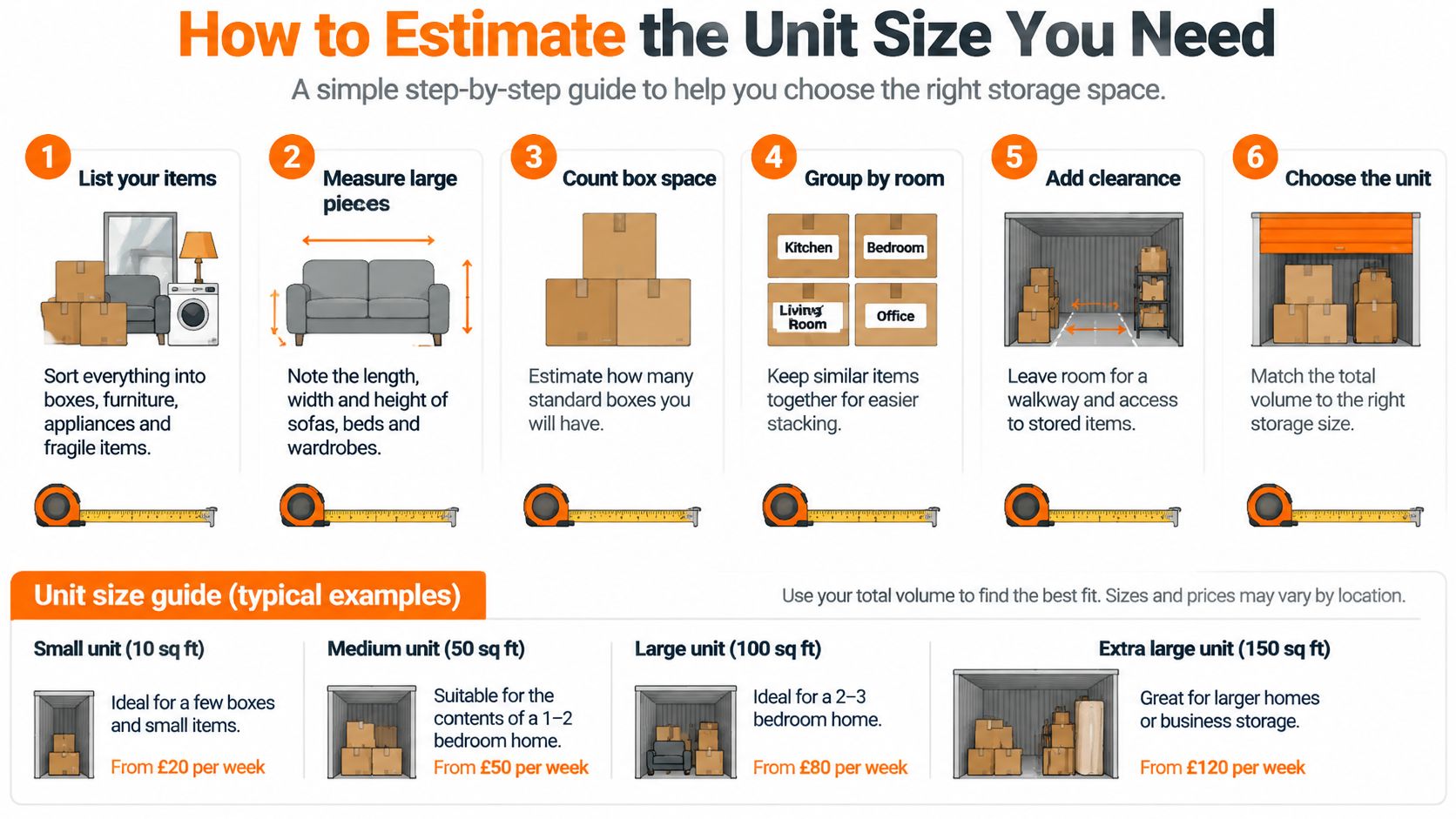
- List everything, then group it. Write down every item going into storage and sort it into boxes, furniture, appliances and fragile items. Grouping matters because boxes stack vertically while furniture mostly doesn't, so the two behave very differently in a unit.
- Measure the largest item in each group. Length, width and height, including the legs and any awkward angle on a sofa. A wardrobe or an American-style fridge freezer sets your minimum unit size regardless of how few boxes you have.
- Add up the footprints and leave a walkway. Total the floor area each group needs, then add a clear path so any box can be reached without moving the rest. That path is the difference between a two-minute collection and a half-hour reshuffle.
- Match the total to the unit list. Pick the smallest size that holds the stack with room to spare, not the smallest one it will physically fit into. The tighter unit saves a little rent each month, but every visit costs you handling time, and jobs that should take one trip end up taking two.
- Estimate the duration carefully. A short gap between tenancies needs far less planning than a renovation running for months. Long rentals reward proper racking, labelled boxes and a permanent aisle, because you'll be in and out repeatedly.
- Decide how often you'll visit. Frequently visited units need clear paths and heavy items near the door. A unit you'll open once at the end can be packed much tighter, and that's the one situation where squeezing pays.
Local household size is a useful sanity check. The Surrey census 2021 household characteristics release records an average household size of 2.58 people in Epsom and Ewell, the largest average in Surrey, across 31,321 households, up 5.2% from 2011. A family home here usually holds more furniture, more seasonal kit and more boxed inventory than a single-person flat, so don't size a three-bedroom house against a studio's worth of belongings.
The check you can do at home
Mark the planned unit's footprint on the floor of your largest room with masking tape, using the back wall as one edge. Load the biggest group into that space in your head, then confirm a path to the door survives. For a second opinion on the arithmetic, this page helps you work out your storage unit size with volume estimates, and our storage unit size guide sets out the unit range against typical contents.
Common Sizing Mistakes and How to Avoid Them
Four errors account for most of the regret people feel a month into a rental. Each one has a fix you can apply before you book or during the first week.
| Common Mistake | What It Causes | Fix Before or During Rental |
|---|---|---|
| Overfilling the unit | Slow retrieval, extra handling and a longer rental | Choose the next size up if you visit often |
| Picking the cheapest unit without measuring | Furniture that doesn't fit or stacks to the ceiling | Measure the largest item and leave a walkway |
| Stacking boxes directly on the floor | Damp damage and wet cardboard | Raise boxes off the floor and label them by contents |
| Keeping the first size without review | Paying for unused space or being unable to reach items | Review the unit within a week and resize if needed |
Why the cheapest unit rarely stays cheapest
The saving on a smaller unit is fixed and visible. The cost of overfilling is neither. Every visit turns into a dig, every dig means handling items twice, and the job you meant to finish in one afternoon spills into a second trip. People then keep the unit "just until I sort it out", and the sorting never happens because sorting is unpleasant in a packed space.
Timelines slip more often than anyone budgets for, too. Epsom and Ewell's 2024–25 annual monitoring report recorded 112 net new homes, against an assessed housing need that rose from 569 to 817 dwellings per year, so completion dates and moving plans in a tight local market are worth padding.
The cheapest unit is the one you can empty on the day you planned to empty it.
Resizing after the first visit
Go back within the first week, while you still remember what went in. Try to reach three specific boxes without moving anything else. If you can't, you need more floor area, not better stacking. If you can walk to the back wall without stepping over anything, you're paying for air and should move down a size.
A sizing estimate is a starting point, not a permanent decision. Ask about moving between units before you sign, so a change is a phone call rather than a second move.
Who Needs Epsom Storage and Why
A renter hands back the keys on a Friday and can't move into the next flat for six weeks. The gap itself creates the need. Nothing about that person's belongings has changed, but for a month and a half they need a room they don't have, and a small unit with easy access beats a friend's spare bedroom every time.
Renters between tenancies
The ONS census area changes profile for Epsom and Ewell shows households renting privately rising from 13.3% in 2011 to 16.1% in 2021, while social renting increased from 8.0% to 8.8%. Renters typically store boxed clothes, a bed, a bike and kitchen kit, and the need usually runs weeks rather than months. Short, flexible terms matter more than a discounted long commitment here.
Flat dwellers have a slightly different pattern. The council's borough profile records 20.9% of homes as purpose-built flats or tenements, where there's no loft or garage to absorb overflow, so a small unit often becomes semi-permanent extra space rather than a moving stopgap.
Homeowners, sellers and everyone else
- Renovating owners: furniture, flooring and appliances out of the rooms being worked on, commonly for the length of the build rather than the quoted fortnight.
- Sellers in a delayed chain: boxed possessions and non-essential furniture held for a few weeks while dates move. Cyber Homes' gap housing tips for relocating sellers are worth reading before you assume the completion date will hold.
- Students: a term's worth of books, bedding and a bike over the holidays or a gap year, which we cover with dedicated student storage at Epsom.
- Small businesses and tradespeople: stock, samples, tools and archive boxes, often open-ended and visited weekly.
Identify which group you're in, then run the sizing steps with that duration and visit frequency in mind. A three-month renovation and a six-week tenancy gap should not produce the same booking.
Security and Access Features to Check
Security is a set of specific things you can verify, not a word on a website. Walk the site with this list and ask about the exact unit you're booking, because features differ between locations and sometimes between buildings on the same site.
- 24-hour CCTV covering the site and access points: cameras at the gate and along the unit runs record who came and went, which is both a deterrent and the first thing anyone asks for after an incident.
- Gated or controlled entry: a perimeter that limits who can enter, and when, keeps casual traffic off the unit rows entirely.
- Lighting at the unit door: motion-sensor lighting means you're not holding a torch in your teeth while trying to find a box label in December.
- Ground-floor units with vehicle access: you can back a van up to the door instead of carrying a washing machine up stairs or along a corridor.
- Clean, dry units with no leaks or damp: look at the floor corners and the ceiling for staining, because damp ruins paper, upholstery and cardboard long before it ruins anything metal.
- Access hours that match your schedule: check evenings, weekends and bank holidays against the times you'll turn up, not the times you imagine you will.
- Door type and opening width: a roller door and a hinged door behave differently with a long sofa, and the widest item you own decides which you need.
What we provide at Epsom
Every unit at our Epsom site is clean, dry and secure, with 24-hour CCTV surveillance and motion sensor lighting, and the location offers 24 hour customer access. Units are ground floor with vehicle access, so loading is a straight carry from the van to the door. If you want to go deeper on what CCTV, perimeter fencing and locks each do and don't protect against, our piece on how secure self storage is covers the practical limits.
Do this before you sign: walk the route from the gate to the unit door at the time of day you'd normally visit, and check the lighting and the path.
A site that looks fine at eleven in the morning can be awkward at nine at night. Take the tour in the dark if that's when you'll be loading.
When Business Storage in Epsom Makes Sense
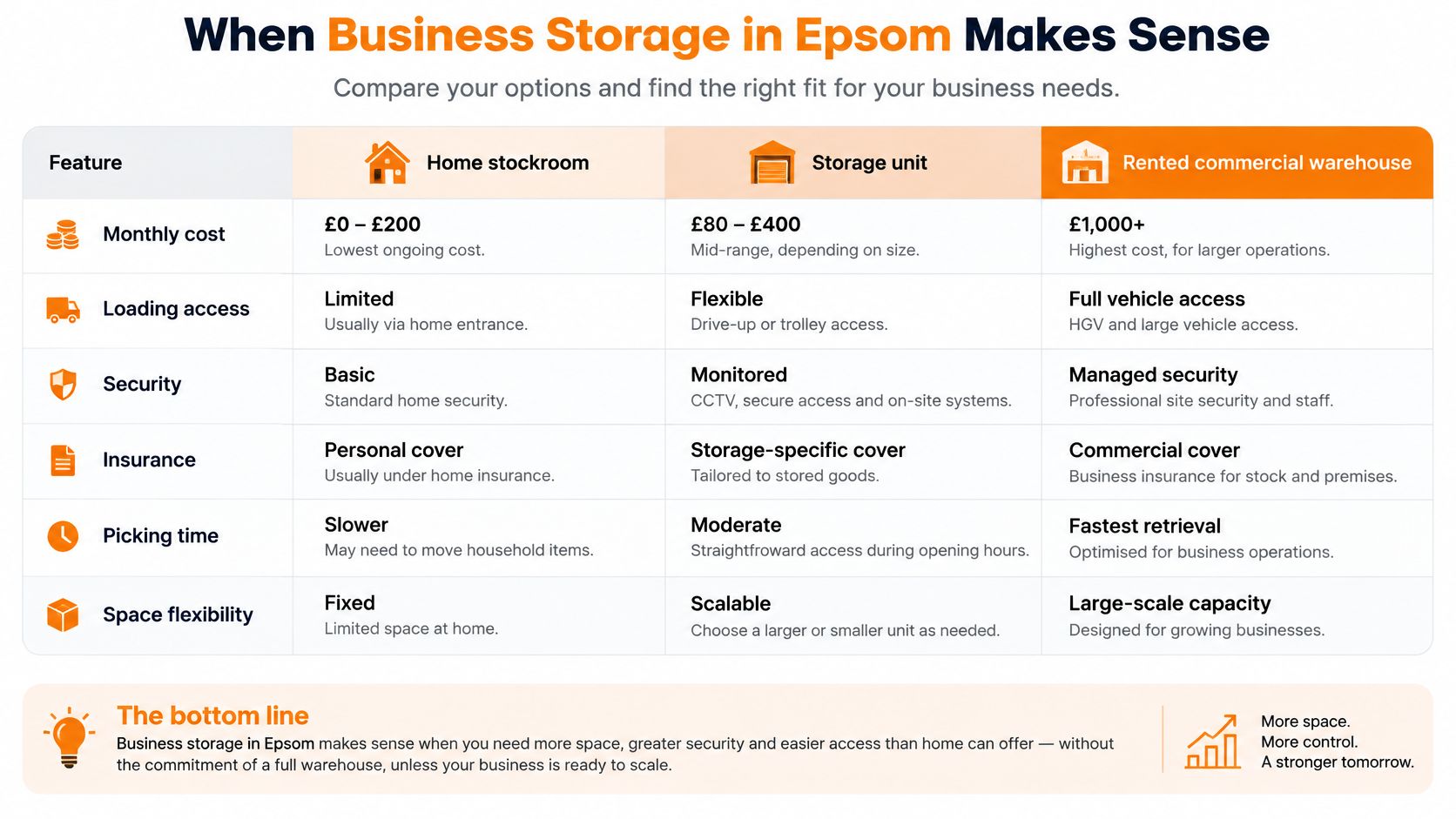
Three models cover almost every small firm's decision, and they differ on more than price.
| Criterion | Home Stockroom | Storage Unit | Commercial Warehouse |
|---|---|---|---|
| Monthly cost | Low, uses existing space | Set by unit size | Highest, plus lease and service commitments |
| Loading access | Limited by home layout | Depends on site and unit door | Designed for regular deliveries |
| Security | Depends on home setup | Site-level CCTV and controlled access, check per site | Usually strongest, varies by premises |
| Insurance | Home policy may not cover stock | Check operator and own business cover | Business policy usually required |
| Picking time | Fast for small volumes | Moderate, depends on packing | Fast with racking |
| Business rates | Possible if home is used commercially | Check with the local council | Usually payable on the premises |
Storage units suit low-volume stock, documents, samples and equipment. A home stockroom suits very small volumes. A warehouse suits regular high-volume operations.
The local business case
The Surrey local government review evidence on economic growth records 3,925 active business enterprises in Epsom and Ewell in 2023, with 415 business births and 340 business deaths. That churn is exactly the storage customer: a new firm needing low-commitment space for stock and records before it takes premises, or a restructuring one holding assets during a relocation. The same evidence identifies approximately 56,000 square metres of employment floorspace need for 2022–2040, which is why flexible space works as an interim layer rather than a permanent substitute. Our business storage guidance sets out the operational side in more detail.
Where a storage unit stops working
Temperature-sensitive goods, hazardous materials, high-volume pallet movements and frequent courier collections all need specialist premises. A unit isn't a distribution hub, and a courier who can't wait while you dig through boxes will cost you more in failed collections than you save in rent.
For document-heavy firms, raise archive boxes off the floor on pallets or shelving and label them by retention date, not just by department. You'll retrieve faster and keep paper away from any moisture at floor level.
Before you write off the home option entirely, consider whether the space problem is really a joinery problem. Interiors by DeX's walk-in wardrobe design options show how much fitted capacity a spare wall can yield, which sometimes removes the need for off-site space altogether.
A sole trader with boxes of stock and files will usually fit a storage unit comfortably. A firm moving pallets daily won't, and shouldn't try.
Terms, Steps and Decision Rule
Booking is straightforward once you've sized properly. Work through these in order and you'll avoid the clauses that catch people out.
- Choose the size from your estimate, then check your largest item against both the door opening and the internal height. Floor area alone won't tell you whether a wardrobe stands upright.
- Check availability for your start date. Listed sizes should be confirmed on the day you book, particularly if you need a specific unit type for vehicle loading.
- Confirm the minimum rental length. Some agreements commit you to a set period even if you only need three weeks, so match this to your realistic timeline.
- Read the notice period for leaving. You usually pay until the notice runs, so a fortnight's notice on a unit you empty today is a fortnight's rent you didn't plan for.
- Check the full price line: monthly rate, any deposit, admin or lock fees, and whether an introductory rate changes after a set period.
- Check the insurance requirement. Ask whether your own contents policy extends to goods stored off-site, and what the operator requires if it doesn't.
- Confirm access hours and how you'll reach the unit. Gate codes, key collection and vehicle entry all matter on moving day, not on the day you sign.
Fixed term or rolling monthly
A fixed term suits a known end date. Say you've exchanged on a sale with completion booked, you know the furniture comes out on a set day, and a fixed term with a clear finish is simple to budget.
A rolling monthly agreement suits an open-ended renovation or a delayed move, where the end date depends on a builder or a chain. Paying a slightly higher monthly rate for the freedom to leave is usually cheaper than committing to three months you might not need.
Reading rule: find the notice, cancellation and fee lines first, and confirm they match what you were told at the desk or online.
Booking at Epsom
Our Epsom facility is at 2a Lower Court Road, Epsom, KT19 8SH, with clean, dry units, 24-hour CCTV, motion sensor lighting and 24-hour customer access. Book online or by phone, and arrange the move for a time when the unit is ready and you can get a vehicle to the door.
The decision rule is simple. If your estimate fits a listed unit and the terms match your timeline, book it. If the largest item doesn't fit, move up a size first, because a unit you can't load properly is a unit you'll be paying for while you work around it.
Standby Self Storage runs clean, dry, secure units at 2a Lower Court Road in Epsom, with ground-floor vehicle access, 24-hour CCTV and 24-hour access so you can load at whatever hour suits the move. Bring your measurements and your largest item's dimensions, and we'll help you pick the size you can reach into rather than the one you can just about squeeze into. Check sizes and book online at Standby Self Storage, or call us and talk through your inventory before you commit.