Your stock has probably reached the point where home storage is slowing the business down. The spare room is full, the garage is half packing bench and half overflow shelving, and every courier collection turns into ten minutes of shifting cartons just to reach the right SKU. In Reigate, that problem usually starts small, then gets expensive fast once late dispatches and stock confusion creep in.
That's where local storage starts making sense for online sellers. You keep stock close enough to reach it quickly, but out of the house and into a site built for access, security and routine handling. For a lot of small retailers, that's the point where fulfilment becomes organised instead of reactive. If you're weighing up local storage against marketplace fulfilment, it also helps to understand where self-storage sits beside options like scaling your business with FBA, especially if you want part of your stock under your own control.
Reigate is well placed for that kind of hybrid setup, and local operators have made business access a lot easier than the old model of simple lock-up units. If you want a feel for what that looks like on the ground, Reigate self-access storage options give a practical reference point for how online booking, business use and stock storage now fit together.
Introduction to Local Storage Solutions
The typical Reigate e-commerce storage problem isn't lack of ambition. It's lack of working space. Sellers grow from a few shelves to stacked cartons, then realise they're running a retail operation from rooms that were never meant for inbound deliveries, stock counts or urgent weekend picks.
Local self-storage solves that when it's chosen for retail use rather than personal overflow. You need a unit that supports repeat access, regular loading, clear security procedures and enough room to separate reserve stock from active picking stock. The gap most retailers miss is simple. A storage unit can be local and still be wrong for e-commerce if your access hours don't match your order pattern.
For storage for online retailers in Reigate, the primary question isn't only “Where can I put the stock?” It's “Can I get to it when customers are still placing orders, marketplaces are still issuing dispatch deadlines, and couriers are still booked for the next morning?” That difference decides whether storage helps the business or just moves the bottleneck somewhere else.
Choosing the Right Unit Size and Location
Storage gets expensive when you rent the wrong shape of space. Too small, and your team spends time restacking to reach fast movers. Too big, and you pay for air while stock gets spread so thin that counting takes longer than it should.
The upside in Reigate is that the wider market is mature. As of 2025, the UK self-storage industry has expanded to approximately 5,100 facilities, which means regional operators and suburban locations are a normal part of the market rather than an afterthought, according to Stortrack's review of the UK self-storage industry. For a small retailer, that usually means you can choose for workflow, not just settle for whatever is nearest.
Match the unit to the stock profile
Different catalogues create different storage pressure.
- Apparel and soft goods need clean shelving discipline more than floor strength. You can store a lot if items are boxed consistently and labelled by size or variant.
- Electronics and fragile stock need cleaner separation, easier counting and less over-stacking.
- Bulkier goods need wider turning space. If your cartons are awkward, the issue won't be square footage on paper. It'll be whether staff can move around the unit without rebuilding it every day.
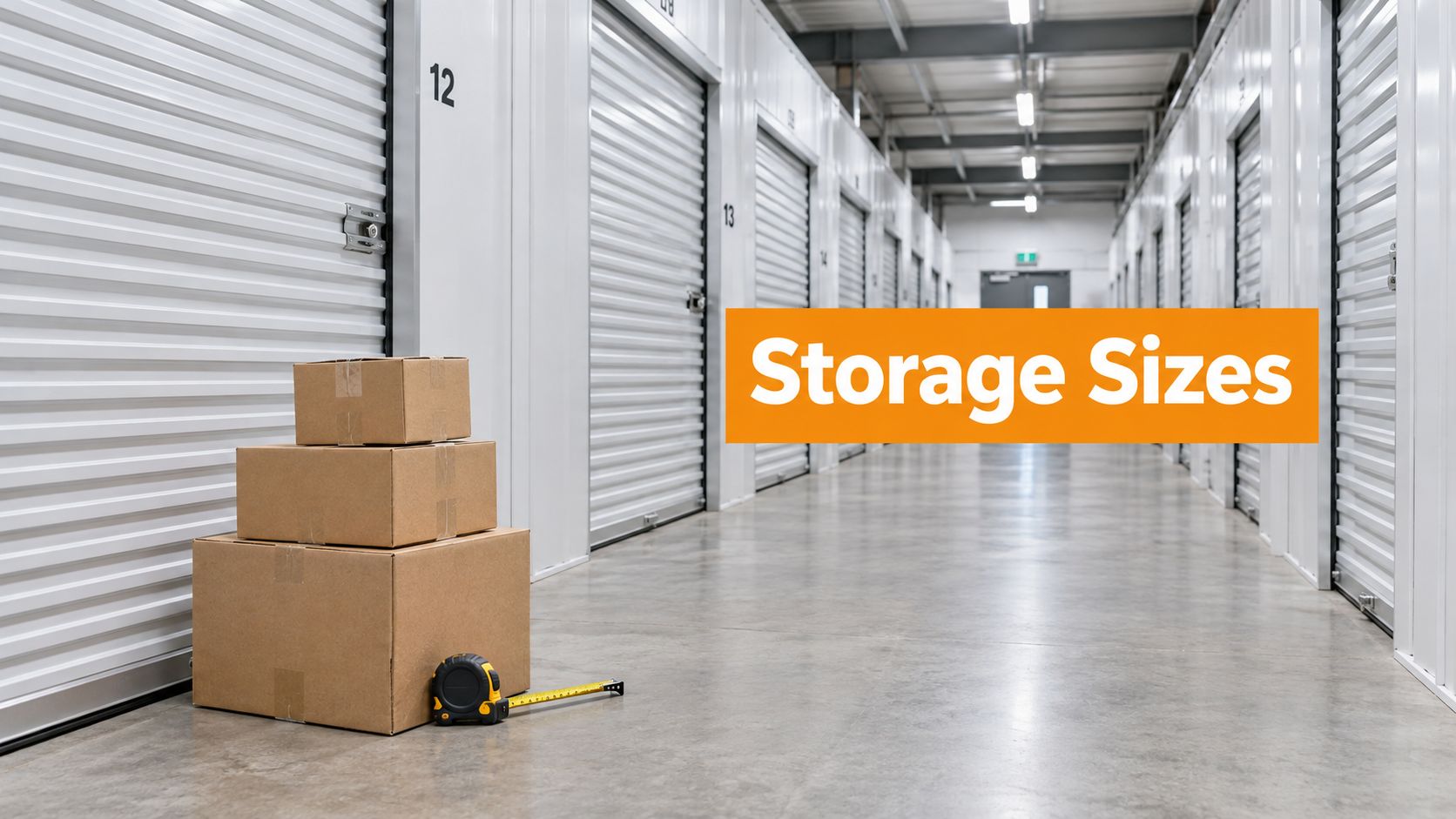
Use this as a starting point, then compare it against a proper storage unit size guide before booking.
| Unit Size (sq ft) | Ideal Use Case | Approx Monthly Cost |
|---|---|---|
| 25 | Slow-moving stock, samples, archive cartons, small accessory lines | Varies by provider and access type |
| 50 | Early-stage online retail with boxed inventory and a small packing area | Varies by provider and access type |
| 100 | Mixed catalogue storage with room for reserve stock and active picking | Varies by provider and access type |
| 150 | Higher SKU count, regular replenishment, clearer aisle access | Varies by provider and access type |
| 200 | Bulk stockholding, larger cartons, more structured stock zoning | Varies by provider and access type |
Pick the location for handling, not postcode pride
Central convenience sounds attractive, but it can work against you if every load-in involves tight access, limited stopping space or hand-carrying through corridors. Industrial-edge locations usually win for retail storage because they handle vans, pallets and repeat movements better.
A simple way to shortlist locations in and around Reigate:
- Prioritise road access if you receive regular supplier deliveries.
- Check loading distance from vehicle to unit. A short walk matters more than a slightly shorter drive from home.
- Think about dispatch habits. If you prep evening orders, a location with practical after-hours access matters more than a town-centre address.
- Leave room for growth. If Q4 always swells your stockholding, don't choose a unit that only works in a quiet month.
Practical rule: Rent for the next stage of your stock flow, not for today's neatest stock count.
Securing Your Inventory with Insurance and Security Essentials
A Reigate seller finishes packing at 9:30pm, then realises the last carton of a best-selling SKU is in storage behind a gate that closed at 8. The problem is not only stock security. It is whether you can get to your own inventory when orders keep coming in outside normal access hours.

What security actually matters
For online retail stock, site security and site access have to be assessed together. A locked-down facility with narrow access windows can still create fulfilment failures, especially if you dispatch in the evening, replace missed picks after hours, or need weekend access during peak trading.
Henfield Storage's Reigate self-storage information highlights features such as CCTV, alarms and controlled access. Those are useful, but the practical questions are more specific. Is access logged by user? Are individual units alarmed or only the main gate? Who responds if an alert triggers at 11pm? Can you retrieve stock outside staffed hours without breaching site rules?
Ask for clear answers before signing:
- Controlled entry with user-specific PIN or app access
- Individual unit alarms rather than perimeter monitoring alone
- Recorded entry logs you can refer back to after a stock discrepancy
- A written alarm response process for nights, weekends and bank holidays
- Access hours that match your dispatch pattern, not just your supplier delivery times
That last point gets missed all the time. E-commerce runs every day. Many local storage sites do not.
One business-facing option in the area is storage unit contents insurance for business stock in self-storage. Review the policy wording and the access terms together. There is no point paying to insure stock you cannot reach when your order cut-off runs later than the site gate.
Insurance is where many sellers get caught out
Insurance problems usually show up after a claim, when it is too late to fix the paperwork. The common mistake is assuming a standard policy covers stock held for resale, seasonal peaks, returns waiting to be checked, and packing materials stored in the same unit.
Check these points in writing:
- Business use is accepted. Some policies are built around household goods, not retail inventory.
- The declared value reflects peak stockholding. Christmas and promotional buys can push unit values up fast.
- Covered causes of loss are listed clearly. Theft, escape of water, accidental damage and vermin are often treated differently.
- Evidence requirements are realistic. Keep supplier invoices, SKU-level stock reports and dated photos.
- Access-hour conditions do not undermine the claim. If staff enter outside permitted times or leave stock in a shared loading area, cover can get messy.
Keep your records tight. A simple stock sheet is better than relying on memory, and if you want a lightweight way to track changing Amazon quantities, Automate Amazon inventory in Sheets and keep a dated trail that supports both reordering and claims.
A camera on the wall helps after a loss. Correct cover, documented stock values, and access that fits how your shop fulfils orders do more to protect the business.
Designing Inventory and Packing Workflows
A storage unit becomes useful to an online retailer when the handling flow is right. If the unit forces you to carry cartons through corridors, wait for lift access, or stack stock in a way that blocks replenishment, you haven't solved fulfilment. You've relocated the friction.
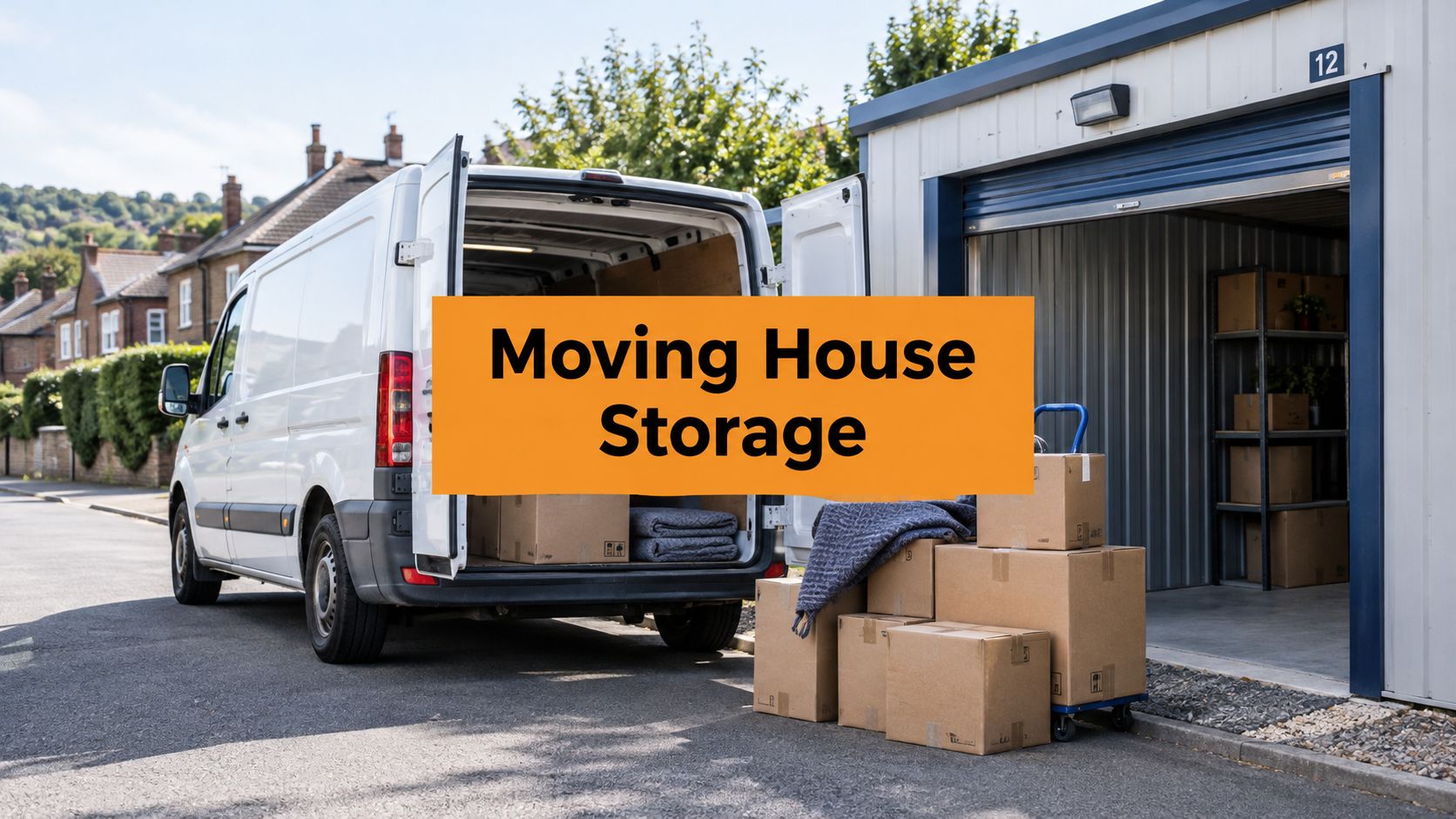
Units with drive-up access reduce stock handling time by 40% compared to lift-and-carry methods, and 92% of UK e-commerce self-storage now offers this feature, according to Standby's guidance on storage near Reigate. That's why serious sellers should start with vehicle access and door clearance before looking at almost anything else.

Build a drive-up handling routine
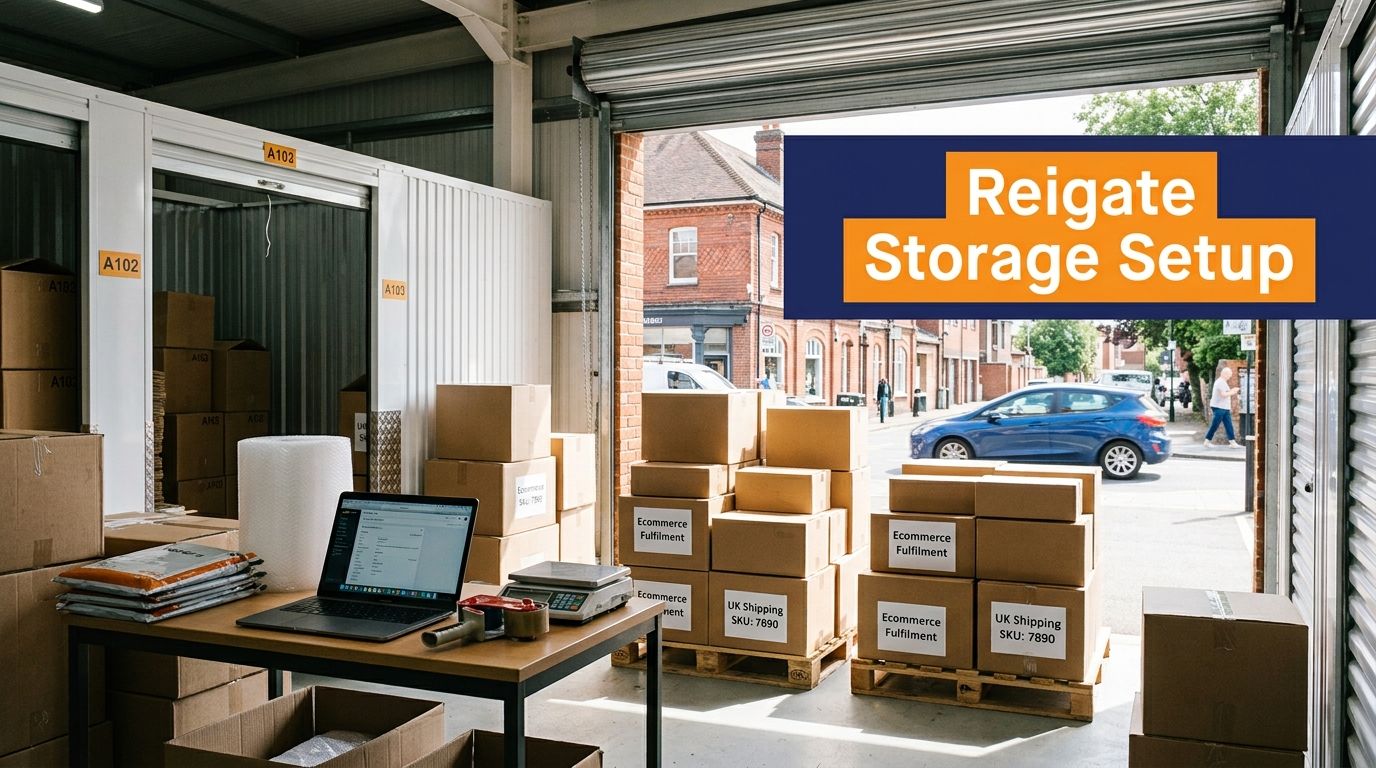
If suppliers send boxed freight or palletised goods, your target setup is simple. Van arrives, unit opens, pallet truck moves stock straight in, reserve stock goes to the back, active stock stays forward.
Check for a minimum door height of 2.4m+ if you expect regular van-side loading. Then check whether the site layout gives enough turning room to use that access properly. A drive-up unit only helps if you can unload without blocking yourself or other users.
Set the unit up in three zones:
- Reserve stock at the rear for bulk cartons you won't touch every day.
- Active picking stock in the middle with clear labels and visible SKU grouping.
- Packing materials near the entrance so outgoing orders don't interrupt replenishment.
Keep the pick path short
Most small retailers make the same early mistake. They arrange stock by what arrived together, not by what sells together. That slows every pick.
Use a more practical rule set:
- Fast movers nearest the door
- Bundles and multi-buy combinations adjacent
- Returns quarantine in a separate crate or shelf
- Damaged stock isolated immediately
- Packing bench kept clear of inbound cartons
A modest shelving system and consistent carton labels will do more for accuracy than a larger unit with no structure. If you already track Amazon or marketplace replenishment in spreadsheets, tools like Automate Amazon inventory in Sheets can help tighten stock visibility between the unit and your online channels.
Warehouse habit that pays off: Never let inbound stock land on the floor without a labelled destination.
Protect stock from avoidable damage
Humidity becomes a real issue once you hold electronics, accessories with metal parts, paper-packaged goods or anything that degrades in unstable conditions. If the unit runs hot, damp or stale, stock quality slips before sellers notice.
For susceptible stock, ask about temperature stability and inspect the unit yourself. Don't rely on a brochure description. Look for signs of condensation, stale odours, damp corners or cardboard softening near walls.
Basic controls work well:
- Use sealed plastic totes for sensitive SKUs
- Keep cartons off the floor with pallets or shelving
- Leave a small airflow gap against walls
- Check outer packaging weekly in wetter periods
- Rotate older inbound stock forward to stop forgotten cartons sitting too long
Good workflow turns storage from overflow space into an extension of fulfilment. Bad workflow turns every dispatch window into a scavenger hunt.
Integrating Local Logistics and Financial Planning
The hardest part of storage for online retailers in Reigate usually isn't finding a unit. It's making the unit fit the order cycle, courier timing and cash flow of the business. A site can look fine on a tour and still fail on Monday mornings, peak weekends or late-night dispatch catch-up.
That's where access hours stop being a footnote and become an operating constraint. 68% of UK e-commerce businesses report fulfillment bottlenecks during peak periods due to limited storage access hours, yet only 22% of South East providers offer true 24/7 retrieval, according to Flexible Cargo's ecommerce warehousing overview. If your sales channels generate orders outside ordinary business hours, fixed retrieval windows can insidiously wreck service levels.

Align access with your real dispatch pattern
Plenty of sellers think seven-day access is enough, then run into trouble during peak trading. The issue isn't whether you can visit often. It's whether you can retrieve stock when the business needs it.
If you're selling through Amazon, eBay, Shopify or multiple channels at once, ask yourself:
- Do orders need evening picking after your day job finishes?
- Do weekend orders need stock retrieval before Monday courier cut-offs?
- Will Q4 require earlier starts or later finishes than usual?
- Can your team access the unit without waiting for office staff?
A unit with standard daytime access may suit a steady catalogue with low urgency. It won't suit a fast-moving seller promising quick dispatch.
Budget for the full operating cost
Monthly rent is only one line in the storage budget. Retailers should also check for move-in fees, lock requirements, insurance add-ons, loading constraints, notice terms and whether a “cheap” unit creates extra labour every week.
Use a simple planning model:
| Cost Area | What to Check | Why It Matters |
|---|---|---|
| Unit fee | Base monthly rate and billing cycle | Core occupancy cost |
| Insurance | Business stock cover and declared value | Protects saleable inventory |
| Access model | Daytime only or true 24/7 retrieval | Affects fulfilment speed |
| Loading practicality | Drive-up, parking, bay access | Affects labour time |
| Contract flexibility | Notice period and upgrade path | Important for seasonal swings |
If you're serious about margin control, pair storage planning with the same discipline you use elsewhere in operations. Teams already reviewing vehicle spend, delivery costs or carrier margins may find ideas in streamlining transport company finance useful when building a tighter fulfilment cost model.
Reigate-specific trade-offs to think through
Albert Road and surrounding estates can work well if they keep van access straightforward and don't force repeated short-stay unloading problems. What matters in practice is whether you can arrive, load, pick and leave without adding friction to every order cycle.
Focus on these trade-offs:
- Closer to home can be useful for solo operators.
- Closer to arterial routes usually helps more once deliveries and courier runs become routine.
- Flexible contracts matter if you scale quickly or carry strong seasonal ranges.
- Low headline price isn't a bargain if access limits create missed dispatch windows.
The right storage site saves time every day. The wrong one bills you monthly and still steals hours from fulfilment.
Seamless Booking Move-in and Ecommerce Integration Tips
A common failure point shows up after the unit is booked. Orders are still coming in at 9pm, a courier cutoff has moved forward, and the storage site only allows routine access within staffed hours. In Reigate, that gap between local access rules and round-the-clock ecommerce demand causes more disruption than the booking form itself.
Book the unit against your dispatch reality, not just your storage need on paper. Before paying, check the latest access terms, move-in rules, loading arrangements and document requirements. A unit that looks workable online can still slow you down if evening retrievals, weekend stock checks or late supplier drop-offs do not fit the site's operating pattern.
Use a simple booking checklist:
- Check live availability for the unit size you need.
- Confirm access hours in writing and match them to your real picking and dispatch routine.
- Review move-in rules so you know whether lifts, trolleys, loading bays or drive-up access are available.
- Choose a move-in slot that does not clash with your busiest order day or inbound delivery window.
- Prepare documents such as ID, business address details and account contacts.
The access point deserves more scrutiny than many sellers give it. If your shop runs all week but your stock is locked behind limited hours, you need a buffer plan. That usually means holding two or three days of fast-moving SKUs outside the unit, or choosing a site with access that supports early starts, late collections or weekend retrieval. The cheaper option often stops being cheaper once missed dispatches and split stockholding start eating time.
Move-in day sets the standard for everything that follows. Turn up with shelf labels ready, zones decided and barcode or SKU checks prepared before the first box comes off the van. If cartons are mixed, relabel them at the door rather than promising to sort them later. Later rarely comes in a busy ecommerce operation.
Keep the layout practical:
- Separate reserve stock from active picking stock so replenishment is controlled.
- Store packaging near the packing point to cut walking time.
- Label every bay or shelf with a location code that matches your stock record.
- Count and record opening stock immediately so online availability starts clean.
For system setup, keep one source of truth for stock. The storage account handles access, billing and unit admin. Your ecommerce or inventory system should handle SKU counts, low-stock alerts and reorder points. If those roles get blurred, oversells and phantom stock usually follow.
The goal is straightforward. You should be able to book, move in and start dispatching without rebuilding your whole operation around the storage site's limitations.
Conclusion and Next Steps
If you're choosing storage for online retailers in Reigate, don't judge the unit by square footage alone. Judge it by whether you can receive stock cleanly, store it safely, retrieve it on your actual dispatch schedule and insure it properly as business inventory.
The access-hours gap is the issue many sellers miss until peak season exposes it. A tidy unit with restricted retrieval can still choke fulfilment. A slightly less convenient location with better loading, stronger security and workable access often performs better in day-to-day retail operations.
Keep the setup practical. Choose a unit size that supports your next stage, not just your current overflow. Demand proper security controls. Build a drive-up workflow if your stock profile allows it. Price the full operating cost, not just the monthly rent. Then make sure your move-in process starts with labelling, zoning and stock accuracy from the first day.
Storage should remove friction from the business. If it adds another layer of delay, it's the wrong setup.
If you need flexible business storage with online booking, controlled access and units suited to stockholding, check current options at Standby Self Storage and compare the unit against your actual fulfilment routine before you book.